







San Francisco
Eleanor Oakes at Tyler Wood Gallery
Today from our partners at Art Practical, we bring you a review of Eleanor Oakes’ solo exhibition at Tyler Wood Gallery in San Francisco. Author Anton Stuebner notes: “In aestheticizing the random distortions effected onto this film stock, Oakes shows how time marks material substances with a distinctive presence.” This article was originally published on May 14, 2015.
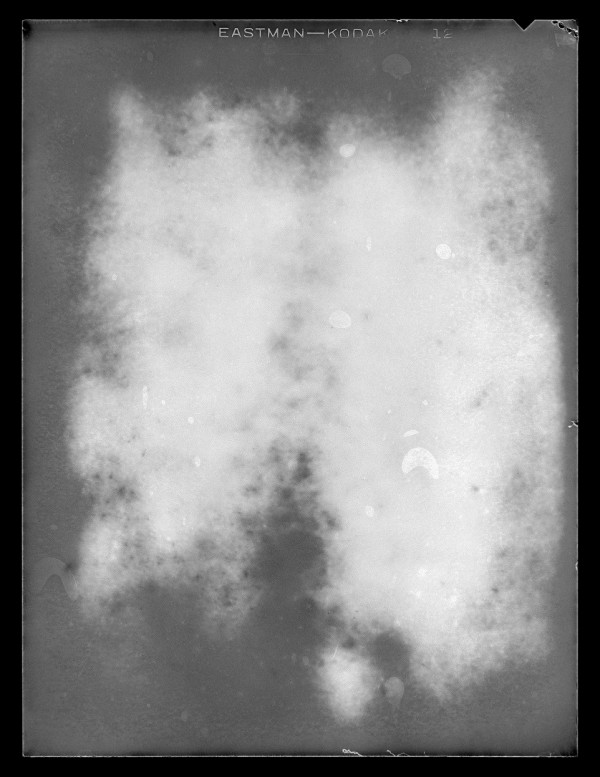
Eleanor Oakes. Panchromatic 1, 2015; silver gelatin print; 8 x 10 in. (matted); edition of 5 + 1 AP. Courtesy of the Artist and Tyler Wood Gallery.
Our bodies leave behind innumerable traces: dead skin, soil, loose follicles of hair. Most are invisible to the naked eye, but these traces can also become stains, markers of our physical encounters with material environments. We use solvents and solutions to hide these marks and make them invisible, and we try to eliminate proof that our bodies are capable of physically disrupting the world around us. But what happens when we encounter a stain that we cannot remove? How do we react when we realize that our bodies leave behind traces that we cannot control? And how do we feel when confronted with bodily marks that will inexorably continue to exist long after we are gone?
Eleanor Oakes’ solo exhibition at Tyler Wood Gallery raises critical questions about how we “trace” presence by examining the material substances that we leave behind. The two photo series on display, conversely, investigate the correlation between bodily encounters and their stains. The series Expired [1927] (2015), on view in the rear gallery, features eleven panochromatic silver gelatin prints arranged in a grid. At first glance, the prints on display seem like nebulous experiments in abstraction, with streaks of white cloudlike shapes against a gray paper stock. Initially, it’s unclear what is being photographed here, and some of the images depicted resemble bodily organs. The flocked, oval-shaped objects in Panochromatic 1 (2015), for instance, could be mistaken for an X-ray image of a lung. Other images in the series are more ethereal. It would be difficult to discern any remotely figurative shape, for example, in the whiteout wash of Panochromatic 11 (2015), which amorphously bleeds from the center out toward the edge of the frame.





