







Los Angeles
Paris Photo Los Angeles
With its high-profile galleries and smattering of celebrity artists, curators, and collectors, it would seem that not much differentiates Paris Photo LA from the multitude of art fairs competing for attention in California. Where the fair does stand out, however, is in the way it makes the case for photography as a vibrant medium for contemporary expression.

Mohammad Ghazali. Untitled, from Tehran a Little to the Right, 2010-2013; expired Polaroid film; 3 3/8 x 4 1/4 in. Courtesy of the Artist and Ag Galerie, Tehran.
The 1970s saw the rise of an active market for photography collection. In 1981, photography critic Gene Thornton reflected on the gains photography made in that decade, and on its evolving position in the art world. In the New York Times, he wrote, “Photography has so recently begun to be taken seriously by museums, collectors, and critics that it may be presumptuous to ask what its present state is. It has been recognized as art, hasn’t it?”[1]
Taking Thornton’s position, then, what is the state of photography as demonstrated within the stalls and storefronts of Paris Photo? Contemporary artists are playing with scale, investigating serial forms, and manipulating photographic processes. Unglee, a French artist with an enigmatic biography, takes hundreds of photographs of tulips. Presented either individually—with a level of detail and sensuousness evocative of a Georgia O’Keefe flower painting—or as masses of subtly distinctive Polaroids, Unglee’s examination verges on the fetishistic.
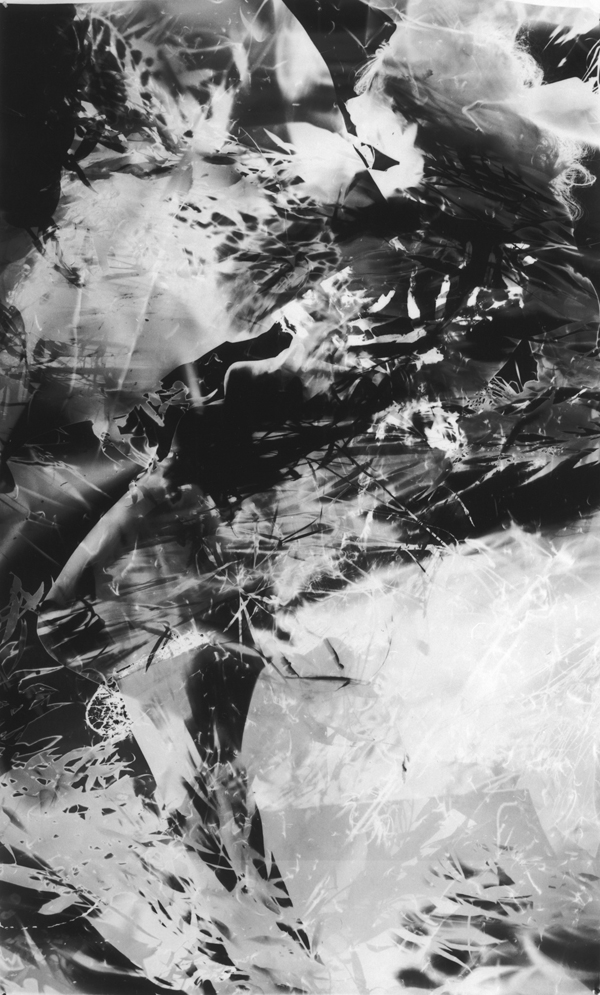
Floris Neusüss. Nachtbild (48), 1991; photogram, unique; 68 x 42 in. Courtesy of the Artist and Von Lintel Gallery, Los Angeles.
Many galleries go for spectacle-inducing, vivid large-scale prints, or on the opposite end of the spectrum, tiny, intimate, exquisitely detailed 4-by-6-inch images. There seems to be no happy medium. Floris Neusüss’ gigantic photograms envelop the viewer in black-and-white, abstract geometries. From the series Nachtstükke, Nachtbild (1991) was made at night, in a garden, by exposing photosensitive paper to a shock of bright light. The resulting image is a dense kaleidoscope of foliage made immersive through its great size. Neusüss employs the spectacle of sheer size to make a natural scene feel new. On the opposite end of the scale are works like Mohammad Ghazali’s Polaroids from the series Tehran a Little to the Right (2010–13). For each photograph, the artist revisited places in Tehran where protesters gathered after Iran’s contentious 2009 elections. Ghazali used expired Polaroid film, which resulted in unpredictable white blotches and a strange greenish-yellow cast that gives the streetscapes a surreal, nearly unrecognizable quality. At just 3 by 4 inches, Ghazali’s pictures draw the viewers in, allowing the political undercurrent to unfurl and sink in.
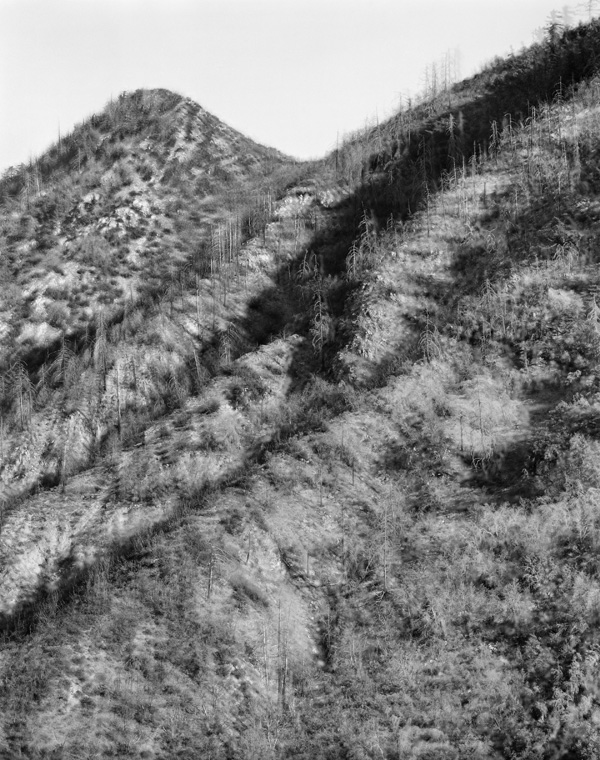
CJ Heylinger. Hell Mirage #1, 2015; archival inkjet print, 60 x 48 in. Courtesy of the Artist.
This is not to say that all of these photographic interests are entirely revolutionary. Indeed, scale, seriality, and manipulation have deep roots as rich arenas for photographic investigation. C.J. Heyliger, an MFA candidate at UCLA, manipulates exposure and his film to create fragmented and distorted images of the landscape, as in Hell Mirage #1 (2015). Heyliger’s textured, almost pleated surfaces echo Harry Callahan’s play with multiple exposures in his images of trees. Likewise, both Ghazali’s and Unglee’s use of the Polaroid as their preferred film format draws on a diverse lineage of artists that includes Lucas Samaras and Robert Heinecken. As such, what makes Paris Photo unique is not the setting, on the Paramount Pictures lot with a mix of traditional white-box spaces, and quirky storefronts on the life-size set of New York. Rather, it’s the ability to see in one day, or one weekend, a diversity of perspectives on the state of photography. To answer Thornton’s question, photography is decidedly an art, and one that is still ripe for investigation.
Paris Photo LA was on view in Los Angeles from May 1–3, 2015.
[1] Gene Thornton, “Photography View,” The New York Times, September 6, 1981.





