







San Francisco
Sequence’s Travels Into Several Notions of the Museum
From our partners at Art Practical, today we bring you an excerpt from Rob Marks’ consideration of Richard Serra’s Sequence, recently moved from the Cantor Arts Center to SFMOMA. Marks notes, “Sequence is massive, particularly when seen from afar. But it becomes something completely different up close.[…] For Jonathan Swift, too, size stood as much for difference as it did for power. The Lilliputians start by seeing Gulliver as enormous, foreign, and dangerous, but eventually their relationship becomes intimate.” This essay was originally published on April 30, 2015.
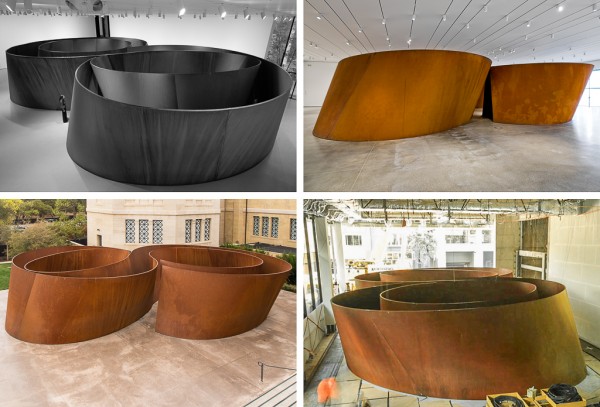
Richard Serra. Sequence, 2006; weatherproof steel; 153 x 488 x 782 3/17 in. overall and 2 in. thick; installation views at New York MoMA (top left) Photo: Lorenz Kienzle. Collection of the Artist, © 2007 Richard Serra / Artists Rights Society (ARS), New York, LACMA (top right) Courtesy of the Artist, the Cantor Arts Center (bottom left) Photo: Saul Rosenfield, © 2014–15, with permission of Cantor Arts Center at Stanford University, and SFMOMA’s 85-foot wide by 55-foot long Howard Street gallery (bottom right) Photo: Henrik Kem © 2015.
It was foolish to have imagined that Richard Serra’s Sequence (2006) would easily relinquish its claim on the courtyard of Stanford University’s Cantor Arts Center. Even after power-washing, the concrete pad preserved the contours of the sculpture’s twelve twenty-ton weathering steel plates. During its four-year residency, a bond had grown between Sequence and its foundation, just as one had blossomed between the work and its community of followers. Visiting during the de-installation, these pilgrims sought one last visual memento, however inadequate, of the shifting experience of space and time conjured by Sequence’s winding pathways.
Sequence demands, and then commandeers, spaces like the Cantor’s courtyard, or the new San Francisco Museum of Modern Art gallery into which the sculpture moved in February 2015 in anticipation of the museum’s spring 2016 reopening. But just as the Lilliputians shackled Gulliver to a twenty-two-wheeled cart hauled by fifteen hundred tiny horses, transplanting Sequence is no simple undertaking. Riggers chained each of its thirteen-foot-high plates to its own eighteen-wheeler to conduct it from Palo Alto to San Francisco.1





