







Houston
Double Life at the Contemporary Arts Museum Houston
In Double Life, now on view at the Contemporary Arts Museum Houston, it is clear that the city is in the midst of becoming one of the most interesting and significant locations for performance art in the southeast—a statement confirmed by the national attention given recently to the performance art collective DiverseWorks, the emergence of the Lone Star Explosion International Performance Art Biennale in 2012, and the construction of the interdisciplinary Cynthia Woods Mitchell Center for the Arts in collaboration with the University of Houston in 2014.[1] The curatorial impulse for Double Life—to explore and expand representational and conceptual notions of performance within the museum—is presented through the work of three very different artists: the French conceptual choreographer Jérôme Bel, Los Angeles–based performance artist and filmmaker Wu Tsang, and the South Korean multimedia artist Haegue Yang. Given the recent increase by major American museums to expand their commitment to artists making live work, Double Life offers a strong argument of what movement means or might be able to mean in the art gallery in the twenty-first century. However, while Double Life does indeed enrich the current international conversation about movement and performance in the museum, the exhibition does more to identify the conditions inherent in the viewing of performance (specifically, the ways in which performances call and constitute audiences to their subject positions) and the problems manifested by the museum’s incorporation and domestication of “liveness” than it does to simply present movement.[2]
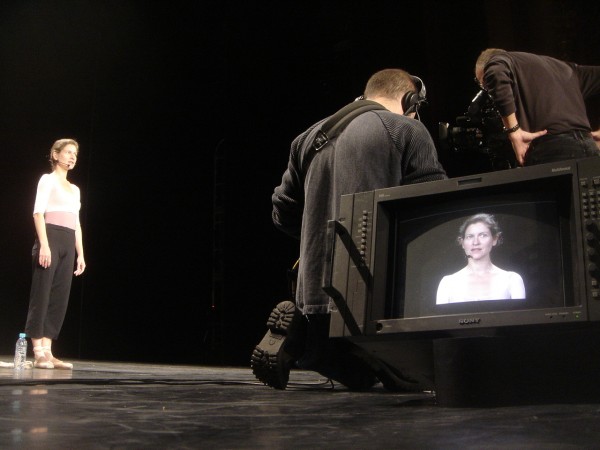
Jérôme Bel. Performance Still from Veronique Doisneau, 2004. Image courtesy the artist.
Double Life features two videos of live performances conceived by Jérôme Bel, whose work has re-charged the conservative dance scene through its blatant critique of the repressive codes of representation that structure concertized dance. By emphasizing the disciplinary constructs that enclose notions of “the subject” within his dances, Bel bypasses the conventions of anti-bourgeois vulgarity and Dada-inspired shock tactics that often feature in contemporary performance art to focus more on the emancipatory origins of twentieth-century modern dance, wherein questions of freedom were entwined with questions of individual expression and the inner self.[3] In Veronique Doisneau (2004) and Cédric Andrieux (2009)—named after the individual dancers featured in the films—Bel de-familiarizes the strict codes of behavior that surround a performance by giving the two dancers opportunities to speak directly to the audience and reveal the feelings of alienation and boredom that accompany a dancer’s experience. Comprising short monologues, movements that quote from Doisneau and Andrieux’s performance repertoire, and long durations of silence and stillness, the performances pierce the space between performer and viewer and interrupt the flow of continuous movement that identify traditional dance performances. By staging an encounter in which the audience is forced to listen to the dancer as opposed to watching them, Bel’s works point to the complicated nature of the dancer’s dual role as both the dance’s author and its subject—a subject that must silently submit to a network of other authors (the musical coordinates of the composer and the musicians, the representational vision of the choreographer, the technical and aesthetic demands of the art form, and the physical requirements mandated by the history of dance). Bel’s close attention to the ways in which both artist and viewer are simultaneously recruited into and rendered complicit in restrictive performances of aesthetic labor and voyeurism effectively shores up the idea of “double life.”
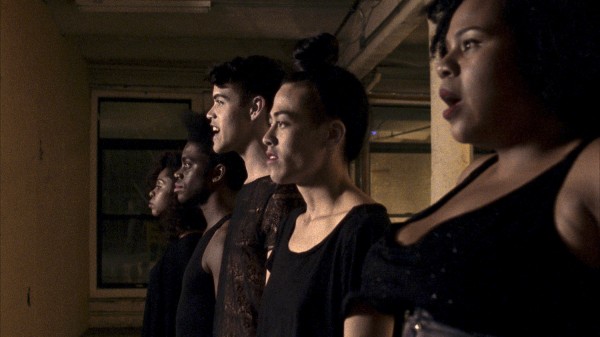
Wu Tsang. Performance Still from For how we perceived a life (Take 3), 2012. Image courtesy WuTsang.com.
Wu Tsang’s 2012 nine-minute film loop For how we perceived a life (Take 3) shares Bel’s interest in the task of embodiment within performance. Here the body creates, as well as refuses or disturbs, normative representational codes of identity, sexuality, and race through appropriation and quotation. Composed of Tsang and four performers speaking appropriated lines and quotations garnered from researching the production of Jennie Livingston’s 1990 documentary Paris Is Burning—an invaluable document that explores the demise of the New York “ball scene” within the Latino, African American, gay, and transgender communities in 1980s New York. Using a technique he calls “full body quotation,” Tsang and his participants recite and perform the dialogue via hidden audio sources, channeling the performer’s speech, bodily movements, and breath to create a dissonant form of mimesis built not on exact repetition but idiosyncratic, ambiguous forms of “re-speaking.”[4] By staging the gap between what is said and what is meant, Tsang uses movement to point to its unique position outside of language and reveal the messiness involved in attributing a subject’s authenticity through speech acts alone.
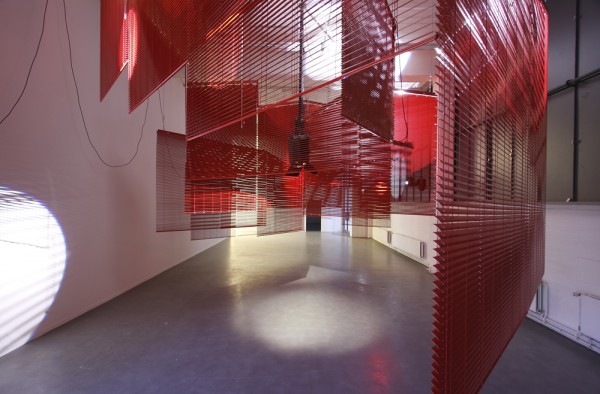
Haegue Yang. Installation Shot of Mountains of Encounter, 2008. Aluminum Venetian blinds, powder-coated aluminum hanging structure, steel wire, moving spotlights, floodlights, platform ladder, and cable. Dimensions Variable. Image courtesy Fred Dott, Hamburg, Germany.
Haegue Yang’s Mountains of Encounter (2008) is an installation of aluminum window blinds and moving spotlights that envelop the viewer with warm light and soft sounds of shivering steel, as the outside and the inside infiltrate one another. Haunting and lovely, it shapes movement in the space around the viewer and provides a poetic epilogue to the exhibition, boldly claiming the art object’s place as a worthy contender within the open field of “live” art.
Double Life is on view at the Contemporary Arts Museum Houston through March 13, 2015.
[1] See Kate Taylor, ‘The Public May Now Comment,’ The New York Times, May 8, 2013, p. C1.
[2] See dance historian Mark Franko’s analysis of Althusser’s notion of subjectivity in The Work of Dance: Labor, Movement and Identity in the 1930’s, Middletown: Wesleyan University Press, 2002, p. 60.
[3] Isadora Duncan and Martha Graham’s explorations of dance movements resonate with Jérôme Bel’s work. For a more in-depth discussion of Bel’s critique of representation, see Una Bauer’s article, ‘The Movement of Embodied Thought: The Representational Game of the Stage Zero of Signification in Jérôme Bel,’ Performance Research, Vol. 13, No. 1, 2008, pp. 33-39.
[4] See Aimee Walleston’s interview with Wu Tsang in ‘In Both Bi- and Triennial, Wu Tsang Talks Community,’ Art in America, February 14, 2012. Accessed at: http://www.artinamericamagazine.com/news-features/news/wu-tsang/





