







Los Angeles
Saying Yes to Everything at Honor Fraser
Saying Yes to Everything, an exhibition featuring nineteen artists working in collage, recently opened at Honor Fraser Gallery in Los Angeles. On display are a range of works made between 1960 and the present day by both established and emerging artists. The title is a commentary on the essential inclusivity of collage. But understanding the medium’s place in art history can help the viewer appreciate the form. Collage surfaced with modernism in the 20th century, in the wake of the horrors of World War II—the Holocaust, strategic bombings, nuclear warfare—resulting in a fragmentation of consciousness and a loss of sense or meaning.
Anything is permissible in collage, and multiple mediums like paint, paper cutouts, and found objects collide on and with the surface plane. The very selection and composition of incongruous materials reveals an attempt at order and meaning. In Saying Yes to Everything, source materials include glitter dollar signs, gold chain, penciled math problems, a rusted comb, comic-book cutouts, and a vintage stamp booklet cover. The boundaries of the medium are limitless, and therefore democratizing.
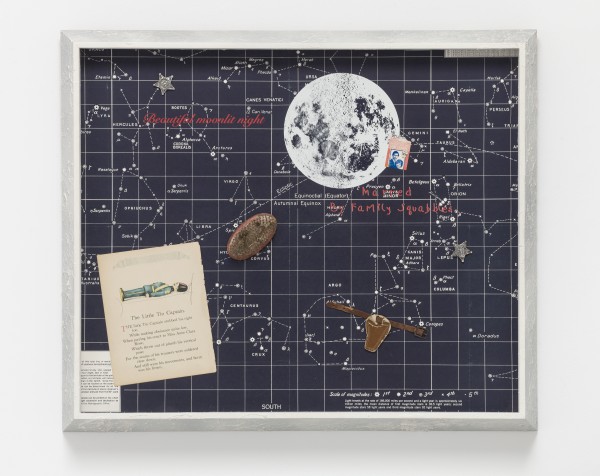
Alexis Smith. Kerouac Haiku, 1994; mixed-media collage; 27 x 32 x 2 in. Courtesy of Honor Fraser Gallery, Los Angeles. CA. Photo: Elon Schoenholz Photography.
The exhibit opens with a narrative diorama by Alexis Smith titled Kerouac Haiku (1994), in which a chart of constellations is affixed with various childhood objects. Two deputy sheriff badges flank the moon, and with red paint, the artist complements the original title “Beautiful moonlit night” with “marred by family squabbles.” The map’s key notes the magnitude of the stars and brings attention to perhaps the distance of these memories or desires in relation to each other.
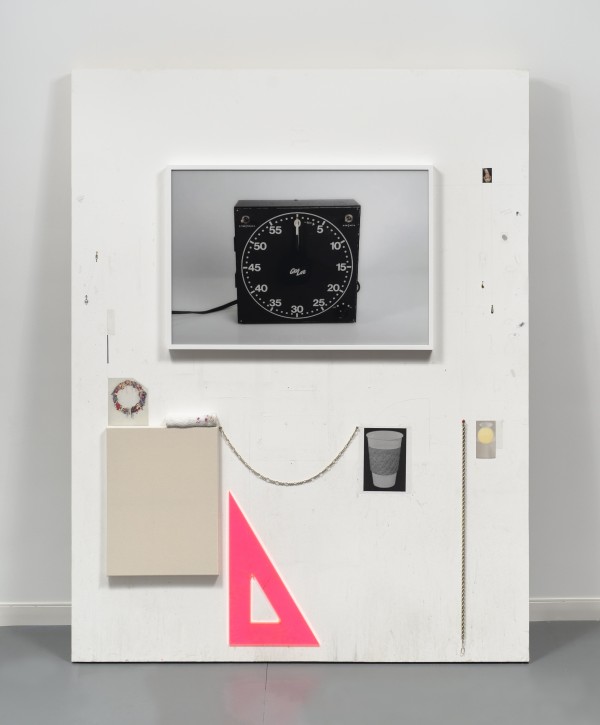
Amanda Ross-Ho. Untitled Wall Arrangement (TIMER), 2012; sheetrock, wood, latex paint, acrylic paint, graphite, framed lightjet print, single earring, found images, blank canvas, thesis rag, aluminum thumbtacks, vintage goldtone chain, yellow plastic thumbtacks, CNC acrylic triangle, laser print, red plastic thumbtack, vintage goldtone chain, single earring, Keinholz thumbprint test, aluminum thumbtack; 96 x 74 x 4 in. Courtesy of the Artist and Mitchell-Innes & Nash. Photo: New York Photo.
Amanda Ross-Ho’s Untitled Wall Arrangement (2012) is striking. What is visible to the eye is minimal, despite the artist’s use of at least twenty separate materials. The objects of measurement here—the photograph of the timer, the sleeved cup, the acrylic triangle ruler, the box—are either immovable or missing a dimension, and therefore nonfunctional. Unexplained math computations in graphite suggest themselves to be outside the realm of this collage, speaking to an unknowable context.
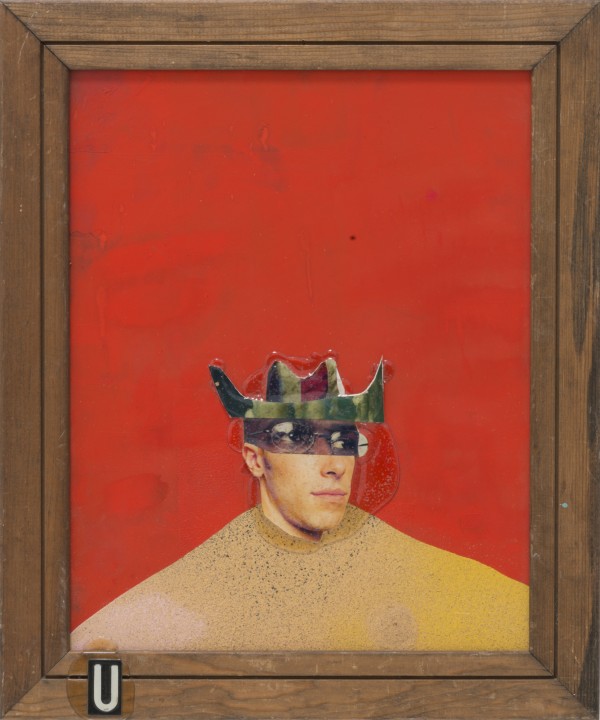
Brenna Youngblood. History of the Cowboy, 2008; color photographs, spray paint, gouache, and found frame; 24 x 20 in. Courtesy of Honor Fraser Gallery, Los Angeles, CA. Photo: Joshua White/JWPictures.com.
Ray Yoshida’s Comic Book Specimen #1—Right Profile (c. 1965) is both earnest and humorous in its carefully cut study of comic-book characters. The portraiture profiles are cleanly cut from comic-book pages and presented in neat rows. Another standout in this exhibit is Brenna Youngblood’s History of the Cowboy (2008), in which both photography and paint are used. The piece is a play on and challenge to royal portraiture. Mounted in a found wooden frame and set against a blood-red background, Youngblood’s subject possesses distorted facial features and an enlarged body, wears a crown-like cowboy hat, and is set low in the frame.

Ray Yoshida. Comic Book Specimen #1 — Right Profile, c. 1965; collage on paper, 22 x 28 in. Courtesy of the estate of Ray Yoshida. Collection of KAWS, New York. Photo: Tom Van Eynde.
The works in this exhibition speak to the range of ways—conceptually, personally, impersonally, textually, visually, spacially, and through narrative—that American collage artists have addressed their experiences in the world since 1960. These works echo the original purpose of collage in the early 20th century, and demonstrate the progress of collage in American art history.
Saying Yes to Everything is on view at Honor Fraser Gallery through December 20, 2014.





