







San Francisco
Transformations – Death, Breakage, and the Unexpected
Today from our partners at Art Practical, we bring you a recent installment of “Notes from di Rosa,” a column produced in conjunction with Art Practical’s yearlong residency at the museum. In this edition, author Terri Cohn explores the collection and its legacy. This article was originally published on October 8, 2014.
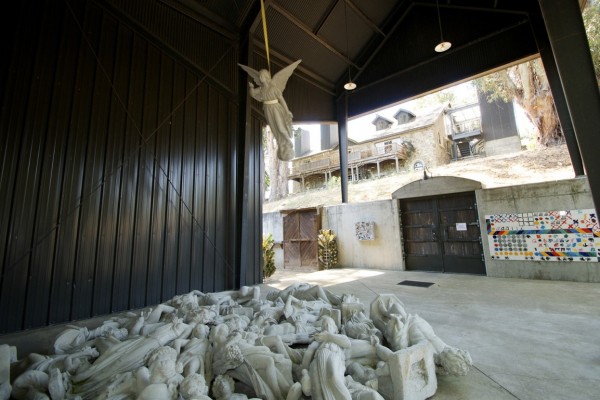
David Ireland. Angel-Go-Round, 1996; fiberglass, cast concrete figures, and motor; 180 x 191 x 191 in. Courtesy of di Rosa collection, Napa. Photo: Israel Valencia.
Beautiful, bucolic, and quiet, di Rosa stretches out over its 200 acres with obvious and discoverable wonders. Di Rosa’s physical charm and the eccentricities intrinsic to its collection are deeply engaging, and the scope of the grounds and collections make a lasting impression. Yet the opportunity to spend some time at di Rosa this summer provided several unique and thought-provoking experiences.
To his great credit, Rene di Rosa (1919–2010) had a tendency to collect bodies of work by the artists that interested him—notably Beat Generation artists (Bruce Conner, Jay DeFeo, Joan Brown, George Herms, Wallace Berman); Conceptual artists (Paul Kos, David Ireland, Tom Marioni, Lynn Hershman, Jim Melchert); and many of the artists affiliated with the Bay Area Funk movement, including Robert Arneson, William T. Wiley, Roy De Forest, and Robert Hudson. He was also passionate about various mixed-media sculptors, photographers, and printmakers, including David Best, Deborah Butterfield, Viola Frey, Mark Alice Durant, Ray Beldner, and Enrique Chagoya. These “collections within the collection” provide a sense of the breadth and depth of di Rosa’s vision and his expansive interest in California art.





