







San Francisco
Sarah Oppenheimer at Mills College Art Museum
From our partners at Art Practical, today we bring you Lea Feinstein’s review of Sarah Oppenheimer’s current solo show at Mills College Art Museum. Feinstein notes: “[Oppenheimer] creates immersive experiences for participants, in which literal reflections inspire personal reflection and wondering is a product of wandering. […] But without hours of serious research before seeing the exhibition, it is difficult to parse the scope or significance of her installations from the cryptic fragments on display.” This article was originally published on October 28, 2014.
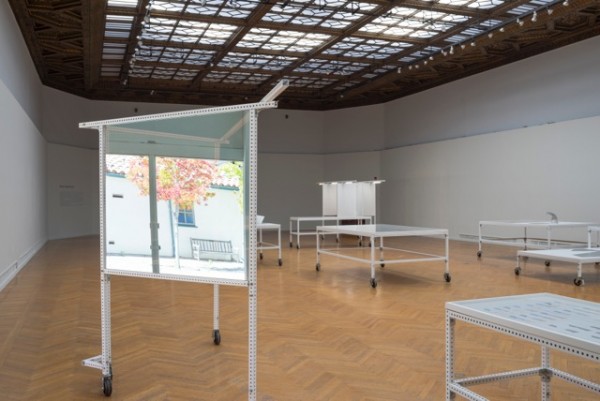
Sarah Oppenheimer, 2014; installation view, Mills College Art Museum. Courtesy of the Artist and Mills College Art Museum.
Do your homework before you see this show. Sarah Oppenheimer is a much-heralded artist whose scrupulous work crosses the borders between architecture and sculpture and is grounded in theories of cognitive, linguistic, and psychological sciences, particularly perception. To create her mind-bending work, she has pierced and reconfigured walls, corners, floors, and entryways in galleries, universities, and art museums. Like periscopes and kaleidoscopes, her interventions probe the bodies of buildings and employ transparent and mirrored surfaces to create new and disorienting ways of experiencing familiar spaces.
But none of these aspects are in the current exhibition at the Mills College Art Museum. What is there are Oppenheimer’s sketches, studies, ideas for interventions, and maquettes: carefully milled, drilled, and fabricated samples of glass and aluminum that play a part in recent commissions in New York, Switzerland, and in other locations in the United States and Europe—studio shots, so to speak.
The assembled array of white-painted steel tables with sketches and drawings under glass is tantalizing but not revealing. It offers the initiate only hints of Oppenheimer’s process, her extreme concern with perfection; pieces are milled to within 1/32 inch of her requirements. The titles of her works (33-D, D-33, OE-15) provide few clues except the inclusion of her fabricators’ names and their locations, suggesting she considers them artistic collaborators in this work.





