







New York
Roger Hiorns at Luhring Augustine
Roger Hiorns’ current solo exhibition at Luhring Augustine—the British artist’s first in New York City—presents viewers with two inscrutable situations: In one, a quantity of gray powder has been deposited, apparently by hand, over a large, rectangular area occupying the better part of the main gallery; in another, a nude male model loiters about a massive, faceted stone object and a low table, the surface of which is a flat-screen TV monitor displaying video content by the Wall Street Journal. The model occasionally uses each for a bench, making use of a panel on the table’s frame that seems to be intended as a seat.
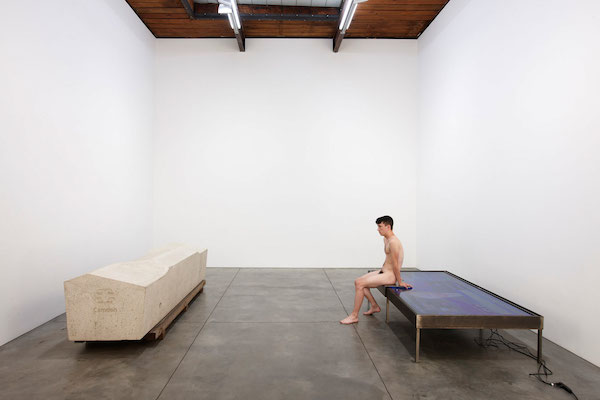
Roger Hiorns; Untitled (Security Object), 2013; cast stone; and Untitled (Surface 2), 2014; steel, flat screen, and youth; © Roger Hiorns; Courtesy of the Artist and Luhring Augustine, New York.
I consciously use the term “situation” because, in the first gallery, the dematerialization of the object is, as we will see, the crux of the work, and in the second gallery, the presence of the live model activates a highly theatrical mise en scène, in which it would be awkward to contemplate the “props” as art objects in their own right. This is in contrast to the third gallery in the exhibition, which presents a group of works, all “Untitled” (as the others in the exhibition are), that look something like the plastic bowels of a moped. Strung from the ceiling and rigged up to a compressor, they slowly extrude foam in scatological coils. This surreal aggregation, grotesquely anthropomorphic yet somehow serene, makes itself available for perceptual exploration in a way that the other installations do not.
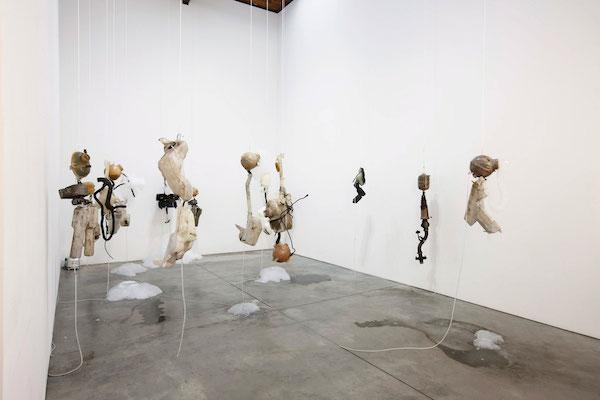
Roger Hiorns; Untitled, 2014; plastic, compressor, and foam. © Roger Hiorns; Courtesy of the Artist and Luhring Augustine, New York.
Indeed, Hiorns’ “situations” appear opaque—at least in absence of further reading. The exhibition guide reveals the origin of the plane of grit to be a “passenger aircraft engine and granite altarpiece” that the artist melted down and atomized. Similar versions of the piece have, with this background information in view, deservedly earned praise as powerfully anxiety-inducing as well as elegiac gestures—acutely so in the context of exhibitions like September 11, which ran at MoMA PS1 in 2012. However, without such a compelling conceptual framework with which to interpret “Untitled 2” (its media, listed as “steel, flat screen, and youth,” are not so enlightening), I cannot but read the work in heavy, metonymic terms: the TV as technology, the boy as humanity, the Wall Street Journal as hegemonic power, the nude as vulnerable body—all rather hackneyed dichotomies of the day, made ready-to-hand by the exhibition’s press release.

Roger Hiorns; Untitled, 2014; atomized passenger aircraft engine and granite altarpiece. © Roger Hiorns; Courtesy of the Artist and Luhring Augustine, New York.
Hiorns is perhaps best known for his 2008 piece, “Seizure,” in which he pumped an empty ground floor flat full of a copper sulphate solution, causing the interior to become coated from floor to ceiling in a deep blue crystalline growth. Such a work demonstrates not only a healthy penchant for the surreal, but also a sensitivity to the potential impact of processes that continue in the artist’s absence. The atomized aircraft piece achieves, or is at least capable of achieving, its own form of presence in absence. Yet Untitled 2 does something of the reverse. Its combination of readymade and theatrical components, provocative spectacle and wan social commentary, elbows out prolonged contemplation. It rings hollow, regrettably assuming the look of generic contemporary-art fare. Hiorns’ better works in this exhibition speak to art-historical traditions in more distinctive tongues—of techno-grit and foam, as it were. They offer something to behold.
Roger Hiorns runs through October 18 at Luhring Augustine.





