







Grant Barnhart
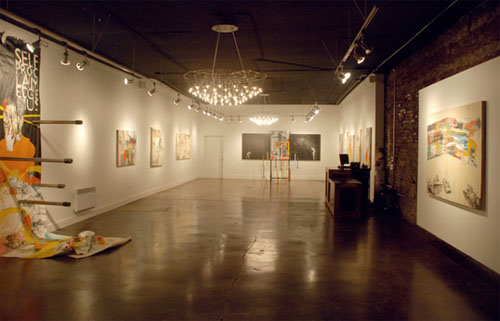
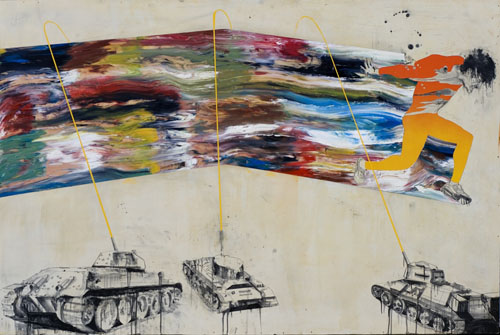
Currently on view at OKOK Gallery in Seattle is Exact Change, new works by artist Grant Barnhart. For his fourth exhibition with the gallery, Barnhart has completed a series of paintings and a site-specific installation in the space. Barnhart has a forth coming exhibition scheduled in 2008 with Leslie’s Art Gallery in Luxembourg and will be represented in Miami this month at Aqua Wynwood, Art Now Fair and Gen Art. The artist recently spoke with DailyServing about his current body of work featuring tinkling tanks, rockets and portraits in multi-colored leotards.
DS: So Grant, you currently have an exhibition on view at the OKOK gallery in Seattle, tell me a little about how long you have lived and worked in Seattle and how you began working with the OKOK Gallery?
GB: Charlie Kitchings used to hustle broads on the corner of Ohio and Lyme in Seattle. One night I was admiring his selection of women and he asked me what my career was. I replied “art”. “Art” he said. I said, “Yeah art”. He bitched slapped me across the face. Rubbing my cheek I told him I would take the red head. “Fine choice” he smirked.
Two years later he contacted me saying he was running a contemporary gallery and offered me the chance to show with him and the rest his history.
DS: For your current exhibition “Exact Change”, you have been very open in discussing the influence of Robert Rauschenberg on your work and process. How has Rauschenberg’s body of work been used to construct the new work in your exhibition? How important is it for a viewer to understand this relationship before they view the work?
GB: Rauschenberg’s artistic stance is rather infinite. He helped redefine notions of painting, sculpture and performance art, and really opened the “flood gates” to conceptual contemporary art as a whole. To me his smile says it all. The man really enjoys creating and living through his art and I wanted to try and experience a small taste of that feeling. From a very fundamental level I pulled from the designs of particular works. I took his formulas and compositions and redefined them with my own concepts and subject matter. While I was creating this body of work I was never concerned with the viewer actually being able to reference Rauschenberg as a starting point. From a very selfish standpoint this body of work was about my experience or relationship to Rauschenberg’s work. If I did my job correctly it would be more of an aside for the viewer to discover Rauschenberg’s foundation and blueprints allowing my work to stand on its own rather than simply feeling derivative.
DS: Outside of Rauschenberg, what are the other driving forces in the selection of content for your current exhibition?
GB: A large portion of Rauschenberg’s work was created during the Cold War and reflected the world he lived in. I feel that there are currently undeniable parallel socio political situations and I wanted to comment on my own personal views of these conditions.
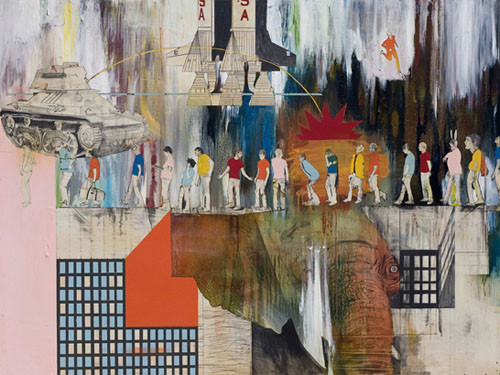
My friends and family also play a large roll. They are represented by the whimsical futuristic soldiers that appear throughout the work. These figures are sourced from homemade action photographs as well as old family photos that were given to me by my mother some time ago. I was often surprised by my reaction to rediscovering these images. I was starring at a photo of myself standing in a deserted playground at the age of four and began to make up false memories and fantasies of how I may of thought at that age. Initially, the old family photos were used as sterile reference to create new characters for the paintings. However, I was unable to remove my emotional connection or in certain instances lack of connection, and the painting started to reflect an abstract sense of a futuristic family photo, a family portrait that did not exist prior to me painting this body of work for the exhibit.
DS: One of the most interesting connecting elements in your work seems to be your use of humor. How do you use humor to address sensitive social issues like war or sex, and what’s up with the “Terrible Tinkling Tank” series?
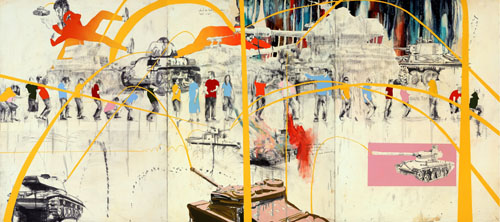
GB: I would never address War or Sex as sensitive social issues. A romantic might but I wouldn’t. If war and sex were sensitive then the idea of discretion would apply. What is discrete about those ideas in western civilization? I thrive on the crass and absurd and enjoy injecting humor into the work. My humor is a personal therapy of sorts. Conservation, or the lack there of, wars with no end in sight, and the amount of Arby’s barbeque sauce on Brittney Spear’s vagina sums up the daily American visual experience from my perspective. With this body of work I hope to juxtapose a completely serious narrative with the absurd and fleeting American pop culture.
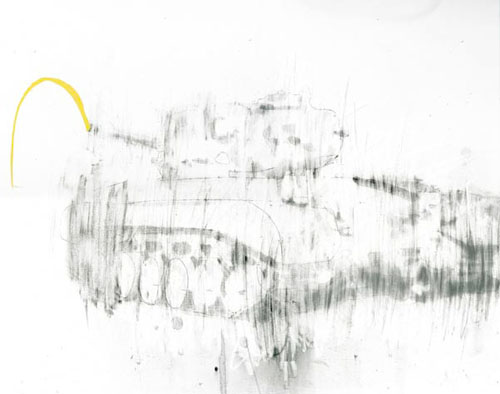
Humor also helps me address more serious situations that can be almost too painful to reflect on otherwise. One such theme is the United State’s ever proliferating military industrial complex. The “tinkling tanks” represent my attempt to humiliate aggressive masculine mechanisms, to remove their inherent physical prowess. What better way to humiliate such a masculine symbol then to give it a small prostate and weak piss stream. The urine is also a reference to the current over usage of bodily fluids in revered contemporary works. Some of the tanks I have tried to erase leaving a faint reminder of the original image. No matter how hard I try to completely remove the image it is still noticeable. These erasing are also a reference to Rauschenberg’s mark making in his transfer drawings.
The humor also helps me address my own personal failures and shortcomings, which I attempt to convey through confessional stream of consciousness writing, which is littered throughout the works.
DS: Certain aesthetic patterns emerge when looking at the complete body of work in your current exhibition, such as specific color use, application and location. What is the significance of the color pink in your work, what does the use of graphite imply, and why are your figures wearing brightly colored leotards?
In the painting “Ontos Is Explored Behind High School Bleachers”, the graphite renderings add a cold weighted element to the overall narrative. The crayola color palette acts as a joke attempting to cover up the graphite, but never fully succeeding. The leotards are a visual band-aid that implies life will be “fixed”, or “made better”, in the future, a world without war. I use the idea that I can apply soft color, such as pink, to act as deterrent to a more harsh reality or situation.
The exhibit is a slice of American experience, or at least what I perceive that experience to be. People are bombarded with war, society’s obsession with celebrity, and a perpetual passing of the buck, which I view as a sort of chronic short sightedness. The protagonists in the paintings reflect my perception of the participants that exist in this society, including myself who appear mad, mischievous, overwhelmed and often utterly confused.
I hope to acknowledge how easy and convenient it is to change the channel to ignore the horrific images of war making for a mind numbing escape.
DS: The uses of autobiographical references are found in your work through self-portraits and the use of portraits of other family members like your Father and Grandfather. How do you choose to represent yourself through the language of portraiture, and what insight does that offer the viewer or even yourself as a creator?
Portraiture has been a great artistic tool throughout history. When creating my self-portraits in this series I go into the process thinking of total freedom and creative liberties to portray myself in a grandiose fashion. The goal is to recreate myself in a new visual context when in reality my face melts and I have trouble avoiding honest self-destructive presence on canvas. This is best illustrated in “Supple With Juicy Bang Bang” and “Hand Guns Cause Finger Bangs”. In “Supple Supple With Juicy Bang Bang” I try to salvage the situation by giving myself a well-defined figure athletically bounding through the air.
The portraits of my father and grandfather are handled with more reverence and sincerity. I clearly hold them to a higher regard than myself.
GB: You collaborated with your Father on the largest work in your exhibition, the installation piece, “Happy Ending”. What is the significance of that work and how did that collaboration come to fruition?
“Happy Ending” is inspired from Rauschenberg’s “Wager” combine. The visual activity occurring in the center of “Wager” became the focus of “Happy Ending”. I knew immediately that I had a rare opportunity to involve my dad in the project. He is an engineer in Kansas City. I emailed him a unique design of a vertical conveyor belt that would continuously rotate silk-screened family photographs. The conveyor would stand in front of a large graphite drawing of my dad and I playing catch. I used this piece to really bond with my family and invite them into my creative world. My wife, mom and step dad helped construct the colorful rockets that are suspended in front of the sculpture. It really was a family affair.
DS: There seems to be a subtle shift and integration of your paintings with other three-dimensional elements. Do you feel that your future works will remain rooted in flat painting, or will the integration of sculpture and installation continue to unite your two and three dimensional works?
GB: I would really hate to limit my output to a two dimensional surface. I am constantly challenging myself to grow aesthetically and conceptually and I do see things developing in a more sculptural realm.
DS: Now that the “Exact Change” exhibition is complete and on view, what are some of the upcoming projects or bodies of work that you are planning?
GB: I’m most excited to let this body of work grow and develop upon the foundation I have created for my current exhibit. My work continues to grow organically over time. A personal goal is to always challenge myself and to continually surprise and entertain the viewer. I have piles of ideas that I would love to create and mediums I would like to explore and add to my current repertoire. If someone would have told me a year ago that I would be creating a body of work consisting of men running around in leotards and dodging urinating tanks I would have thought them crazy.





