







Gustav Hellberg’s Obstruction
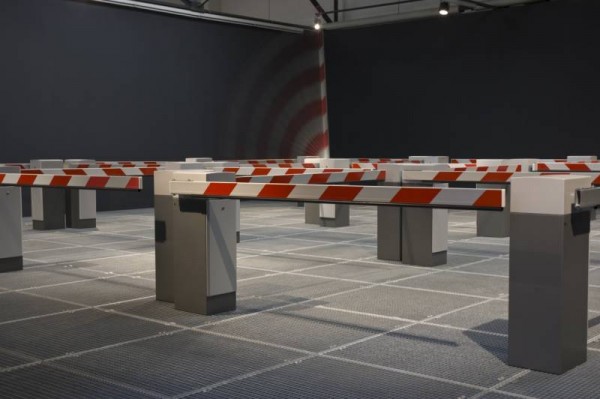
Obstruction, Exhibition View, 2010. Courtesy of Hamish Morrison Galerie.
Gustav Hellberg’s Obstruction at Hamish Morrison Gallery began in a stark grey room, empty except for a model-train size road barrier bar lit up on a pedestal in the center. The sporadic hum of a quiet motor could be heard from the second room. There, a 3×3 grid pattern of twenty-four real, working barrier bars consumed most of the floor space of the second room, the installation centered with a walkway around its perimeter. The bars raised and lowered at random times, allowing and denying access to individual squares or a series of squares at any one time.
Reminiscent of the various security clearance measures taken at airports and government offices where people are systematically herded through a series of rooms or confined spaces, I questioned the desire to enter the grid and navigate through the barriers. I could find no practical reason to enter the installation, but there was something playfully enticing about the proposition offered by Hellberg.
Because of their function in urban space, the rules of appropriate interaction with the road barriers are implicitly known, and even within the gallery they are treated with the same authority. Move when a bar is lifted, and do not walk under a down bar. Game play is transformed into the realization of how open we are to give over power to another individual or thing, despite knowing here that even the biggest success to be had leads to no actual goal other than taking a long and potentially surprising movement through the gallery. Power is wilfully sacrificed to be afforded the opportunity of engaging the piece.
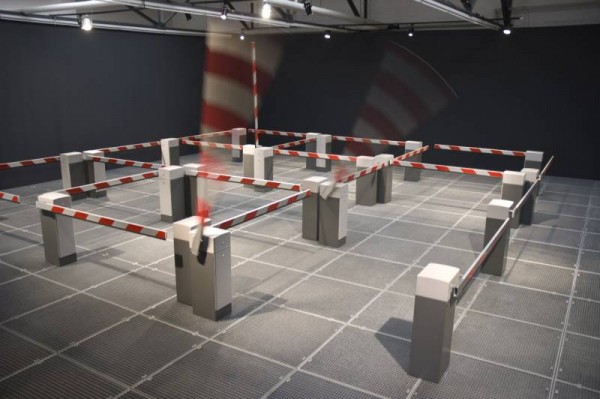
Obstruction, Exhibition View, 2010. Courtesy of Hamish Morrison Galerie.
After initial entry and entrapment, the fear of waiting leads to acting in haste and moving at the first opportunity, rather than sticking to a pre-defined route. There may be some comfort in letting a system make our decisions for us, even though the installation feels a bit like its moving cattle to slaughter, but participants make a conscious decision to enter the piece and follow the rules. Here, however, a previous movement can be instantly regretted upon seeing a better option present itself when it is too late. That feeling of failure challenges the notion that the machine is in control. The participant is still in control of their movements, but has allowed their decisions to be reactionary to the randomly triggered motors operating the contraption.
While typically, in life, there is no way of knowing how one decision versus another can have significant affects, Hellberg’s Obstruction provides us with the direct relationship between our decisions and the results of them. Like an angel presenting George Bailey with the repercussions of his would-be suicide in It’s a Wonderful Life, one can watch to see how other decisions would have led to potentially more desirable outcomes, but while Bailey was offered a chance to change his decision, ours is played out in real time, without the benefit of hindsight.
The privilege of accessing restricted space, in this case, means giving up full control of our mobility, and leads to the fetishization of other space and guilt over the choices we cannot take back.





