







Spotlight Series
Spotlight: Art Practical
This summer, Daily Serving is shining a light on some arts publications that we regularly read and love. We’re excited to partner with publications such as Reorient, ARTS.BLACK, Contemptorary, and others, and will highlight the work of a different site each week. To begin, we’re proud to shine our light on some recent work at our sister site, Art Practical. Today we bring you Anne Lesley Selcer’s essay “What Imaginary Thing Is a Museum?” Selcer poetically unravels the broader implications of museums that represent (via their collections) or mount exhibitions of work by Ana Mendieta in relationship to work presented by that of her former husband. The questions she raises go beyond the personal narrative of two artists to probe the lack of social responsibility employed by art institutions. This article was originally published on May 4, 2017.
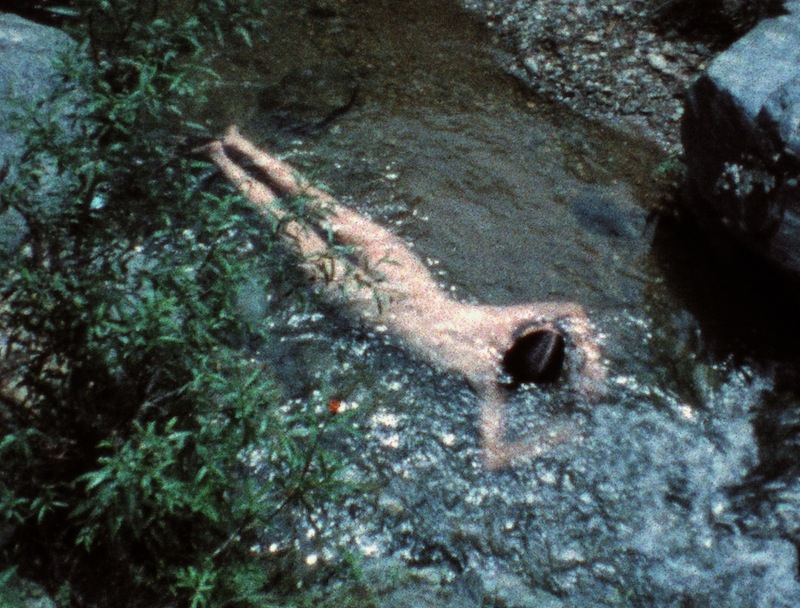
Ana Mendieta. Creek, 1974 (still); Super 8 film, silent.
Two distinct rooms in two different Bay Area museums from early November 2016 to mid-February 2017 displayed the work of two major artists, one of whom killed the other. One was male and one was female, one was born in 1948 in Havana and one was born in 1935 in Quincy, Massachusetts. One showed at the Guggenheim, one won the Rome prize. Although these identifiers are in some ways useless, they put these differences into dialog. In 1988 Carl Andre was famously acquitted for the death of Ana Mendieta, his wife with whom he had been fighting with loudly just before she fell thirty-four stories. This tragedy holds resonant meaning for many people, but none of it gets carried by the museums and galleries who support Andre’s work. The ruling was based on insufficient evidence but is countered by many facts; it is contested by a significant number of people and not currently accepted by Mendieta’s family and friends, or by many fellow artists and curators. The San Francisco Museum of Modern Art displays a room of Andre’s sculpture on their fifth floor. Ten of his works are owned in their collections, as well as three of Mendieta’s. The Berkeley Art Museum exhibited the luminous exhibition Covered in Time and History: the Films of Ana Mendieta last winter. The museum holds six of Andre’s works in their permanent collection and one of Mendieta’s. Carl Andre: Sculpture as Place recently opened at the Museum of Contemporary Art in Los Angeles, the retrospective Dia: Beacon exhibited in 2015 to hearty protest. An action protesting the exhibition includes many Los Angeles curators, one of whom is a former curator at the museum itself.
Mendieta’s death occurred during roiling aesthetic, political, and intellectual struggles in the art world. In the 1970s and ’80s, art emerged as socially confrontational and performative, and at turns conceptual and semiotic. The context of an emerging international contemporary art market attenuated these differences and raised all stakes. A few years earlier, Carolee Schneemann’s Meat Joy (1964) opened new possibilities for the body in art; its messy, anarchic conglomeration of bodies answered male abstract expressionism. In 1976 Lucy Lippard published the book From the Center: Feminist Essays on Women’s Art. Film theory propagated new feminist logics and lexicons. In her writing and performance, conceptual artist Adrian Piper parsed racism and worked through philosophy. Mendieta used her face and body as a Bataillean challenge, and later developed an articulated decolonial praxis. From her lecture, “The Struggle for Culture Today Is the Struggle for Life,” Mendieta writes, “The U.S., the greatest imperialist power, rich in material as well as technological resources, maintains some of the most shameful, hurting, and inhuman forms of racial, economic, and social descriminations [sic] amongst its own people. The overflowing of its frontiers, aggressions, and military occupations, and colonial and neo-colonial politics of the United States imperialism, have denaturalized and violated cultural and artistic tradition of other peoples as well as within the U.S. itself.” Her death was imbued with an uncanny feeling. Their fight in the New York high-rise apartment was about the minimalist Andre getting (in his words) “more exposed to the public” than Mendieta.





