







Summer Session
Summer Session – Value/Labor/Arts: The Manifestos
This installment of our Summer Session considering labor comes from our sister publication Art Practical. In 2014, the Arts Research Center at the University of California, Berkeley, held a day-long practicum entitled Valuing Labor in the Arts, and today we’re sharing a collection of artists’ manifestos put together by organizers Shannon Jackson and Helena Keeffe. This article was originally published on April 3, 2014.
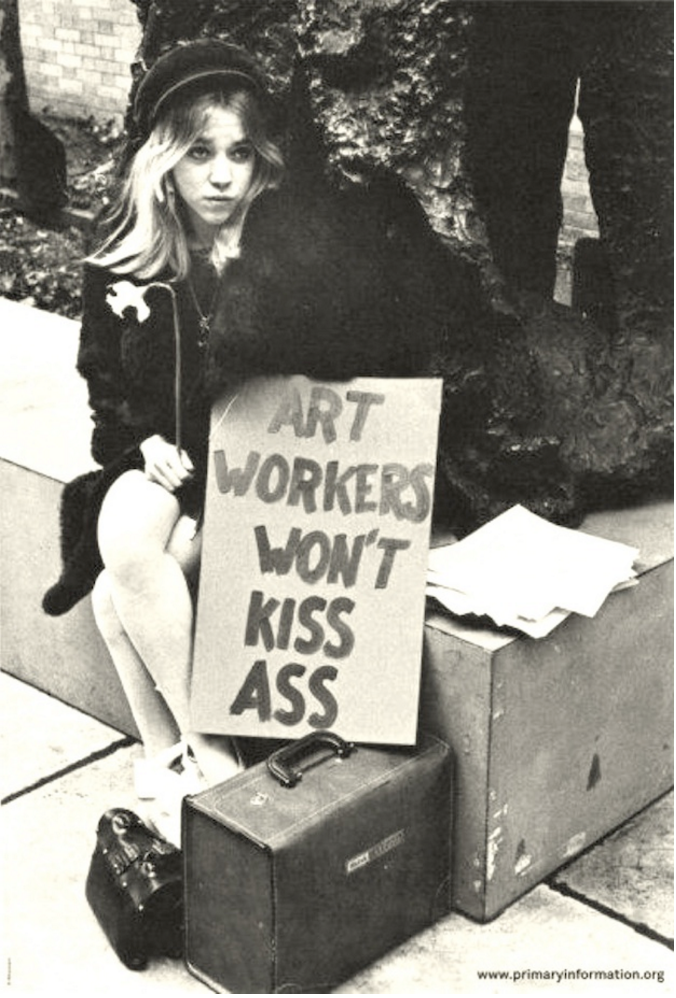
Art Workers’ Coalition. Courtesy of Primary Information.
The Art Workers’ Coalition (AWC) was a loose group of artists, writers, and members of the creative community formed in January 1969 after the artist Takis protested the Museum of Modern Art (MoMA) by removing his sculpture from their exhibition, The Museum as Seen at the End of the Mechanical Age. In the case with Takis, the artist was concerned with his ability to control the exhibition of his work after it had been sold (the museum had exhibited his work against his wishes because they owned it and felt that their right of ownership superseded his rights as an artist to control its exhibition). This initial protest was a spark that ignited the coalition—which gathered members and concerns exponentially throughout the early months of 1969. At the time, the Art Workers’ Coalition was concerned with the responsibility of museums to artists and aimed their efforts at building a dialogue between themselves and MoMA.





