







San Francisco
Take This Hammer: Art + Media Activism from the Bay Area at Yerba Buena Center for the Arts
Today from our sister publication Art Practical we bring you editor Emily Holmes’ review of Take This Hammer at YBCA in San Francisco. Holmes notes, “Although there is crossover between works, particularly in regard to the social issues they address, violence is perhaps the single thread running through all of Take This Hammer. […] It takes many forms, but the exhibition particularly exposes systemic inequities and state-sanctioned uses of lethal force, in the global (military) uses as well as the local (police).” This article was originally published on April 19, 2016.
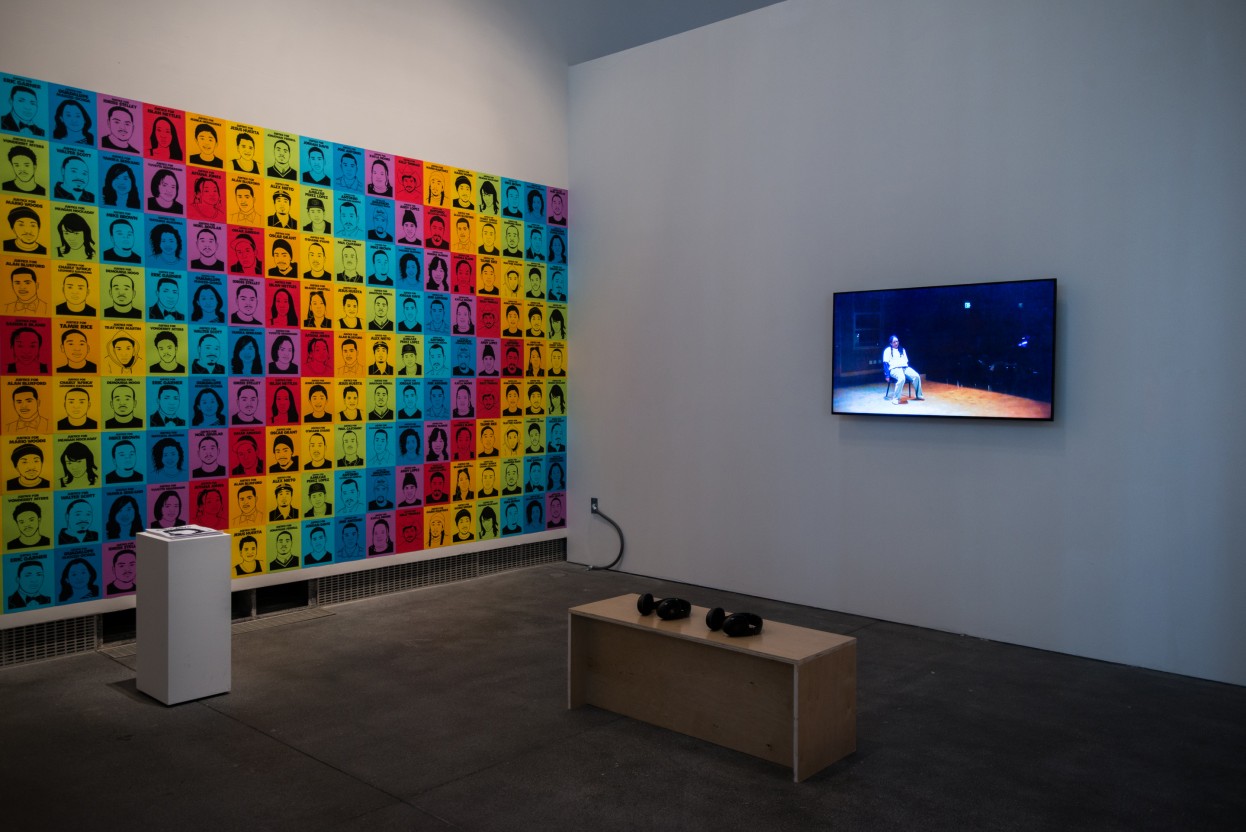
Take This Hammer: Art + Media Activism from the Bay Area, installation view, Yerba Buena Center for the Arts. Left: Oree Originol. Justice for Our Lives, 2014-ongoing. Right: Cat Brooks with Black Lives Matter. Anti Police-Terror Project, ‘Tasha,’ 2015. Courtesy of Yerba Buena Center for the Arts, San Francisco. Photo: Charlie Villyard.
The command within the exhibition title Take This Hammer: Art + Media Activism from the Bay Area, on view at Yerba Buena Center for the Arts (YBCA) through August 14, 2016, is an incendiary offering. It is a suggestion filled with implicit actions that could go in any direction, or perhaps multiple directions at the same time: smash, build, repair. Curated by Christian L. Frock, the exhibition itself evokes a similarly complicated empowerment—a sort of optimism fueled by grief, anger, and the fear that change will not occur fast enough. Derived from the title of a documentary (on view in the lobby) featuring James Baldwin on the topic of Black life in San Francisco in the 1960s, Take This Hammer as a phrase and exhibition directs viewers to implicate themselves in contemporary social issues.
The exhibition provides a wide sampling of work by eighteen Bay Area–based artists and activists who work individually or collectively. Like the region itself, it’s a diverse grouping—both in terms of points of view and strategies of political intervention. Seeing some of the pieces or documents in a museum context raises questions about whether they would be better served being wheat-pasted onto walls or held up high while marching through the streets. Other works more clearly feel as though they “belong” in a gallery site, like the video pieces and paintings. Others initially or continuously exist online, their inclusion here a remove from that already-expansive viewing context of the internet. Regardless of the context each piece apparently belongs to, Take This Hammer uses its institutional and educational frame to create a comprehensive experience of political work being produced today. Indeed, YBCA—with its current marketing campaign that includes phrases like “the center for the art of doing something about it,” as proudly asserted by banners outside the building—lays claim to the idea that museums should foster political awareness in the community.





