







Chicago
A Feast of Astonishments: Charlotte Moorman and the Avant-Garde, 1960s–1980s at the Block Museum of Art
The Juilliard-trained musician and performance artist Charlotte Moorman, the so-called topless cellist, never shied away from the spotlight. In addition, as a monographic exhibition at Northwestern University’s Mary and Leigh Block Museum of Art demonstrates, Moorman’s work as a cunning and forceful impresario contributed significantly to the international visibility of New York’s burgeoning avant-garde music scene beginning in the ’60s. A Feast of Astonishments: Charlotte Moorman and the Avant-Garde, 1960s–1980s offers visitors a sonically and visually cacophonous encounter with the diversity and tenacity of the artist’s energies and output. Combining an impressive array of ephemera, photographs, film and video footage, props, and artifacts, the show makes a virtue of Moorman’s decades-long disinterest in producing art objects with its informative multimedia cavalcade.
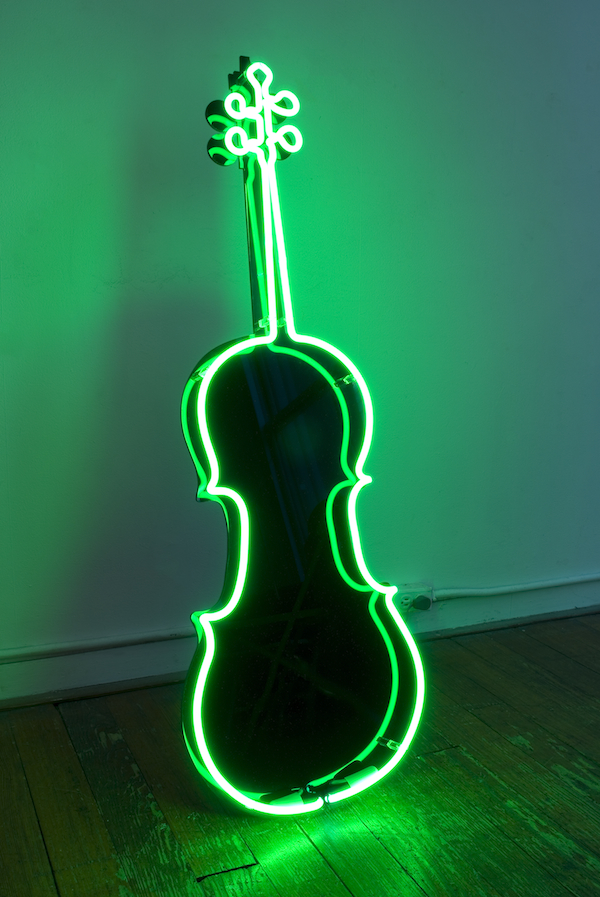
Charlotte Moorman. Neon Cello, ca. 1989; Plexiglas, neon, and electrical parts; 48 1/2 × 16 in. Courtesy of Emily Harvey Foundation. Photo: João Simões.
The art objects, like Neon Cello (1989), that Moorman did create to finance her performance work are more interesting as documents of the sacrifices she made to support and cultivate a community of creators than as objects of aesthetic interest. A Feast of Astonishments documents Moorman’s considerable bravery and leadership, which at times came at the expense of the artist’s welfare. For instance, the exhibition relates the story of Moorman’s 1967 arrest for indecent exposure during her performance of Opera Sextronique, a work by her longtime collaborator Nam June Paik, which featured the cellist in various states of undress. Through newspaper clippings, photographs, and letters from artists such as Claes Oldenburg calling for her release, the exhibition reiterates the centrality of this “topless cello” moment in the consolidation of Moorman’s artistic persona and her career-long deliberation of her agency as a performer and the history of the female nude in art.
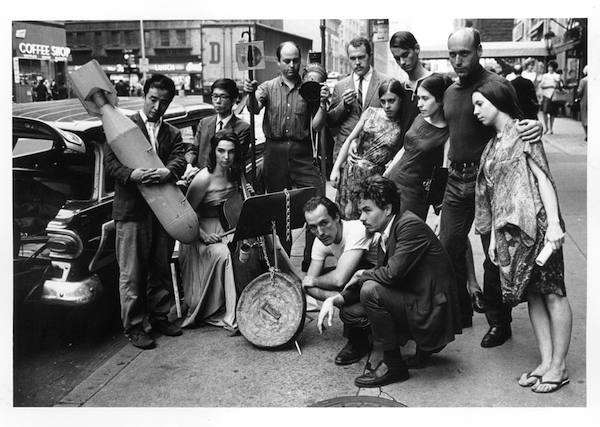
Peter Moore. Publicity photograph for 3rd Annual New York Avant-Garde Festival, August 26, 1965; left to right: Nam June Paik, Charlotte Moorman, Takehisa Kosugi, Gary Harris, Dick Higgins, Judith Kuemmerle, Kenneth King, Meredith Monk, Al Kurchin, Phoebe Neville; in front, kneeling: Philip Corner and James Tenney. Photo © Barbara Moore/Licensed by VAGA, NY.
As a whole, the exhibition explores Moorman’s complex role as producer, provocateur, and performer to set the record straight on her significant contributions to postwar American art and music. In addition to the impressive and interesting documentation of the twenty years of festivals spearheaded by Moorman, a selection of anecdotes, photos, and documents draws attention to the gendered dynamics of power that structured Moorman’s significant contributions.
After seeing a performance of John Cage’s work 26’ 1.499” for a String Player, performed by Kenji Kobayashi in the early ’60s, Moorman dedicated herself to the New Music scene emerging in downtown Manhattan. Moorman would make Cage’s formative work one of her calling cards, performing it incessantly throughout the’60s, according to her extensive annotations to Cage’s score. A color photograph documents Moorman’s setup for 26’ 1.499” at WNET studios in 1974: an array of innocuous and politically charged objects—including an inflatable clown, a chessboard, and a toy missile—lay inert, awaiting Moorman’s forceful activation. Her effusive and theatrical renditions of Cage’s work inspired the ire of the composer while earning her invitations to perform on the Johnny Carson, Merv Griffin, and Mike Douglas TV shows. Recordings of her visits to these shows reveal, on the one hand, her mastery of serious avant-garde performance and, on the other, her embrace of slapstick absurdity and popular media as means to render New Music accessible and interesting to the broadest possible audience.
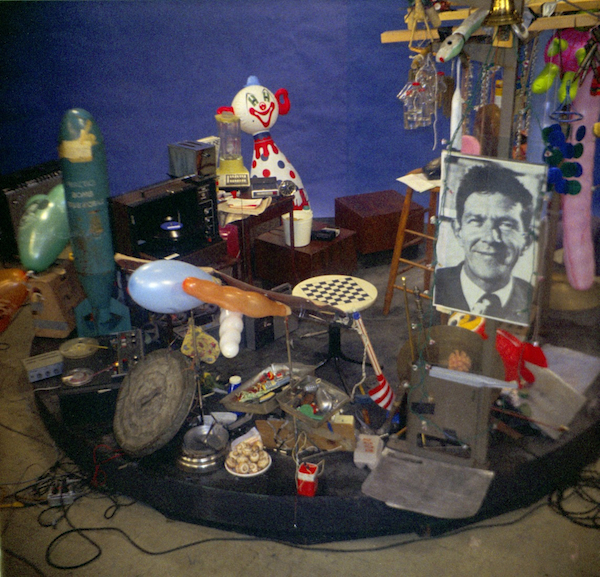
Charlotte Moorman’s setup for John Cage’s 26′ 1.1499″ for a String Player at WNET studios, 1974. Courtesy of Charlotte Moorman Archive, Northwestern University Library.
Cage’s disdain for Moorman’s singular interpretation of his score is striking, given his exalted status as the permissive father of a newer, freer music. The gendered power dynamic that traditionally characterized the composer–performer relationship, it seems, persisted in New Music even as typical conceptions of authorship shifted. Moorman’s unapologetic absurdity and seriousness—palpable in all her endeavors on display, both in her performance of Cage’s score and throughout her career—and her willingness to embody and destabilize the objectification of the female form in music and art performance made her an ideal and willing collaborator.
Moorman cultivated an impressive network of confederates—including Yoko Ono, Ornette Coleman, Joseph Beuys, Carolee Schneeman, and Jim McWilliams—who appear in photos and other ephemera throughout the show. Ono’s well-known Cut Piece would become a staple in Moorman’s repertoire, the shredded remains of which are elegantly displayed on stretched canvas.
In a photograph documenting a work composed specifically for her by McWilliams in 1973, C. Moorman in Drag, the artist dons a tuxedo and a Pablo Casals mask and pantomimes a Bach solo recording by Casals, once the most famous cellist in the world and a darling of the Kennedy White House. A marked departure from Moorman’s other works that trade in the spectacle of the female nude or new technology, this work humorously skewers the devotion to the classical genre’s staid concepts of musical virtuosity and quality rooted in the romantic figure of a solitary male genius.

The Pablo Casals mask used by Charlotte Moorman in the performance of Jim McWilliams’s C. Moorman in Drag, 1973. Courtesy of Charlotte Moorman Archive, Northwestern University Library.
Demonstrating that Moorman was more than simply a prop for the development of Paik’s impressive, psychedelic, yet heterosexist experiments in video/performance art and avant-garde music, this exhibition presents the tension between issues of gender, agency, authorship, virtuosity, and performance. This curatorial intervention opens a useful conversation about these challenging topics as they relate to the dependence of male authors on other, often unnamed, female performers whose reputations were based on performing sexualized acts in happenings and video and performance works. Moorman’s virtuosity and organizational prowess rightly free her from obscurity or diminishment, but much remains to be done to reevaluate the criteria with which the history of performance art is documented and interpreted.
A Feast of Astonishments: Charlotte Moorman and the Avant-Garde, 1960s–1980s is on view at the Block Museum of Art through July 17, 2016.





