







San Francisco
Printed Matters – Daniel Coburn: The Hereditary Estate
Today from our partners at Art Practical, we bring you Larissa Archer’s review of the photography book The Hereditary Estate by Daniel Coburn. The author writes, “It’s the eyes of Coburn’s subjects that will haunt you. The elders seem to have seen everything, leaving them with marked brows and broken hearts. The younger adults seem by turns thoughtsick and mistrustful to downright hardboiled and malicious. The children, however, close their eyes and, as if willing themselves to rise up from the shadows, turn their faces toward the light.” This article was originally published on February 25, 2016.
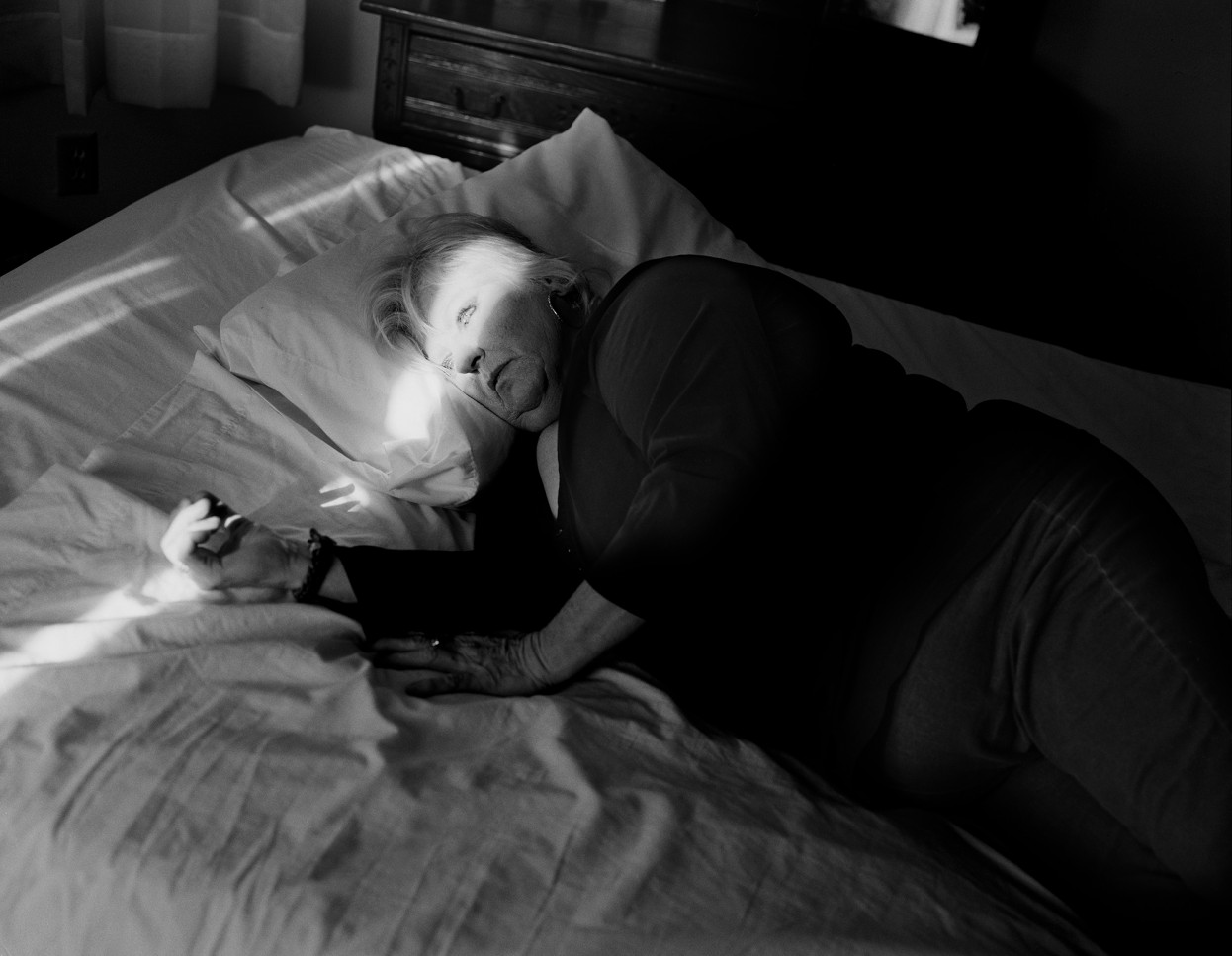
Daniel Coburn. The Matriarch, from The Hereditary Estate, Kehrer Verlag, 2014.
Light plays a complex and outsized role in The Hereditary Estate (Kehrer Verlag, 2014), photographer Daniel Coburn’s “broken family album,” to borrow a phrase of the photographer. Light not only illuminates the vivid Southern gothic panache of Coburn’s subjects—his extended family in and around Topeka, Kansas—but also seemingly seizes and manipulates their actions, leaving them stunned and confounded. Take two contrasting photographs of Coburn’s mother, for example. In The Matriarch, a slab of harsh white light has fallen across her face as if with the force of a poleax. She lies on her side, arms stiff, mascaraed eyes staring blankly, looking as if she was felled rather than simply resting. In Divine Light, she stands backlit like a movie star against a backdrop of trees and a picket fence as a benign sun hovers beyond the branches over her head and radiates light through the fence posts. That glowing orb and its slanting beams seem to nudge her forward toward the viewer, and she stands with one foot primed as if ready to walk out of the frame.
The image is just this side of sentimental; the flattering soft light, pyramidal composition, and quaint setting almost produce the effect of a sugary religious tableau. But there’s something hard, pragmatic, and fully terrestrial in her eyes. While in the previous image his mother appears as the passive object of a malevolent light’s violence, in Divine Light she and the light appear to work in conspiracy with one another. Fluorescent flames in the image of a brush fire on the adjacent page lick across the grass, as if summoned by her from across the gutter to the other side of the book.





