







New York
From Minimalism into Algorithm at the Kitchen
In a 1966 review, Rosalind Krauss described how one of Donald Judd’s “progression” wall reliefs pulled the rug from under her. Its intervallic sequence of supporting members suggested a Renaissance colonnade, but its variable spacing negated the compositional and spatial logic that this model prepared her to expect. “The work itself exploits and at the same time confounds previous knowledge to project its own meaning,” she wrote.[1]
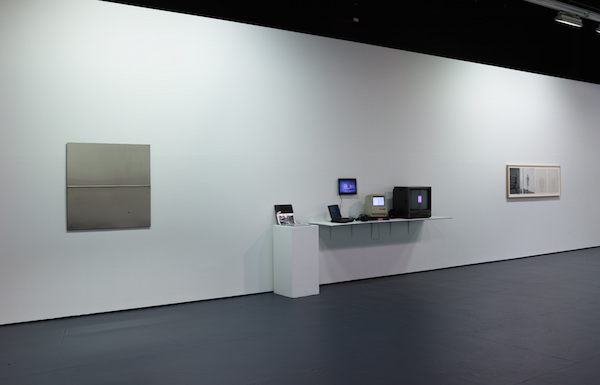
From Minimalism into Algorithm, Phase 1, 2016; installation view, the Kitchen. Featuring works by Donald Judd, Laurie Spiegel, and Charles Gaines. Courtesy of the Kitchen. Photo: Jason Mandella.
The Kitchen’s current exhibition, From Minimalism into Algorithm, pulls a similar maneuver. Its title suggests a cogent historical arc, but in fact it presents nothing of the kind. While the show has been divided into three parts, shown over the course of a few months (phase three is currently on view), these have not corresponded to distinct phases of a historical narrative—such as minimalism, transition, and algorithm—or indeed any other obvious organizational scheme apart from the exigencies of spatial limitations and loan requirements. Each installation has featured a medley of works ranging from the 1960s to the present, with a good deal of overlap among the three parts. Moreover, the older works consistently skirt conventional understandings of Minimalism, while the newer ones reflect upon or utilize algorithms—sets of rules described by formulas, nowadays typically followed by computer software for problem-solving purposes—in such different ways as to render the term disposable. The result is that the show looks like something of a mess, which is its greatest virtue. Rather than presenting one line of thought, it allows for the proliferation of many, giving the included works ample room to project their own meanings.
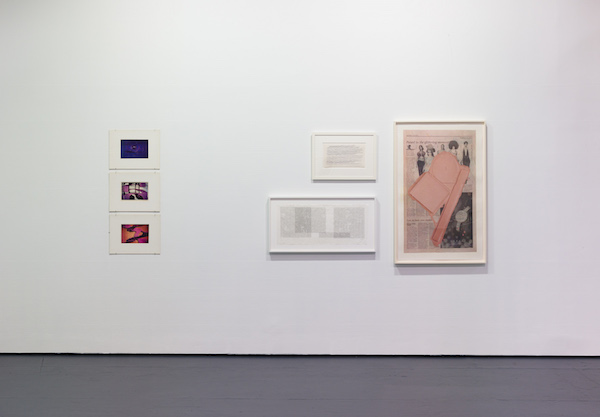
From Minimalism into Algorithm, Phase 1, 2016; installation view, the Kitchen. Featuring works by Laurie Spiegel, Vera Molnar, and Paul Sietsema. Courtesy of the Kitchen. Photo: Jason Mandella.
A paradigmatic work at the nexus of Minimalism and algorithmic composition would be Sol LeWitt’s Incomplete Open Cubes (1974), in which the artist followed a rigidly systematic, if knowingly inefficient, set of rules to produce all 122 permutations of cubic skeletons with at least one side missing. Regrettably, nothing by LeWitt is included in From Minimalism into Algorithm. However, included works by other members of LeWitt’s generation are interesting in different, more unexpected ways. Judd’s Folded Meter (#22) (1982), while described by the exhibition organizers as “a quintessential minimalist work,” is not quite so quintessential. A square length of stainless steel folded onto itself and hung as a wall relief, the work demonstrates a literal approach to industrial materials that is indeed characteristic of the artist’s work. However, it also employs a compositional technique, folding, that is quite unusual for Judd, who generally opted for a more constructional approach that obscures the hand of the maker (usually a hired industrial fabricator). Similarly, a 1974 untitled plank by John McCracken achieves the perfectly polished polyester-resin finish for which the artist is known, but it also presents a riot of color that will come as a surprise to viewers who are familiar only with his better-known monochrome works. Richard Serra and Carlota Schoolman’s video piece, Television Delivers People (1973), is likewise a far cry from the torqued COR-TEN steel sculptures that have become synonymous with Serra. Originally broadcast on cable, the work consists of scrolling text that exposes the capitalist machinations driving mass media, set to Muzak.
In their eccentricity, these works pull the conventionally narrow understanding of Minimalism apart at the seams, drawing out a series of threads that serve as through lines to the more recent works in the show. For example, we can see Judd’s relief—a banal material, shaped and folded according to simple rules to produce a surprisingly visually engaging object—as anticipating a work like Tauba Auerbach’s plywood sculpture, The New Ambidextrous Universe III (2014), which the artist created by water-jet-cutting the material according to a meandering line she drew on a tablet and distorted digitally, then arranging the resulting pieces on the ground in reverse order. The final product is mesmerizing, resembling, in the artist’s words, a “puddle of wood” that “left our universe, went into another space, and came back.”[2] Likewise, the seductive finish of McCracken’s plank reappears in Paul Sietsema’s astounding trompe l’oeil painting, Figure Ground Study (Fashion and Arts) (2015), which depicts a notebook, compact disk, and ruler coated in thick pink paint upon a bed of newspaper. As far as I can tell, this work has nothing to do with algorithms—and it is not alone in this respect—but the McCracken does suggest a historical pedigree (Sietsema too works in Los Angeles) that at least runs in tangent to Minimalism.

From Minimalism into Algorithm, Phase 2; 2016; installation view, the Kitchen. Featuring works by John McCracken, Zoe Leonard, Andrea Crespo, and Cheyney Thompson. Courtesy of the Kitchen. Photo: Jason Mandella.
More complex in its prescience is Serra and Schoolman’s video work, here displayed in the Kitchen’s elevator (during Phase 1 of the show, it was given main-gallery real estate). Of obvious significance is the work’s use of new media. (In 1972, a brief period of eased cable-television regulation began, making airtime available to more distant and often smaller operators.) This aligns Television Delivers People with the many exhibited works that employ digital tools, for instance Seth Price’s untitled 2015 work, a computer-aided panoramic amalgamation of digital photographs that together represent a small area of human skin. Meanwhile, Serra and Schoolman’s use of highly inexpressive Muzak looks forward to the similarly uninflected and repetitive electronic music that artists like Philip Glass and Laurie Spiegel, both represented in the exhibition, would creatively develop over the course of the 1970s. (Glass’s work appears by way of a 1978 video featuring Lucinda Childs in rehearsal for a dance piece then called Work in Progress with Philip Glass, which would form a part of her 1979 Dance collaboration with Glass and LeWitt.) Perhaps most important, however, is how Television Delivers People addresses interlocked social, economic, and technological structures, in effect reconfiguring Minimalism’s systematic formal strategies as tools for questioning the systems of the greater society. In view of this, one can place similarly engaged works—like Trevor Paglen’s South American (SAM-1) NSA/GCHQ-Tapped Undersea Cable Atlantic Ocean (2015), a photograph of an undersea internet cable believed to be tapped by the United States’ National Security Agency, or Cheyney Thompson’s 88.35Tungsten- 67.45Cobalt- 45.36Tin- 28.74Nickel- 18.23 Iron- 82.29Bismuth- 58.84 Aluminum- 41.32Silicon- 24.11Copper- 13.95Chromium (2015), a gestural abstract painting made with the ten titular minerals, whose values anchor the worth of all other metals in financial markets—in a 20th-century sculptural tradition that otherwise might have seemed wholly irrelevant.
Thompson determines the quantities of the metals he will use on a given canvas through an algorithm that indexes their current market rates. Paglen’s work, on the other hand, has no readily apparent connection to algorithms, unless this term is taken to denote digital technology in the broadest sense. Thus From Minimalism into Algorithm, while adumbrating a compelling expansion of Minimalism as a historical launch point for much contemporary work, falters with its second key term, at times illuminating and at other times mystifying the relevance of the algorithm to contemporary artistic practice and discourse. Still, it is productive, if only for raising the question: If a work such as Paglen’s is not quite algorithmic, on what thematic vector should one place it?
From Minimalism into Algorithm is on view at the Kitchen through April 2, 2016.
[1] Rosalind Krauss, “Allusion and Illusion in Donald Judd,” Artforum 4 (May 1966), 25.
[2] The Kitchen, “From Minimalism into Algorithm, Phase 3, March 3–April 2,” gallery handout.





