







San Francisco
Bring It Home: (Re)Locating Cultural Legacy Through the Body at San Francisco Arts Commission Gallery
Today from our partners at Art Practical, we bring you an excerpt from Brian Karl’s review of Bring It Home: (Re)Locating Cultural Legacy Through the Body at the newly reopened San Francisco Arts Commission Gallery. The author notes, “Given the particularly intense struggles in the Bay Area today, where citizens are denied access to civil rights and basic resources by the structural discriminations of racialist and upward-funneling economic policies, the SFAC Gallery can perform a greater social role by further addressing these pressing issues in the cultural realm.” This article was originally published on March 17, 2016.
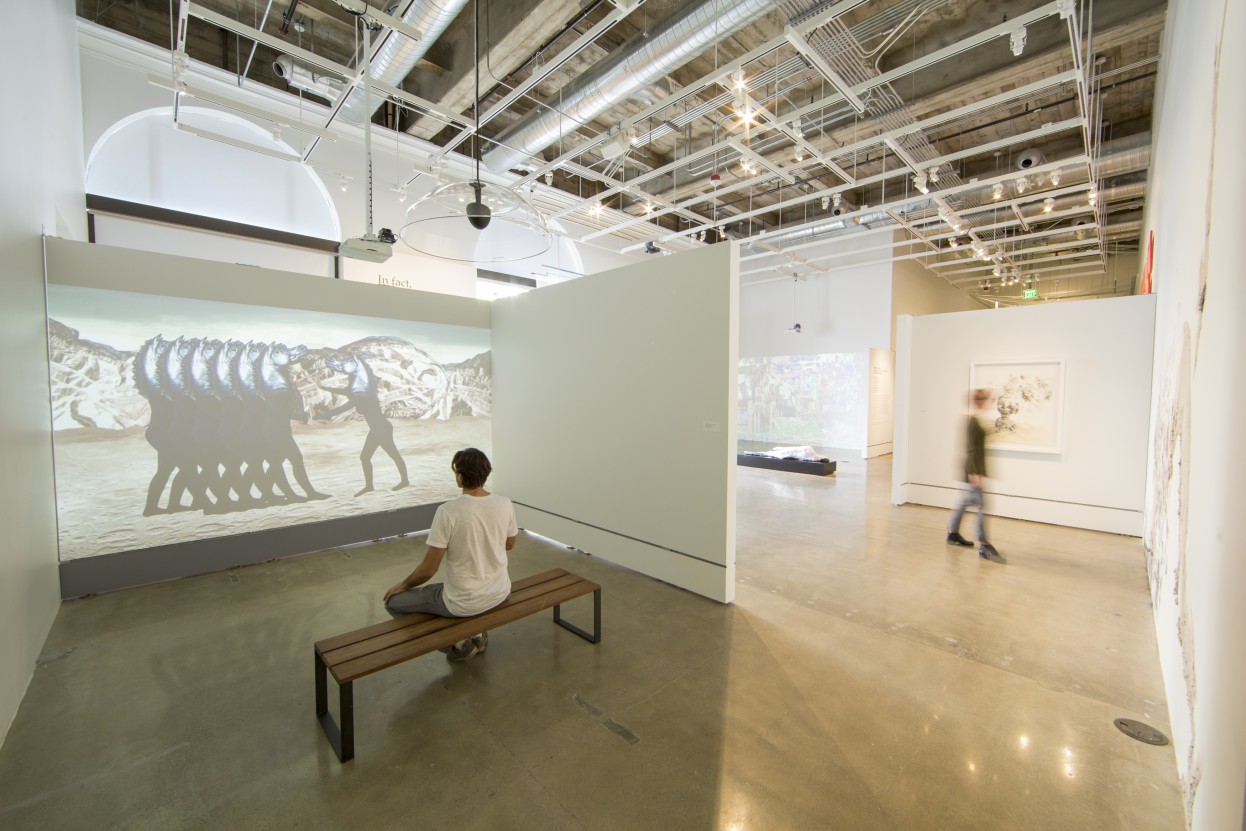
Zeina Barakeh. Homeland Insecurity, 2015; single-channel animated video; 6:00. Courtesy of the Artist. Photo: Scott Chernis.
Bring It Home consolidates several generations of self-consciously multiculturalist impulses in contemporary U.S. art practices. Layered on top of an even-handedness toward gender and some range of age representation, the attention to artist demographics in this show is evident, touching on cultural antecedents originating in far-flung points on the globe, from Asia to the Middle East to south of the U.S. border.
Noticeably balanced, for instance, are neighboring installations by Zeina Barakeh and Dana Harel. Barakeh is a Lebanese-born Palestinian video artist whose project manages to animate, at once playfully and seriously, a wordless narrative of power. Harel is an Israeli artist whose flowing pencil strokes and overlapping stucco relief form the image of a single human body intertwined with a vine-y plant onto a blank gallery wall. The other pieces in the exhibition are diversely arrayed in their placement, media, and materials as well. The insistently vertical physical presence of Ramekon O’Arwisters’s highly textural knitted sculptures evokes the artist and his grandmother as abstract statues of sorts, and are counterpoised to the smooth, low, horizontal pool of Jeremiah Barber’s dark, body-sized platform for a single human body to be laid out and/or performed upon. A text-based wall piece by Guillermo Gómez-Peña, the detailed collage works of Carolyn Janssen and Tsherin Sherpa pointing toward and complicating spirituality for individuals, the more evanescent projections of layered family figures by Summer Mei Ling Lee, and the shifting layers of postcolonial place by Ranu Mukherjee occupy different niches in other reaches of the space.





