







New York
Setting Out at Apexart
In Setting Out (an exhibition selected as part of apexart’s Unsolicited Proposal Program), the guest curators Shona Kitchen, Aly Ogasian, and Jennifer Dalton Vincent showcase works that reframe or enact the vocabularies, tools, and approaches of explorers and scientists. With many intriguing works on display, the most interesting render the Earth strange by observing it with fresh eyes, analogous to the wonder of seeing distant planets and places. As the artists fuse the structure and utility of science with their imaginative objectives and tools, they probe the way we understand place.

Claudia O’Steen. Arc of Visibility, 2015; video, binocular/projector stands, Yellowheart, cedar, glass, rocks collected over time from 41°29’40.72”N, 71°8’8.10”W, sandbags containing sand from same coordinates, video projections, stainless steel, glass reflectors, aluminum, mirrored Plexiglas, compass level; dimensions variable. Courtesy of the Artist and apexart, New York.
Claudia O’Steen’s video and sculpture, Arc of Invisibility (2015), sit amid a table filled with the curators’ and exhibition designer’s vinyl text—identifying topics of inquiry like dissemination, evidence, and illusion—and objects related to the artists’ projects, like maps, a stereopticon, and more. O’Steen partially bypasses the table’s clutter by projecting her video on the floor while her homespun, wooden surveyor transit sits on top. Transits, typically consisting of a telescope with a crosshair, measure the relational distance and angle of objects for construction, landscaping, and geography. O’Steen’s transit differs from conventional ones by producing two images that are split along a vertical axis, one of which is upside-down. In O’Steen’s video, shot at South Shore Beach, Rhode Island (indicated as 41˚29’40.72″N, 71˚8’8.10″W), she walks toward the Atlantic Ocean, holding her transit. While the artist attempts to hold it level with the horizon line, her wobbly split-screen and partially upside-down imagery of the ocean are disorienting. Fashioned almost like a twin-lens reflex camera (with two openings, mirrors, and an eyepiece on the top), O’Steen’s transit combines the acts of looking outward toward the horizon and downward to the ground, such that her video shows the ocean along with beach pebbles and occasionally her feet in the background. With her quasi-scientific approach and tool, O’Steen’s project embraces futility and disorientation to envision the way we comprehend place.

William Lamson. A Line Describing the Sun, 2010 (video still); 2-channel video; 13:35. Courtesy of the Artist and apexart, New York.
Installed on the wall behind O’Steen’s work, William Lamson’s A Line Describing the Sun (2010) resonates with O’Steen’s use of simple optics to calibrate the landscape. Lamson’s two-channel video shows him with an extended, tricycle-like apparatus fitted with an oversize Fresnel lens and mirror. Lamson’s device reflects and concentrates sunlight to burn the ground, demonstrating that light may also be heat. Following the sun’s east-west passage, Lamson creates an earthwork as he draws a line across a dried lake bed in the Mojave Desert. Additionally, with the project’s day-long duration in a harsh climate, Lamson enacts an endurance piece, evidenced in the welder’s goggles that protect his vision as he scorches the earth. The absence of water in the Mojave Desert renders it almost alien to Earth, the “Blue Planet” whose water is considered the source of life.[1] While Lamson most importantly uses video to document his process, he also uses it to create poetic and formal analogies, like when the rotating wheel of his tricycle suggests the motion of the machine and the rotation of the Earth. Additionally, he juxtaposes imagery on one screen of burning the otherworldly, barren, and cracked earth while a bright circle against a black background travels across the other screen—like the moon traveling across the sky. As Lamson scorches the earth, he creates a tangible and linear relationship with the sun and relates it to distant planets or the moon.
![Ivan Puig and Andrés Padilla Domene. Donkey on Mars [Burro en Marte], 2013; digital pigment print; 37.25 x 52.75 in. Courtesy of the Artist and apexart, New York.](/wp-content/uploads/2016/02/5.jpg)
Ivan Puig and Andrés Padilla Domene. Donkey on Mars [Burro en Marte], 2013; digital pigment print; 37.25 x 52.75 in. Courtesy of the Artist and apexart, New York.
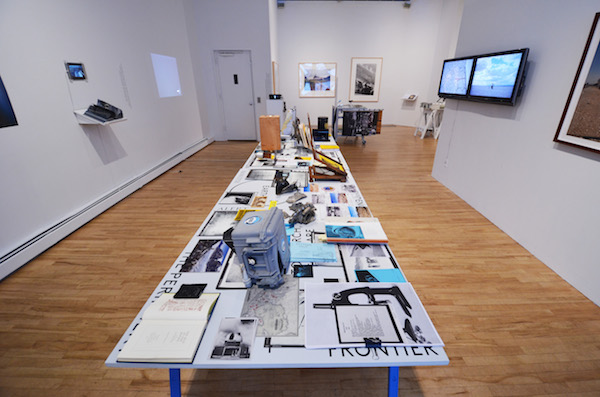
Setting Out, 2016; installation view. Courtesy of apexart.
While these three works succinctly complement each other, the exhibition also follows several different trajectories, like the mysteries of a failed boat exploration, human-animal parallels, stargazing, and surveillance. Much of the work intriguingly creates narratives about what and how we see. Throughout the exhibition, the artists’ playfulness and absurd contraptions disrupt the linearity of scientific practice, provoking questions about utility and goals in art and science.
Setting Out is on view at apexart in New York City through March 5, 2016.
[1] The Mojave Desert averages less than five inches of rainfall a year. This dryness combined with the heat results in a remarkably clear sky, with only a few clouds that obstruct or diffuse the sun’s light. The absence of water is also apparent in the dry, cracked lake beds.





