







New York
Frank Stella: A Retrospective at the Whitney Museum of American Art
The stylistic shift in Frank Stella’s work has been met with fierce criticism, to say the least. Much has been written recently about his current retrospective at the Whitney, trying to connect his wildly expressive, three-dimensional works of the past few decades with his singular striped paintings of the 1960s. More than thirty years ago, Douglas Crimp characterized Stella’s late work from the 1970s as “pure idiocy.”[1] Pointing to an image of Stella’s Harēwa (1978)—the maquette of which appears in the Whitney retrospective—Crimp suggests the state of painting in 1981 is such that “only a miracle can prevent it from coming to an end.”[2]

Frank Stella. Gobba, Zoppa e Collotorto, 1985; oil, urethane enamel, fluorescent alkyd, acrylic, and printing ink on etched magnesium and aluminum; 137 x 120 1/8 x 34 3/8 in. The Art Institute of Chicago; Mr. and Mrs. Frank G. Logan Purchase Prize Fund; Ada Turnbull Hertle Endowment 1986.93. © 2015 Frank Stella/Artists Rights Society (ARS), New York.
While Crimp may have been right about Stella’s works from the late 1970s and early 1980s—a number of which are on view and fail to refute Crimp’s commentary—it is wise to consider the efforts Stella has made in advancing painting in a time of mechanical and digital reproduction, especially in the past couple of decades. While Stella’s engagement of photographic and digital technologies are not quite miraculous, they have helped to reinvigorate the practice of painting since then.
Painting during a medium-specific crisis is not new to Stella. He arrived in New York in 1958—two years after the death of Jackson Pollock—a time when painting’s status was floundering. His early paintings helped catalyze the transition of the dominant mode of painting from Abstract Expressionism to a post-painterly abstraction that minimized any trace of the artist’s hand. In part, Stella’s paintings of the 1960s eradicated composition, pushing painting toward objecthood and away from a flattened pictorial plane.
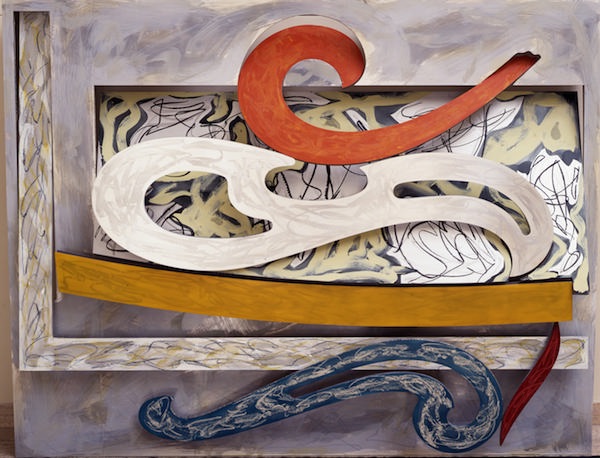
Frank Stella. Eskimo Curlew, 1976; litho crayon, etching, lacquer, ink, glass, acrylic paint, and oil stick on aluminum; 98 3/4 x 127 x 18 in. Portland Art Museum, Portland, Oregon; museum purchase: funds provided by Mr. and Mrs. Howard Vollum 79.36. © 2015 Frank Stella/Artists Rights Society (ARS), New York.
Later he would create more expressive bodies of work; in the 1980s, he began his Moby Dick series, a large group of three-dimensional abstract works inspired by chapters from the Herman Melville classic. Such works as The Whiteness of the Whale (IRS-1 2X) (1987) depart radically from Stella’s earlier paintings and begin to employ narrative. It would seem Stella abandoned the cool purity of his striped paintings, as much of his work from the 1980s onward carries insatiable energy while expanding rapidly in three dimensions, typified by At Saint Luce! [Hoango] [Q#1] (1998) and other works on view.
While the later works seem incongruous with those from the 1960s, Stella’s entire body of work serves as a paradigm in which painting establishes itself against mediums that have been challenging its existence: photography and later digital reproduction. As a technology, photography was developed in the mid-1800s; its threat to painting’s long-held authority of pictorial representation forced artists and theorists to reconceptualize the older medium, which caused radical shifts and fragmentation among artists, primarily in the postwar decades.
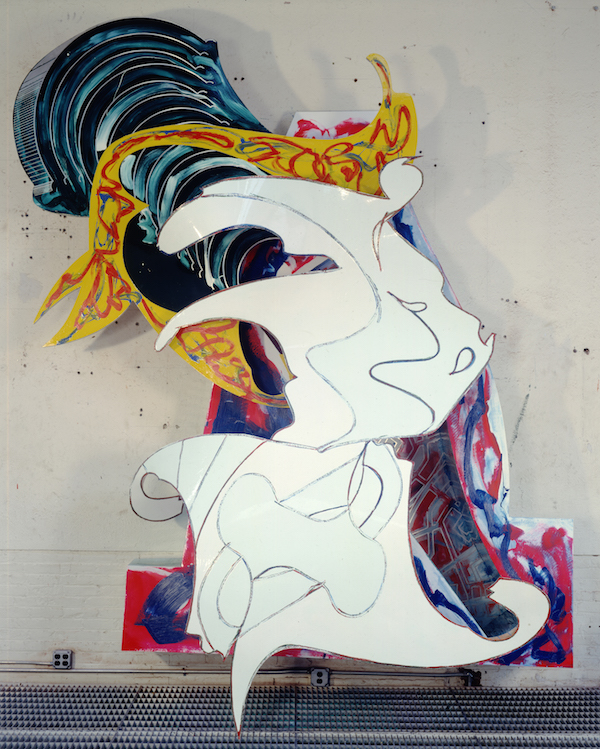
Frank Stella. The Whiteness of the Whale (IRS-1, 2X), 1987; paint on aluminum; 149 x 121 3/4 x 45 1/4 in. Private collection. © 2015 Frank Stella/Artists Rights Society (ARS), New York. Photograph by Steven Sloman.
To combat photography’s encroachment into the realm of pictorial representation, Stella’s paintings asserted their nature as objects by opposing the flatness and indexical specificity of photography. The intrusion of his wall-hung works into the gallery space is a common theme in the exhibition, beginning with his early paintings that employ deeper stretchers than most. Works like Gobba, Zoppa e Collotorto (1985) continue this venture into space, projecting various two-dimensional elements into the viewer’s physical space. In more recent works, Stella extends his paintings outward until they are no longer wall-based, evidenced in the freestanding Black Star (2014).
In asserting painting’s efficacy as a medium, Stella’s recent work also cannibalizes several technologies directly from photography and digital reproduction. His newer working methods include using digital software to create virtual models of works, from which some of his three-dimensional works are manufactured. Stella’s trials with screenprinting are also reflected in the exhibition, with the exquisite Schwarze Weisheit (2000) series of lithographs on view. His Das Erdbeben in Chili [N#3] (1999) also shows digitally rendered smoke rings, transferred to the canvas by hand.
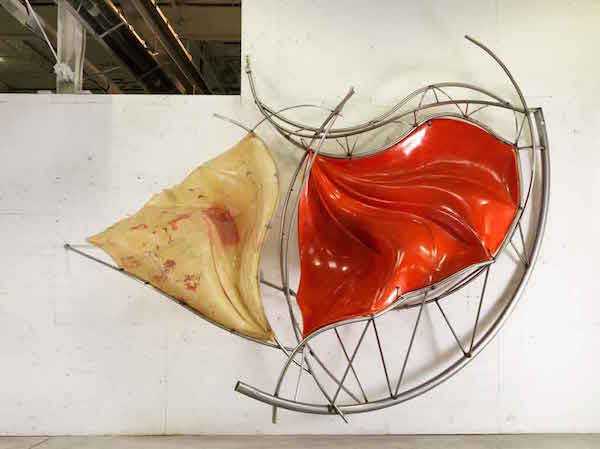
Frank Stella. Redjang, 2009; fiberglass with stainless steel tubing; 155 x 212 x 64 in. (393.7 x 538.5 x 162.6 cm). Private collection. © 2015 Frank Stella/Artists Rights Society (ARS), New York.
The show also offers his experiments with three-dimensional printing, seen in his Circus of Pure Feeling for Malevich, 4 Square Circus, 16 parts (2009), which consists of four wooden tables with a variety of small, rapid-prototyped objects. His K.81 Combo and similar K.37 (both 2008) are monumental explorations of three-dimensional printing. These works consist of a series of printed, brightly colored forms held in place by stainless-steel tubing—a support system that also becomes part of the work, referencing the dialectic between image and object broached by his earliest works. The use of three-dimensional printing bolsters the medium of painting, allowing it to exist as a photograph-like iteration of a single virtual model.
The final gallery of the exhibition, with its juxtaposition of K.81 Combo and Yugatan (1958)—two seemingly disparate works—points to its careful curatorial sensibility. The show’s curators—Michael Auping, with Adam D. Weinberg and Carrie Springer—eschewed a chronological installation for a more thematic one that better contextualizes Stella’s five-decade journey from Yugatan to K.81 Combo. The exhibition characterizes Stella not as a painter wed to a time period or style but as an astute artist who is always aware of the challenges threatening painting and the necessary efforts to push it forward.
Frank Stella: A Retrospective is on view at the Whitney Museum of American Art through February 7, 2016.
[1] Douglas Crimp, “The End of Painting,” October 16 (Spring 1981), 82.
[2] Crimp, 83.





