







San Francisco
Chris Johanson: Equations at Altman Siegel
Today from our partners at Art Practical, we bring you Brian Karl’s review of Equations at Altman Siegel Gallery in San Francisco. The author notes, “Johanson eschews in this set of paintings the strategy of inserting text directly into the worlds he creates. The titles of the pieces do some of that work.” This article was originally published on November 30, 2015.
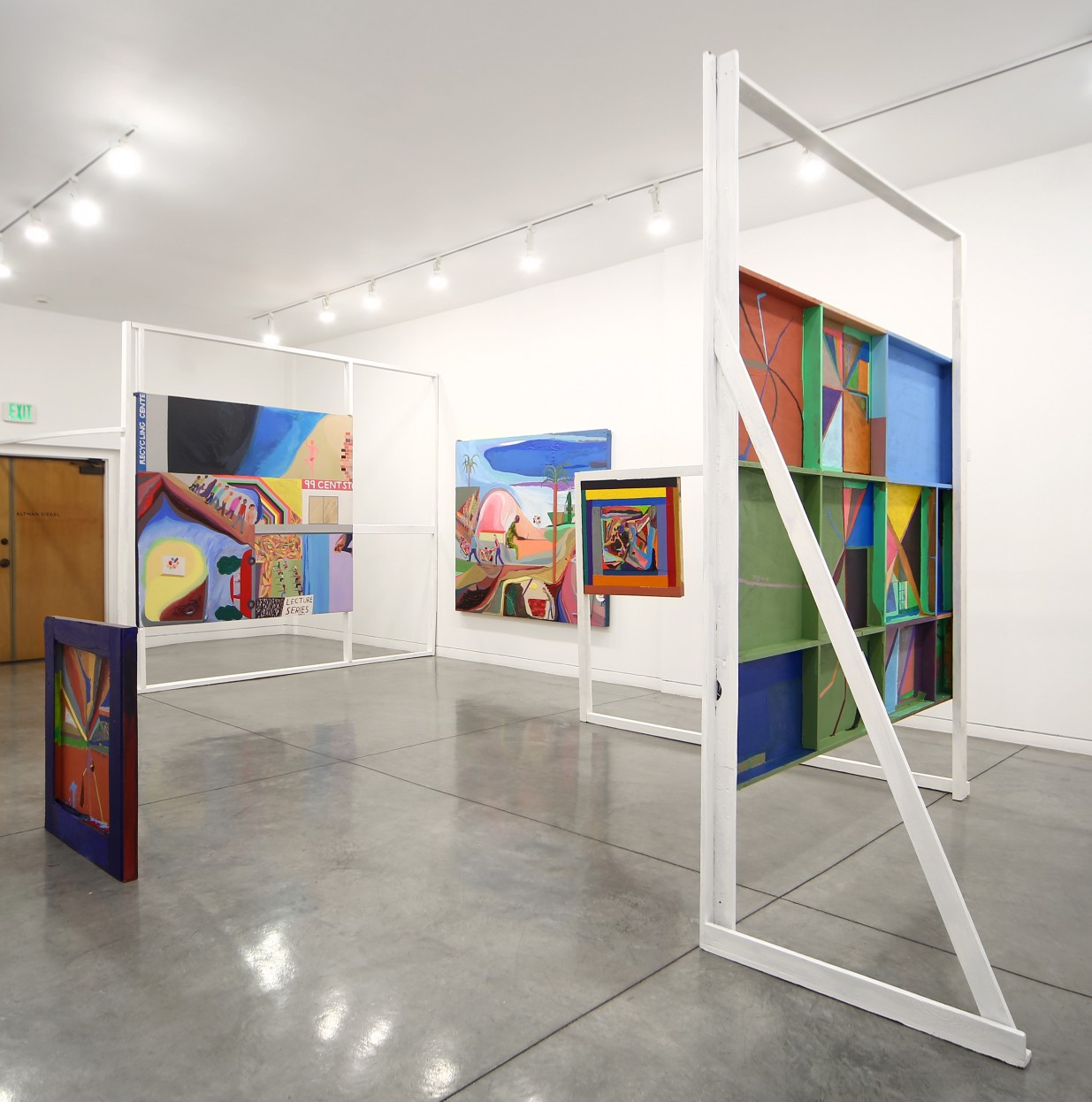
Chris Johanson. Equations; installation view, 2015. Courtesy of the Artist and Altman Siegel.
In this exhibition of ten new works (all 2015) of varying dimensions painted in acrylic on found wood, Chris Johanson represents a series of scenes imbued with psychologically charged if ambiguous atmospheres that depict alienation—with more than a few signs of human yearning—mostly in a small range of contemporary settings. Never showing as a technically “fine” painter, Johanson continues a sketchy pursuit of different genres that include abstraction, as with Reimagining the Square Trying to Make it Round Like a Circle; landscapes of sorts, as in I Am in My Body Again, an exterior view of a suburban ranch home, with gold clouds thickly painted above; interiors, both inside and outside in Infinity; and unrealistically rendered human figures, usually abject in posture or attitude and dwarfed by their surrounding milieu, populating the majority of the pieces here. Though set in apparently sunny climes, and moving through a shared landscape, these figures ultimately all seem to struggle—sometimes bowed singly, others marching in imprecise file—in conditions of great anomie if not outright isolation. Technology features in more than one of these paintings, but mostly as a tantalizing, failed possibility, or, worse, a breeder of even greater awareness of isolation.
Given the cartoonlike basis of most of his portrayals, the slackerly compositions, and the seeming arbitrariness of the surface textures of the paint he uses so dynamically as a set of color choices (seemingly clumsy elements that have often been similarly deployed by other artists who might pass as “outsider,” however relative that term might be), the question arises as to why Johanson chooses to so often paint rather than draw. In these pieces Johanson doubles down on painting in several ways: first, through the large scale of several of the scenes, as with Lecture Series/Abstract Mass, and the bleak consumer composite suburbia of Los Angeles with Pills. Johanson paints on repurposed wood panels and displays most of his work in awkward, large, built wooden armatures to show off both fronts and backs equally (as he has done even more elaborately in installations elsewhere). This prominently shows off the wooden buttressing behind the panels, which he also highlights with “secondary” paintings on the reverse. These include what look like a series of painted geometric doodles mosaic’d on the back of one larger composition, a simple set of color fields of darker and lighter brown parceled out by the different wood elements themselves, and what looks like a beginning painted sketch of an abstract landscape not so dissimilar to what might show up elsewhere as just one among many background components in a “primary” or finished painting by Johanson on the front of one of his panels.





