







Savannah
Manjunath Kamath: As Far As I Know at the SCAD Museum of Art
Four seemingly disparate kinds of artwork make up the exhibition Manjunath Kamath: As Far As I Know, currently on view at the Savannah College of Art and Design Museum of Art in Savannah, Georgia. Quiet paintings in glittering hues hang on three of the walls in the gallery; two groups of tiny, framed drawings and a large-scale digital print are installed among them. There is also a sprawling sculptural installation consisting of an upside-down, miniature car with an elaborately extended tailpipe that beckons a large group of fiberglass rabbits, curious to investigate it.
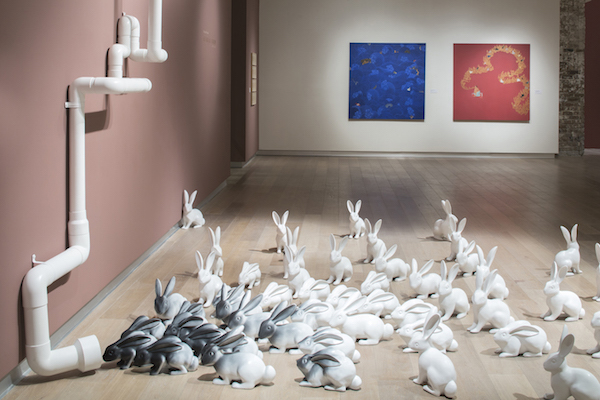
Manjunath Kamath. As Far As I Know, 2015; installation view, Savanna College of Art and Design Museum of Art, Savannah, Georgia. Courtesy of the SCAD Museum of Art.
Perhaps the rabbits can offer visitors a bit of advice: When in a gallery of Kamath’s work, approach the diverse group with open and inquisitive minds. Kamath’s works offer very little in terms of clues to the ideas and questions he is exploring. Though they are visually scintillating, his works provoke contemplative attitudes and allow visitors to project their own narratives onto them.
Dominating the gallery, the sculptural installation Second Hand Car Goes to Heaven (2009) sets the tone for the rest of the show with its humor and its openness to interpretation. The car—similar in form to a Volkswagen Beetle—hangs near the gallery’s ceiling and has been painted white. The tailpipe of the car extends haphazardly down the wall through a series of elbow joints, and the diameter of the pipe becomes larger as it descends. The end of the tailpipe is at floor level, and the aforementioned group of about thirty-five white rabbits poses pensively on the gallery floor. A few rabbits closest to the opening of the tailpipe are dusted with black, presumably from the car’s exhaust.
The humorous pathos in the work is readily apparent, from the rabbits’ curiosity exposing them to deadly exhaust to a car dying and ascending to heaven. Beyond such humor, the work touches on topics from religion to reincarnation, commercialism to environmentalism. But the work’s pure-white finish helps it to evade any distinct message; instead, the work’s components function as markers that can accept various meanings.
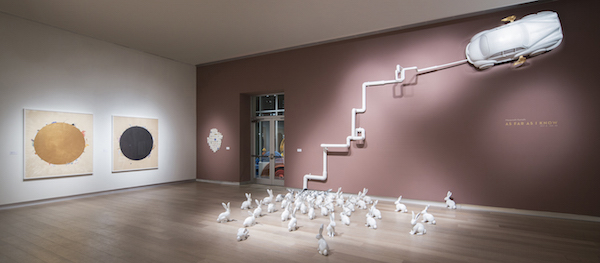
Manjunath Kamath. As Far As I Know, 2015; installation view, Savanna College of Art and Design Museum of Art, Savannah, Georgia. Courtesy of the SCAD Museum of Art.
Such openness in terms of meaning is also apparent in Kamath’s paintings. A highlight of the exhibition, the large triptych Customised Kalpavruksha (2014) stands on the wall opposite Second Hand Car. Measuring fifteen feet wide and nearly eight feet tall, the painting portrays a peculiar version of a Kalpavruksha, which is the “wish-fulfilling tree of life, first mentioned in the Rig Veda,” a sacred text in Hinduism.[1] Kamath’s tree consists of a few lengthy branches fastened together in an arc—one branch even seemingly grows from a bathroom sink. Attached to the branches are various items from everyday life, including paintbrushes, a soccer ball, shoes, and a globe. What is seemingly a divine tree that symbolizes prosperity now provides familiar consumer items.
The painting is composed of three vertically oriented canvases, and each part is an ostensible reference to Ad Reinhardt’s Abstract Paintings of the 1960s. Each canvas in Kamath’s triptych features a background grid of large blocks in various hues of gold leaf, similar in format to Reinhardt’s typically somber-hued works. Reinhardt’s works have a universal, transcendent quality—one that asks for contemplation from its viewer. Despite the very different palette, Kamath’s work has a similar function, and he adeptly links Abstract Expressionism—a period of Western art history notable for its explorations of Eastern schools of thought like Zen Buddhism—with his personal knowledge of traditional Hinduism.
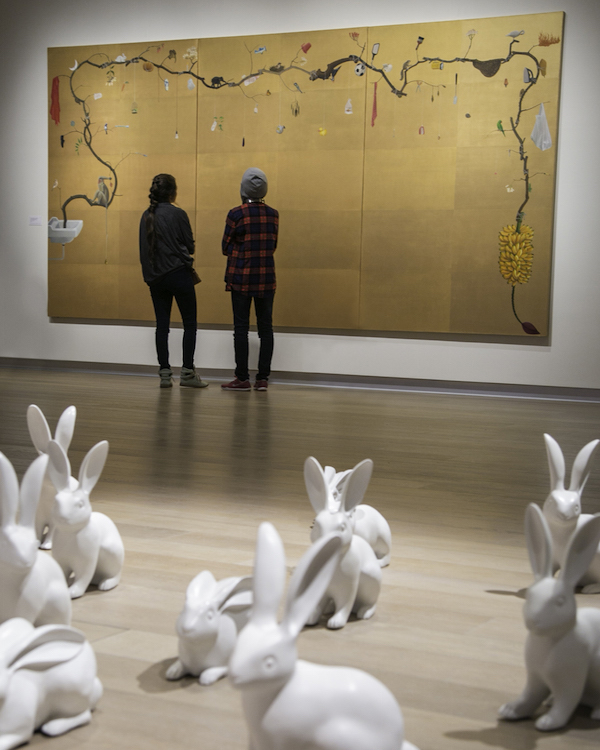
Manjunath Kamath. As Far As I Know, 2015; installation view, Savanna College of Art and Design Museum of Art, Savannah, Georgia. Courtesy of the SCAD Museum of Art.
Kamath’s other paintings on view are similar to Customised Kalpavruksha. The glittering backgrounds of Artist Swallowing Golden Fire and Personal Sea (both 2015) evoke a comparable openness to meaning. Personal Sea consists of a background pattern of rich-blue aquatic waves; the painter’s likeness appears throughout the painting, peeking from various swells. The vivid red background of Artist Swallowing Golden Fire creates a space for a self-portrait to perform the work’s titular task.
The exhibition also includes a digital print, Yes It’s All Mine (2011), a comical amalgamation of everyday items stacked high and secured to the back of toy horse with lengths of rope. The items include quotidian objects such as pillows, furniture, and potted plants; the conversion of these items into art subjects is obvious, given the inclusion of Duchamp’s infamous readymade urinal in the stack of items.
With the Duchamp reference as well as inclusions of paintbrushes in Customised Kalpavruksha, Kamath is eager to remind the viewer of his toil as an artist, one that insists on engaging diverse forms of media. This exhibition shows that whatever Kamath may create, whether a glittery painting or a fiberglass sculpture, underlying concepts of humor and generosity pervade each work.
Manjunath Kamath: As Far As I Know is on view at the SCAD Museum of Art through January 30, 2016.
[1] Nanditha Krishna, Sacred Plants of India, (London: Penguin, 2014), 49.





