







Fan Mail
Fan Mail: Eric G. C. Weets
For Eric G. C. Weets, size does matter. Since 2007 he has been creating sprawling canvases of intertwined line drawings in his studio in Pune, India, where the Belgian artist has lived for the past twenty-three years. In searching for a means to document human experience through form, Weets discovered in scale a conceptual and practical mechanism that served his desire for an expansive, albeit laborious, mode of expression. With the help of his partner and representative, Filomina Pawar, who is instrumental in the production and management of Weets’ work, the artist has created a series of large-scale paintings that explore expressions of human civilization across time.
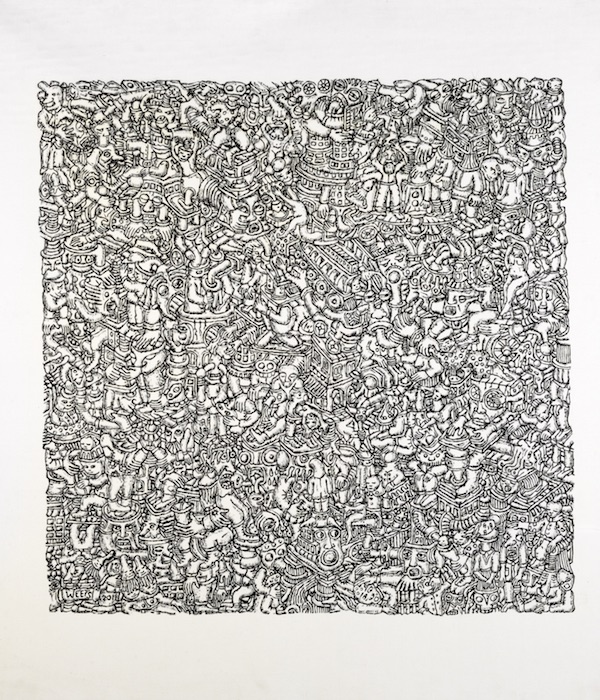
Eric G. C. Weets. The Journey I, 2011; oil on canvas; 30 x 30 in. Courtesy of the Artist.
Weets describes his first visit to a South Indian Hindu temple in Madras in 1987 as having had a lasting impact on his work almost three decades on. On the large, looming walls covered in countless sculptures and figures depicting stories of gods from thousands of years past, Weets confronted the passage of time. Experiencing this in a single physical space intended to house humankind’s journey became an idea that Weets struggled to encapsulate in his own work. As a self-taught artist who experiments with multimedia projects ranging from sculpture to electronic music, Weets’ first engagement with the type of freestyle painting that is now a focus of his practice emerged from his desire to express the subconscious. The artist speaks of an obsession to develop a mechanism that would enable him to create work uninterrupted by thought. As a strategy, he devoted himself to penning whatever crossed his mind upon contact with the canvas and slowly building on the lines that emerged without a set plan or preconceived vision. Weets also never erases or attempts to “fix” any of the constellations that unfold. In this process, Weets sought and found unrestrained creative freedom.
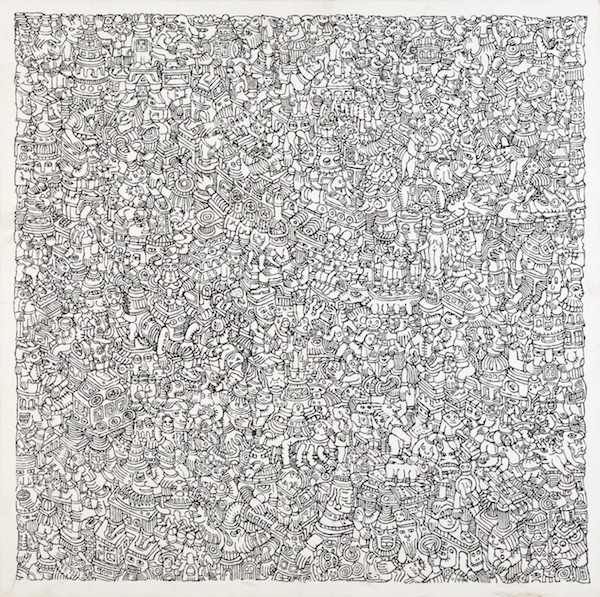
Eric G. C. Weets. Painting Number 10 – Without The Greens II, 2010; oil on canvas; 25.6 x 26 in. Courtesy of the Artist.
At the core of these ornate, large-scale drawings lies an impulse to depict the interconnectedness of the human experience as it transcends time and place. He compares his creative impulse to that of early human recordings of daily life through wall etchings, and one could argue that Weets’ paintings are perhaps contemporary chronicles of human civilization in all of its glories and failures. In Without the Greens II (2010), an amalgamation of robotic and mythical-looking illustrations overlap and collide, seemingly woven with no beginning or end. In this kaleidoscope of imagery, vignettes of progress inspired by the advances of science and technology are contrasted by displays of human aggression and debasement, with hands actively pushing bodies down or, in other instances, an array of necks in chokeholds.
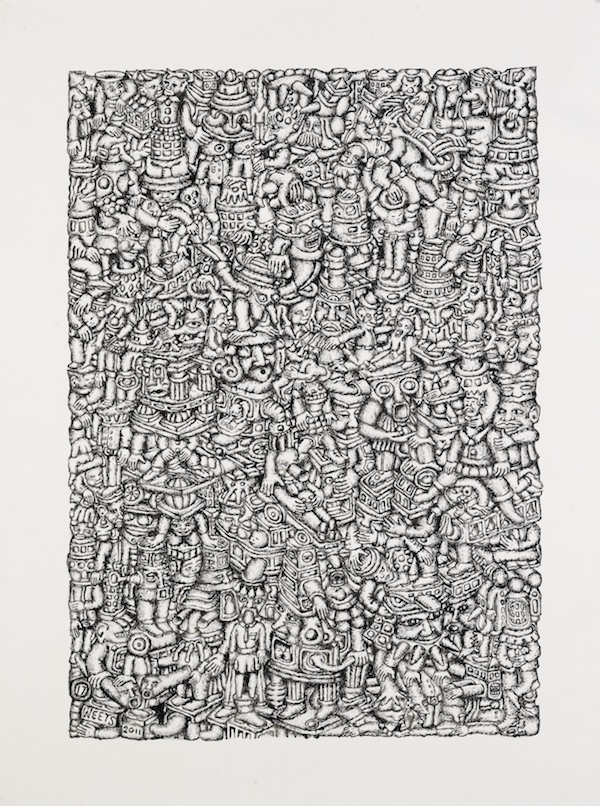
Eric G. C. Weets. Painting Number 17 – An Ongoing Tale, 2011; oil on canvas; 33.4 x 23.6 in. Courtesy of the Artist.
Simultaneously overwhelming and compelling, the breadth and complexity of detail involved in Weets’ paintings are far from static depictions of inner thoughts and frames of reference—they are active fields of the artist’s imagination. Heavily populated, expansive paintings require the viewer to move in order to process the work’s depth, action that the artist intends to evoke travel as a mode for knowledge acquisition. For Weets, perhaps in recognition of his own journey from his birthplace in Belgium to his home of choice in India, compelling the viewer to “travel” within the painting becomes essential to activating the work.
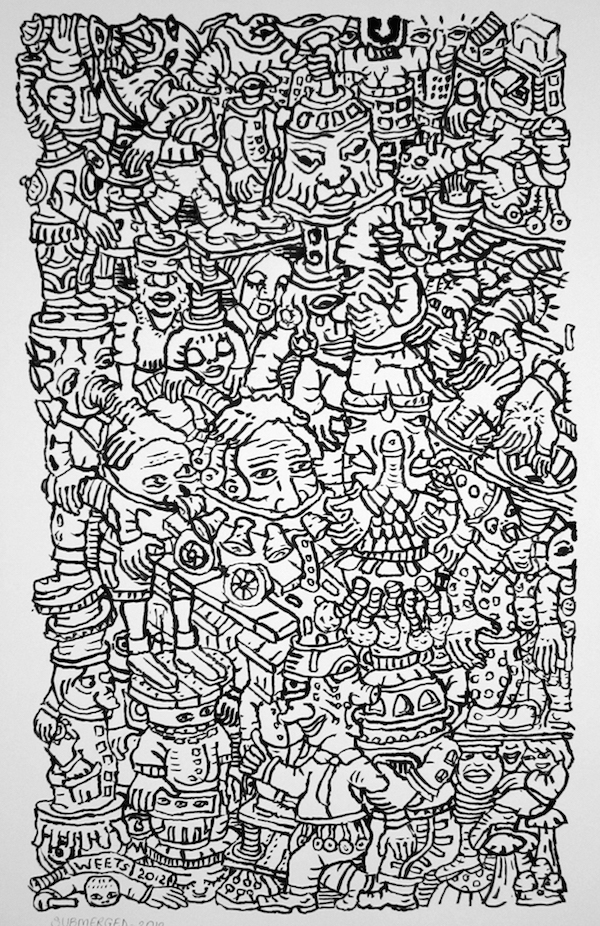
Eric G. C. Weets. Submerged, 2012; black ink on paper; 17.3 x 10.2 in. Courtesy of the Artist.
In recent years, cataracts in his eyes have severely impacted Weets’ vision and subsequently his ability to draw. As a result, he reduced the level of detail for his paintings; though they’re still large in scale in many cases, his illustrations have become more legible from a distance. Though the sentiment of concurrent despair and awe for human civilization persists, works such as Submerged (2012) and Looking Around (2013) show the transition of Weets’ paintings from panoramic sweeps to more contained frames. For Weets, ultimately it is the process of creation that draws him back to the canvas despite his ailing health, describing it as a way of giving life to that which he cannot express in words. In this subliminal plane of subconscious thought, Weets comes to an esoteric comprehension of the world. In translating this mental state onto painting, the artist opens up a space in which viewers can also tap into their own reflections and frames of reference, underscoring the notion of the singular experience giving life to the plural. In this way, Weets’ paintings are perhaps a reenactment of this earth we inhabit, the vastness of our collective experiences connected by our shared geography.
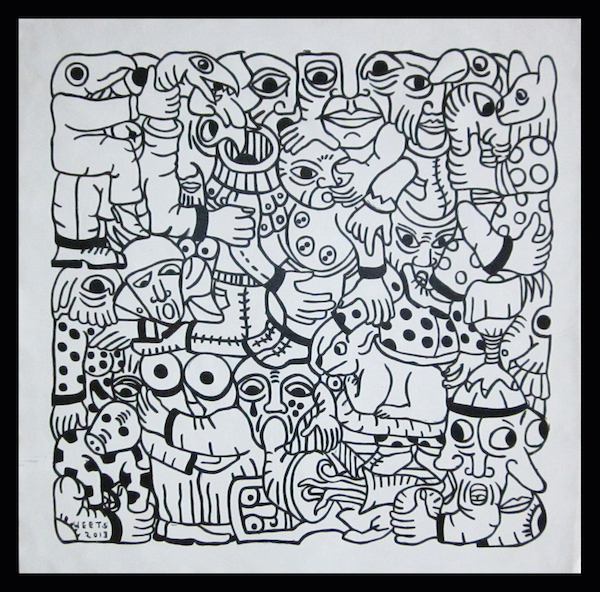
Eric G. C. Weets. Looking Around, 2013; oil on canvas; 31.1 x 31.1 in. Courtesy of the Artist.
Born in Belgium in 1951, Eric G. C. Weets was trained as a diamond cutter but eked out a living doing odd jobs to sustain his growing interest in painting and in jazz and, later, in electronic music. He traveled to the Philippines, eventually settling in India, where he met Filomina Pawar, who represents him to a world from which he has increasingly withdrawn. Weets currently lives in Pune, India.





