







Washington, D.C.
Black Box: Sergio Caballero at the Hirshhorn Museum
Sergio Caballero combines grotesque materials, low-budget techniques, and a healthy dose of dark humor in his film Ancha La Castilla or N’importe Quoi (2014). Ancha La Castilla is the latest iteration of Black Box, a series dedicated to moving-image works at the Hirshhorn Museum in Washington, D.C. The twenty-five-minute film tells the tale of a young girl named Alegría as she becomes possessed and thus in need of an exorcism. With its main characters appearing both as puppets and as costumed actors, the film is emblematic of Caballero’s experimental yet playful style.

Sergio Caballero. Ancha La Castilla or N’importe quoi, 2014 (video still); digital video; 24:00. Courtesy of the Artist and Smithsonian’s Hirshhorn Museum and Sculpture Garden.
Ancha La Castilla begins with a scene that perfectly characterizes the filmmaker’s absurdist style and wry humor. Seen as a live actor in a large, potato-like papier-mâché costume, Alegría’s mother laboriously pours green goo (coffee) from a moka pot into a cardboard carafe, only to haphazardly spill much of it on the floor. Bringing what dregs of coffee made it into her carafe, the mother—now appearing as a gnarly puppet consisting of an actual potato—remarks to her child, “It’s a harmonious day without limits,” and “The petunias sing of love.” This grating optimism contrasts with the grotesque appearance of the characters, assembled with blobs of plaster, hair, and other materials, and the bleak setting of their desolate, poorly lit abode, strewn with trash.
Following her mother’s cheery remarks, Alegría is promptly possessed in a chaotic, strobe-lit scene. Johann Sebastian Bach’s Jesu, Joy of Man’s Desiring plays gleefully in the background, clashing with the distinct barking of a demonic voice. Such jarring sonic contrasts recur throughout the film, often with airy melodies such as Edvard Grieg’s Morning Mood alternating with furiously pulsating synths by electronic duo EVOL.
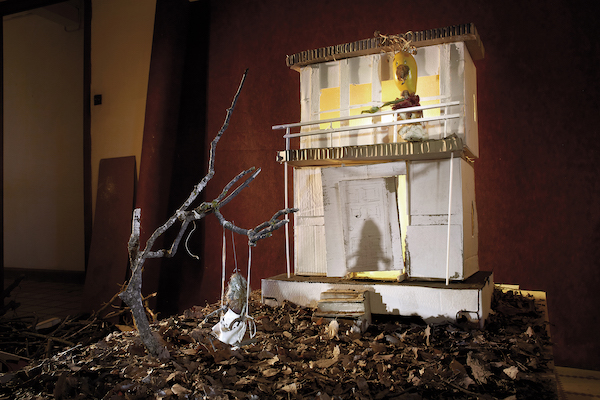
Sergio Caballero. Ancha La Castilla or N’importe quoi, 2014 (video still); digital video; 24:00. Courtesy of the Artist and Smithsonian’s Hirshhorn Museum and Sculpture Garden.
Once Alegría’s parents discover their daughter has been possessed, they seek out several options to cure her. They travel to consult with Father Angelico in the mountains and attempt to communicate with Alegría’s late grandmother, who was also once possessed, in Hell. After traveling far and wide, the parents finally learn that Alegría must be cured by a voodoo priest in the Danakil Desert in Africa, and they make the long trek to find him.
While the plot is amusing—and possibly a tongue-in-cheek response to popular exorcist films—the stylistic and structural qualities make Caballero’s film stand out, giving the work a similar feel to low-budget B movies or film-school projects. The work’s willingness to undermine its status as a conventional film is particularly notable. For a good portion of the film, the characters appear in the form of puppets, but occasionally they are played by human actors wearing giant papier-mâché costumes. Similarly, the film often reveals the constructions of its sets, challenging the highly-polished nature of Hollywood films. Frequently, when the puppets are used in a scene, the camera is zoomed out to reveal the set—often, a tabletop with studio lights—within the studio. Many of the puppetry sets consist of cardboard floors with slashes cut through them, showing the only possible paths for the stick puppets to travel. When the characters embark on a journey to the mountains, for instance, Caballero films the puppets proceeding past obvious printed photographs of different landscapes.
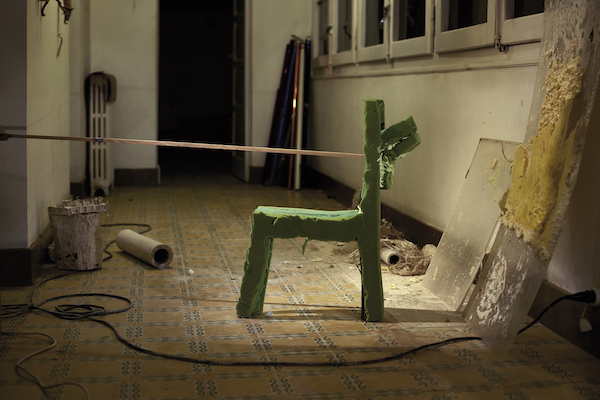
Sergio Caballero. Ancha La Castilla or N’importe quoi, 2014 (video still); digital video; 24:00. Courtesy of the Artist and Smithsonian’s Hirshhorn Museum and Sculpture Garden.
Humor plays a large role in the film, ranging from Chaplin-like slapstick to topical one-liners. Such humor is apparent from the outset in the first scene when the mother brews the coffee. Caballero’s unique humor manifests throughout the film in his portrayal of characters. The family dog, who tears up the house during the family’s sojourn to Africa, is depicted as a dog-shaped piece of foam on a long stick. Caballero also uses dialogue for humor. When the mother asks how the father knows it was Beelzebub who possessed Alegría, he responds, “WikiLeaks!” Caballero’s humor reinforces the work’s status, giving his film a jocular quality that much of contemporary film lacks.
The characters—at least, in puppet form—are jumbles of plaster, hair, rotting food, and other materials, cobbled together into sculptural figures that reference the work of Spanish painters from Goya to Picasso. The grotesque quality of the film reaches absurd levels. For instance, when the mother communicates with the dead grandmother, Hell is depicted as a smoldering cesspool of rotting flesh.
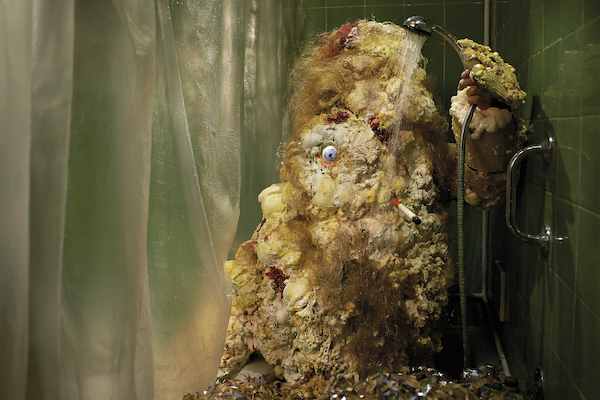
Sergio Caballero. Ancha La Castilla or N’importe quoi, 2014 (video still); digital video; 24:00. Courtesy of the Artist and Smithsonian’s Hirshhorn Museum and Sculpture Garden.
At the end of the film, after Alegría is cured of her possession in a rather anticlimactic fashion, she remarks that the only thing she wants now is “3,000 Euros and a video camera.” Quite likely a reference to the actual budget of Ancha La Castilla, Caballero’s film takes the low production values of B movies to the extreme. Combined with humor and an unforgettable level of the grotesque, Ancha La Castilla is an immensely enjoyable experiment in filmmaking.
Black Box: Sergio Caballero is on view at the Hirshhorn Museum in Washington, D.C., through January 3, 2016.





