







Los Angeles
UH-OH: Frances Stark 1991-2015 at the Hammer Museum
In a mid-career survey as large as UH-OH: Frances Stark 1991–2015, on view at the Hammer Museum, I’m usually tempted to rush over a couple of galleries and maybe even skip a video here or there. From the get-go, Stark’s exhibition, featuring 125 drawings, collages, paintings, and video installations, had me enthralled with My Best Thing (2011), a 100-minute-long episodic animation based on the artist’s video chats with two separate Italian suitors. Using a text-to-speech program, Stark projects her conversations onto semi-clothed toylike avatars floating among a bright green background. With discussions ranging from cybersex (and intermittent exclamations of “mmmmm” and “omg”) to David Foster Wallace’s Infinite Jest, My Best Thing is an endearing video that is sometimes eerie, sometimes erotic, and often hilarious.
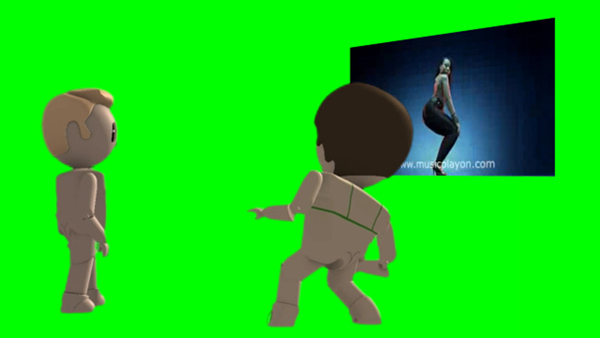
Frances Stark. My Best Thing, 2011 (digital video still); digital video, color, sound; 1:00:00. Courtesy of Gavin Brown’s enterprise, New York.
Stark’s artwork can’t be categorized easily or neatly. Each iteration of her practice looks different from the last. She engages multiple mediums, grappling through the history of literature, art, and philosophy to find new ways of figuring a wide array of subject matter, including such disparate ideas as procrastination, masturbation, poetry, pedagogy, motherhood, and more. In Frances Stark’s artwork, all topics—the banal, the deeply personal, the intellectually rigorous—are fair game. In her process, all of these concerns become conflated, or perhaps they start out that way: mixed and inextricably linked.

Frances Stark. Bobby Jesus’s Alma Mater b/w Reading the Book of David and/or Paying Attention Is Free, 2013; multichannel projection with sound, inkjet mural, and takeaway offset posters; 7:20; installation view, Carnegie International, 2013. Courtesy of Marc Foxx Gallery, Los Angeles. Photo: Brian Conley.
In the video installation Bobby Jesus’s Alma Mater b/w Reading the Book of David and/or Paying Attention Is Free (2013), stacks of polemical takeaways attacking conceptions of success in relation to art history, Christianity, her son’s love of hip-hop music, and the U.S. prison and education systems all appear on a perspectively infinite checkerboard plane. Stark created the installation around the time when the University of Southern California’s Roski School of Art and Design was swallowed by Dr. Dre and Jimmy Iovine’s Academy of Arts, Technology, and the Business of Innovation. Stark eventually left her tenured position at Roski. Bobby Jesus’s Alma Mater is a furiously successful installation, presenting an equalized mapping of various forms of knowledge in a critique of the conceptual trappings of class, race, corporatism, and pedagogy.
Experiments in ways of reading and writing reappear throughout Stark’s career and within the exhibition. An early work, The Love Song of J. Alfred Prufrock (1993), is a tracing of T.S. Eliot’s poem from a used book, complete with scrawled marginalia from a previous owner. In Stark’s carbon copy, scribbles of “Eliot quotes Eliot,” “unpoetic,” and “always ends with a question” appear among other didactic reminders and roadmaps for reading this difficult text. In the works My Best Thing (2011), Nothing Is Enough (2012), and Osservate, Leggete Con Me (2012), online sex chats become the raw material for a collaborative form of storytelling, as recurring characters gain depth over time through exposure and incorporation into Stark’s process. The pianist scoring Nothing Is Enough (2012), a silent film continuing Stark’s sex-chat narrative, is one of the characters who populates My Best Thing (2011).
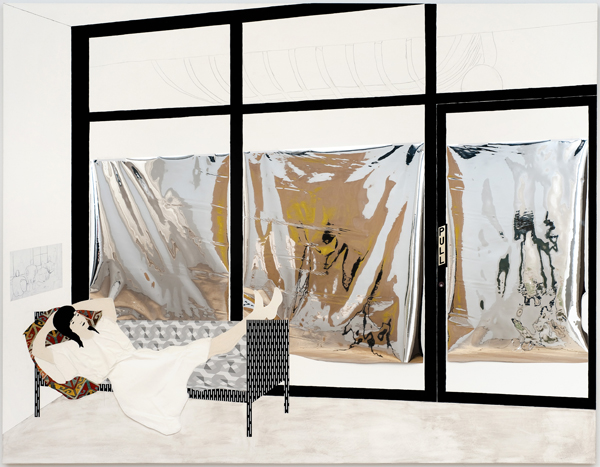
Frances Stark. Pull After “Push,” 2010; mixed media on canvas on panel; 69 x 89 in. Collection of Nancy and Joachim Bechtle. Courtesy of greengrassi, London. Photo: Robert Wedemeyer.
Stark refigures text as shape, form, and landscape in many of her delicate drawings. Words and quotes, often lifted from famous texts, are written and rewritten vertically—rather than horizontally—on diaphanous papers and iridescent tissue, and strung up together with tape. The tiny type is recognizable only as legible characters upon closer inspection, and even then, it takes some recalibration of the mind and eye to read the text that has been stacked and blocked through Stark’s methodology. In another textual turn, autobiography figures into many of Stark’s works, where the artist’s junk mail has been cut up, repurposed, and shaped into elements within her collages. In these surprising digestions of Stark’s everyday life, her name and address remain readable.
Visual and spatial punning and wordplay reveal themselves to the close reader through the structure of the exhibition itself, organized by curator Ali Subotnick in close collaboration with Stark. Without ruining them all, in one corner of the gallery—reading from left to right—a reclining Stark in Pull After “Push” (2010) looks towards a door that opens into Push After “Pull After Push” (2010), which is hung to the left of one of the Hammer’s emergency exits. And to the right of that? A piece titled Emergency Exit (2009). In the same space, a viewer can align their body in relation to the reclining image of Stark in Pull After “Push” (2010) and look back out toward the gallery to face the swirling dresses in each of Stark’s Chorus pieces. Moments like these make UH-OH a fantastically engaging and playful experience.
UH-OH: Frances Stark 1991–2015 is on view at the Hammer Museum through January 24, 2016.
This article is made possible by our Writers Fund, thanks to readers like you. Help us keep it going!





