







Madison
Natasha Nicholson: The Artist in Her Museum at the Madison Museum of Contemporary Art
If the test for the quality of an exhibition is the richness of associations it generates in a viewer, then Natasha Nicholson: The Artist in Her Museum at the Madison Museum of Contemporary Art is a goldmine. The show is installed in the museum as a series of rooms, facsimiles of the artist’s studio: the Thinking Room, Strata (the studio and gallery), the Studiolo (library and Cabinet of Curiosities), and the Bead Room (workshop for jewelry making). I had previously visited the artist’s studio and was interested to see how the intensity of the small spaces might translate into the cool formality of a public institution. It has worked well, although the serpentine journey through Nicholson’s home studio cannot be duplicated by a series of ramps and paths. The exoticism and strangeness is diminished somewhat in a museum setting, where art lovers often encounter the strange, the challenging, and the beautiful. What shines at MMoCA is Nicholson’s exquisite craft, her symbolic vision, and the unerring and jarring conjunctions of her objects.

Natasha Nicholson. Studiolo, 2015; installation view, Nicholson studio. Courtesy of the Artist and Madison Museum of Contemporary Art. Photo: Mike Rebholz.
The imagery and its explication are grounded in Nicholson’s biography, and unsavory events from a remote childhood are given form again and again. The desire to control the past—a child’s frustrated desire to control anything in the world of adults—is reshaped in fantasy. Nicholson’s world is best entered as a dream in toto, with its walls and shelves studded with treasures. In deference to museum protocol, Nicholson created wall labels, with dates and titles for each assemblage. Viewers might search these texts for clues to meaning, but in doing so they would also lose the mystery present when the objects are first seen de novo in the artist’s storefront.
The Studiolo is the most densely packed of the rooms, with the artist’s library, walls of devotional objects, the Cabinet of Curiosities, and two antique clocks that bring audible time (and a heartbeat) to the exhibition space. One wall features a plaster board with an antique three-dimensional instructional model of human organs, ostensibly intended for medical education. It is accompanied on nearby shelves by spinal columns, skulls, and hands. The skeleton is “disarticulated”; each piece is viewed in its separateness, or juxtaposed with an unexpected partner—a painting, a ribbon, a photo. Crucifixes and votive objects, which Nicholson has crafted, heighten the sense of memento mori. Nicholson created the Cabinet of Curiosities for a previous show in 2000 [1], and one might think of it as her own “corpus,” a stand-in for the body in her body of work. Closed, it is an armoire of modest proportions, but with its “arms” open, it reveals astonishing vignettes on every shelf.
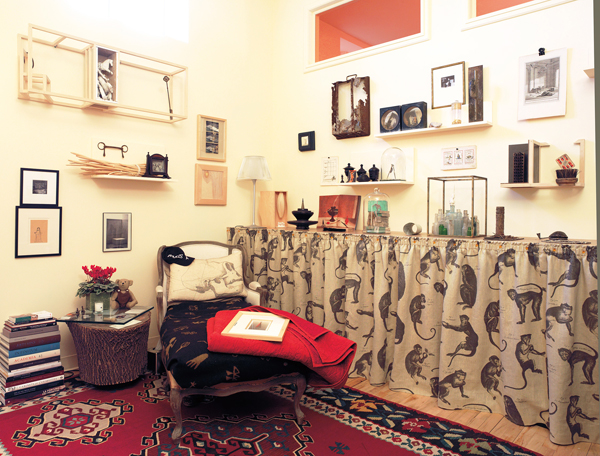
Natasha Nicholson. The Thinking Room, 2015; installation view, Nicholson studio. Courtesy of the Artist and Madison Museum of Contemporary Art. Photo: Eric Ferguson.
In the quiet of the Thinking Room, where the artist can recline on her elegant chaise to contemplate the assembled objects, the spirit of Giorgio Morandi holds sway. A poster and postcard of his work are prominent, as are his methods. Morandi was a master at creating a sense of “stillness” by juxtaposing simple objects in tight compositions, theatrically staged and dramatically lit. Nicholson’s arrangements, and her attention to lighting and careful presentation, bear witness to his influence.
Chairs abound in Nicholson’s creations: tiny antique found chairs; doll-sized chairs; children’s chairs of wood and metal, twigs, and branches; oversized straight-backed chairs. In an early work, For T.H.G. (1978), three small, squat chairs are placed in a miniature house with three chambers. One is loosely bound with linen tape, another is leg-deep in the clippings of the artist’s coppery hair; the chairs read as figures.
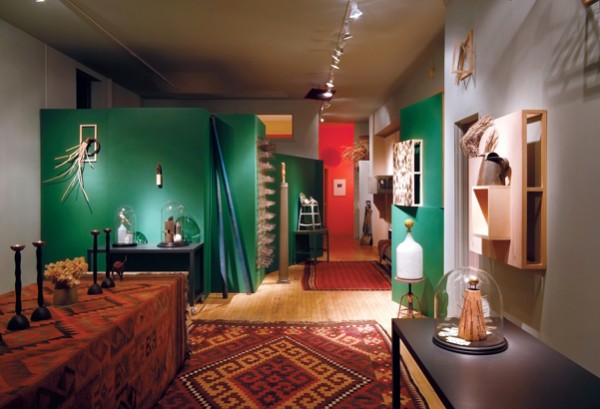
Natasha Nicholson. Strata, 2015; installation view, Nicholson studio. Courtesy of the Artist and Madison Museum of Contemporary Art. Photo: Eric Ferguson.
Human voices are represented by peeled, bleached, and forked twigs, gathered into bundles, that protrude from the mouths of pitchers, beakers, and brass horns. They imply “I’m not allowed to speak, so I will invent a secret language. And with it, I will shout.” A single funnel dusted with powdered ground rubies is suggestive of vaginas and mouths.
Color in Nicholson’s work is deliberate and important. Cardinal reds are prominent, and the walls of Strata are painted a deep green—a rich foil for the rusty iron of old bedsprings, in Voyeur (2002), and the coiled bundles of crimped fencing in Fence (2002). Nicholson’s Cabinet of Curiosities and the shelves in the Studiolo are painted a light, soft green.
Nicholson’s love of materials is highlighted in the Bead Room, the jewelry studio where one pictures the artist seated before her boxes, selecting, arranging, hammering, twisting, pinching, and combining. Strands resemble frog spawn, oversized ornamental breast plates, and delicate dangling bronze hands; the themes present in her sculptural installations—the body, color, transparency, exotic origin, and layered history—are present in her beadwork.
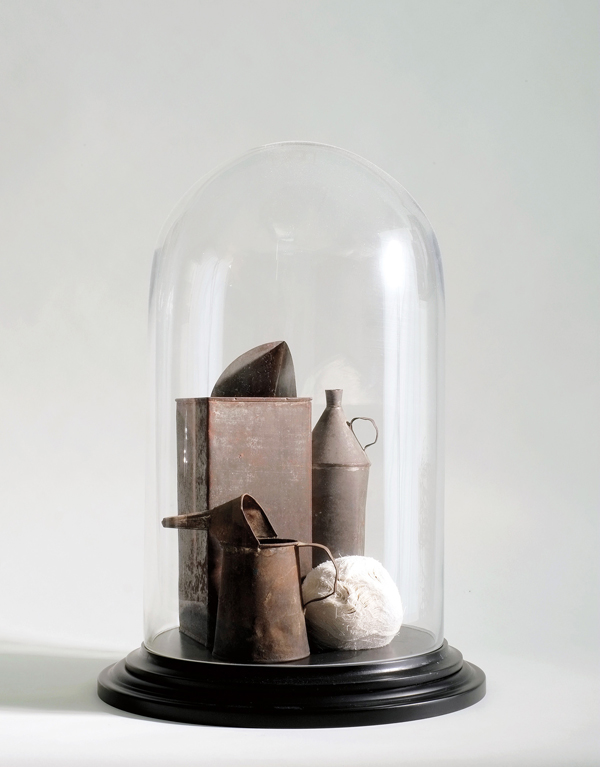
Natasha Nicholson. Vessels, 2011; glass, tin, fiber. Courtesy of the Artist and Madison Museum of Contemporary Art, Madison. Photo: Eric Ferguson.
Inevitably, a comparison could be made to the work of Joseph Cornell, the inveterate collector who invested modest objects with narrative magic in unexpected combinations. The power of his mysterious dreamscapes lies in their their simplicity and devotion to coded meaning. Although Nicholson has also made narrative boxes, her entire studio—its walls, floors, and spaces—is her narrative, and seems to come from a different intention. These are not dreamy homages, but images wrung from a symbolic past. They are fantasies, but mordant ones. Cornell’s work is characterized by restraint and delicate tinkering; in contrast, Nicholson eviscerates her memories and her materials and recombines them in gutsy, muscular gestures.
Natasha Nicholson: The Artist in Her Museum is on view at Madison Museum of Contemporary Art through November 8, 2015.
[1] Cabinets of Curiosities: Four Artists, Four Visions, at the Elvehjem Museum in Madison in 2000.





