







Mexico City
Lorena Wolffer – Expuestas: Registros Públicos at the Museum of Modern Art in Mexico City
Walking into Lorena Wolffer’s Registros Públicos at the Museum of Modern Art in Mexico City is a deeply unsettling experience. The space is tiny, just a few meters across, and the ceiling height is far closer to a bedroom than a gallery. Written in large red letters along the walls are a series of insults and threats from husbands and lovers to their partners–although using that word in this context seems obscene. The text begins with: Te voy a reventar tu pinche madre puta… (roughly: “I am going to beat your fucking head, slut…”). The intimacy of these words reinforces the intimacy of the gallery space; this kind of violence takes place in the bedroom, and the feeling of disquietude stems not only from these worst aspects of masculinity, but from encountering them in such a public way. Wolffer’s work focuses on politicizing these intimate and hidden forms of violence by making them provocatively public.
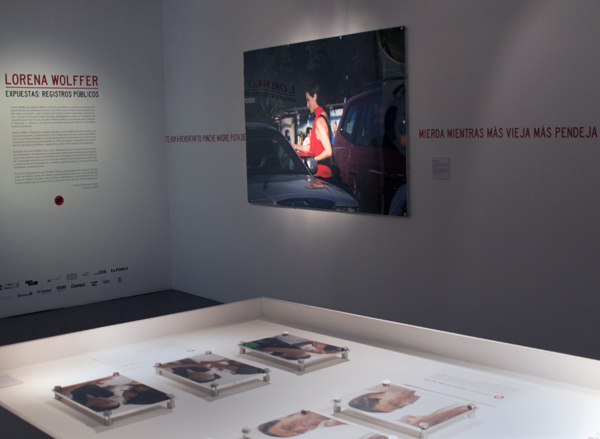
Lorena Wolffer. Lorena Wolffer Expuestas: Registros Públicos, 2015; installation view, Museo de Arte Moderno, Mexico D.F.. Courtesy of Lorena Wolffer and Museo de Arte Moderno. Photo: Jorge Gomez del Campo.
Documentation of several of the artist’s actions and performances make up the majority of the exhibition, which includes documentation of four pieces in particular. The red text along the wall is from an installation titled Acta Testimonial (2009), in which the artist wrote the insults directed at clients of a woman’s shelter on the walls of a gallery, while the clients’ own recorded voices described their experiences.
A large photograph of the artist handing out chocolates to passing motorists, and a plastic tube filled with those chocolates, documents 14 de Febrero (2008). In this piece the artist handed out chocolates with wrappers containing written accounts of the experiences of a woman named Mari who was forced, along with her four children, to sell chocolates on the busy streets of Mexico City. If Mari failed to sell enough, she was beaten and abused by her husband.
On a table in the center of the space, photographs and texts document Antimemorias: Enmiendas Públicas (2011), in which Wolffer invited passersby to interact with her body in such a way that it came to represent the wounds that the individual women had suffered. These interactions included actions such as washing Wolffer’s skin, or placing bandages on the artist’s body at the locations where the victims had been injured.

Lorena Wolffer. Antimemorias: Enmiendas Públicas, 2011; installation view, Lorena Wolffer Expuestas: Registros Públicos, 2015. Courtesy of Lorena Wolffer and Museo de Arte Moderno. Photo: Jorge Gomez del Campo.
On the far wall of the gallery is a video monitor and a small shelf with a text that invites gallery visitors to take a sticker to indicate publicly whether they “have experienced some type of violence against women.” This installation presents another of Wolffer’s actions, Encuesta de Violencia a Mujeres (2008), which consisted of a kiosk with a survey about violence against women. Each participant was then given a sticker to indicate whether or not she had been victimized. Next to this display, in a closet-size black room with a single chair, plays a looped video. This silent, untitled video (2015) of white text on a black background was made specifically for this show. It lists the names of those close to the exhibition that have been harmed by violence against women. In its own words, it is a “manifesto against oblivion” so that this violence will “never be repeated.”
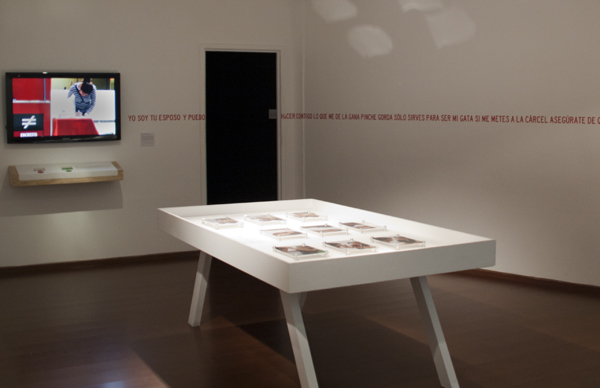
Lorena Wolffer. Lorena Wolffer Expuestas: Registros Públicos, 2015; installation view, Museo de Arte Moderno, Mexico D.F.. Courtesy of Lorena Wolffer and Museo de Arte Moderno. Photo: Jorge Gomez del Campo.
This small exhibit, and Wolffer’s work, makes present the serious and heart-breaking violence that one in five Mexican women report having experienced; it plays with concepts of public and private space in such a way that these forms of violence become something that the viewer has to confront in himself or herself. Wolffer’s work empowers women harmed by violence. It says, “You are not alone; you will not be forgotten.” Her work is also a powerful political message; the performances and actions documented here take place in very public and political spaces, like the Zócalo (main square) of Mexico City, suggesting that violence against women is a public/social problem embodied in private spaces. Unfortunately, the museum presents Wolffer’s work as a solely private, voyeuristic affair.
The viewer is invited to move through a small space filled with horrifying narratives and images about violence (like the account of the beating of a pregnant woman’s belly by her husband until she aborts). But except for the curator’s text on the wall, there is little to push the viewer out into the world, to consider the material and ideological realities of contemporary Mexico that allow for this kind of violence: corruption, machismo, and impunity, to name just a few. This exhibit reads as a human-interest story designed to move the viewer emotionally but not critically. Considering the gallery show as a whole, it becomes clear that it is driven by this specific kind of TV-journalistic and voyeuristic ethos. Documentary filmmaker Adam Curtis describes this type of situation as “Oh Dearism,” in which tragedy is presented without the contexts that might open up strategies of political action, in which the only reasonable response is to enjoy wringing your hands and saying, “Oh dear, how terrible.” Wolffer’s work empowers and challenges, it takes action; this show betrays her activism.
Fortunately, the show includes other elements besides the gallery exhibit. Before the show’s closure on October 18, the museum has scheduled a series of related events that includes a performance and talk by the artist, as well as workshops led by others. Hopefully these peripheral activities might mitigate some of the disempowering elements of the show.
Lorena Wolffer Expuestas: Registros Públicos is on view at the Museo de Arte Moderno in Mexico City through October 18, 2015.





