







Atlanta
Aleksandra Domanović: Turbo Sculpture at Atlanta Contemporary
Aleksandra Domanović’s multidisciplinary work has captured the attention of critics and curators across the globe for its striking account of the aesthetic and political changes at work in the Balkan region, specifically the former Yugoslavia. Born in Novi Sad in 1981—a territory that belonged to the Federal Republic of Yugoslavia before being dissolved in 2003—Domanović’s work in sculpture, film, and video installation addresses the social, political, economic, and psychological hauntings of the region’s Soviet past. In a powerful deployment of the personal and the political, Domanović animates the fraught history of memorials as empty gestures of recovery and forgetting that are financed by the State. The work explores the deep conflicts inherent in the region’s quick assimilation into the markets and meanings of global capitalism and neoliberalism and the unresolved experiences of those who live in the midst of decisions made at the hands of the State power.
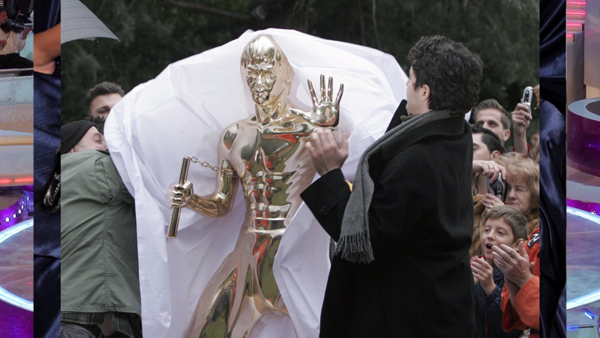
Aleksandra Domanović. Turbo Sculpture, 2010-2013 (video still); HD video, color, sound; 20:00; edition of 5 + 2 AP. Courtesy of the Artist and Tanya Leighten, Berlin.
Domanović’s current installation, Turbo Sculpture (2010–2013) at Atlanta Contemporary, is a twenty-minute crashing of high-definition images and sounds. It examines the recent commission of monumental public sculpture that appears in major public crossways and tourist locales across the former Yugoslavia: Hollywood stars and popular musicians such as Johnny Depp and Bob Marley, fictional film characters such as Rocky Balboa and Donald Duck, and even former President George W. Bush. Garish, expensive, and extremely popular among citizens and tourists alike, these new shrines to popular commodities in American culture refuse the traditional subjects and themes of public monuments (such as national heroes, political leaders, or representations connected to the collective history of a nation) and instead grotesquely literalize the country’s swift embrace and belief in the “cultural logic of late capitalism.”[1] At once extremely jarring, ridiculous, tasteless, and thoughtful in its carefully constructed collusions of site-specific imagery and digital detritus of internet-age image culture, Turbo Sculpture is more than a subversive engagement with the implications of aesthetic failure or neoliberal kitsch. Similar to the dark humor of political philosopher and cultural critic Slavoj Žižek, Domanović brushes against these tasteless sites by forcing the viewer to linger at the fault line between the ridiculous and the serious within the political landscape of former Yugoslavia.
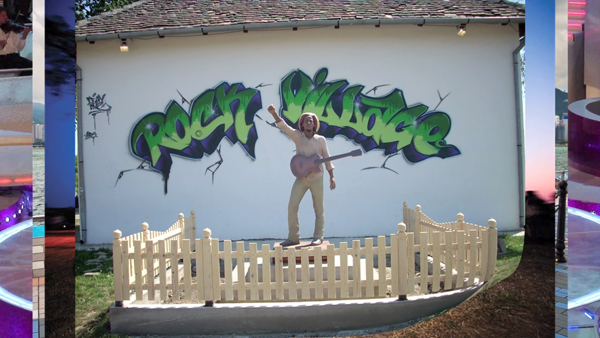
Aleksandra Domanović. Turbo Sculpture, 2010-2013 (video still); HD video, color, sound; 20:00; edition of 5 + 2 AP. Courtesy of the Artist and Tanya Leighten, Berlin.
In the aftermath of Slobodan Milošević’s soft dictatorship of the region—its bloody civil wars, horrifying military interventions, and unresolved ethnic and racial tensions—Domanović’s work points to the broader tensions underpinning Serbian national identity through the current reign of the ersatz. Unable to reconcile history through visual representation, these public monuments to popular culture stand as insistent disavowals on behalf of the state to redirect the iconographic traditions of a nation that cannot own up to its violent, terrorizing past.
Titled in relation to “turbo-folk”—an admixture of traditional Serbian folk music, Western forms of commercial pop, Middle Eastern forms of dance music, and the rave culture that spread across the Balkans during the 1990s—Domanović appropriates the genre’s catchy, commercial lingo of deep rhythms, youthful rebellion, and grotesque scale in order to underscore the funneling of Serbian cultural life into mainstream markets. However, turbo-folk has long been regarded by left- and right-wing groups as the “soundtrack to Serbia’s wars,” both for its blatant, vulgar commerciality in Miloševic’s climate of war profiteering, as well as its distinctly un-European musical origins—a cultural symbol of the dark nationalist tensions and anxieties that circulated between Croats and Serbians during Milošević’s militant nationalist regime.[2] Drawing attention to the challenges at work in separating Serbian “turbo” culture from extreme political ideologies, Domanović places tension on the shallow gap between joyful subversion and reactionary forms of celebration.
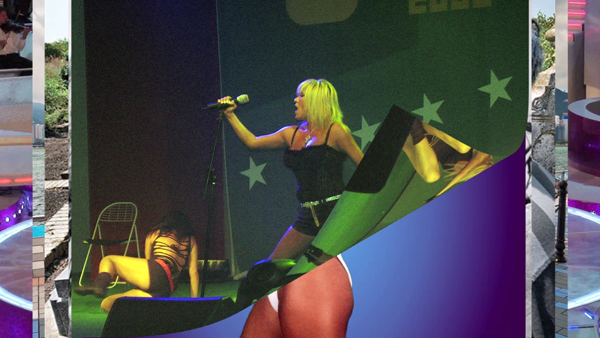
Aleksandra Domanović. Turbo Sculpture, 2010-2013; HD video, color, sound; 20:00; edition of 5 + 2 AP. Courtesy of the Artist and Tanya Leighten (Berlin, Germany).
More importantly, Domanović’s concern with the historical legacy of national signs and symbols sheds light on an important national conversation in the United States regarding the use and abuse of icons of national “heritage” and “legacy.” As Domanović identifies, it is the elastic nature of cultural symbols that allows them to both collapse and thrive under opposing interpretations and conflicting contexts—a testament to the hopeful progressions and regressive compromises surrounding the politics of commemoration.
Aleksandra Domanović: Turbo Sculpture is on view at Atlanta Contemporary through November 7, 2015.
[1] See Frederic Jameson’s iconic text, Postmodernism, Or The Cultural Logic of Late Capitalism (London: Verso Books, 1991).
[2] See Gordana Andrić’s article “Turbo-Folk Keeps Pace With New Rivals,” in the Culture section of English-language news outlet the Balkan Insight. Retrieved on the Balkan Insight webpage on October 1, 2015, at http://www.balkaninsight.com/en/article/turbo-folk-keeps-pace-with-new-rivals.





