







Summer Reading
Summer Reading – Finding Value in a Flattened Field
Today for our Summer Reading series we bring you Patricia Maloney’s recent op-ed from our partners at Art Practical. The author notes, “The commitment to paying contributors must be acknowledged as only the most visible link in a long chain of interlocking, concrete exchanges distributed throughout the ecosystem. Paying a writer or artist is not a unidirectional transaction; it is part of a public health policy.” This article was originally published on August 11, 2015.
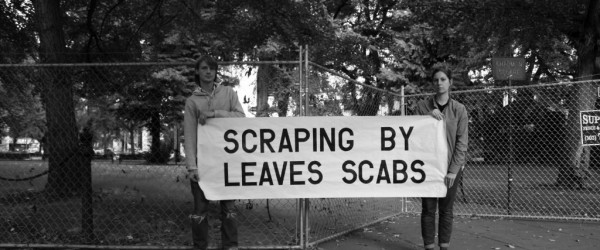
Anna Gray + Ryan Wilson Paulsen. 100 Posterworks, 2009–2013; printed poster; 11 x 17 in. Courtesy of the Artists.
In this late-capitalist era, in which content circulates frictionlessly through digital conduits, the influence of our words is changing. Their value is now less about where they appear (in this publication or that), and more about how far they travel, and how long they persist. Likewise, even though artistic merit has always been quantitatively measurable in some capacity, now those measures are more proximate and immediately visible. Gone is the slow path from obscurity to renown, when an artwork could accumulate a mossy layer of critical appraisal, or the length and location of its provenance could obscure the machinations of market forces. Nowadays, esteem is measured by hits and followers, and the velocity of their accumulation.
In many ways, the question of how quickly an article goes viral is the same as how much an artwork sells for at auction: both are numerical assessments that now supersede other descriptors. (Which movement will characterize early-21st-century art more readily: post-internet art or record-breaking sales?) We’ve acclimated ourselves to our reflections in the glossy sheen the current quantifiers have created and the speed with which they fade. Perversely, the more explicitly we can tally our influence, the less we value exposure, ascribing reach to momentum as much as to merit. And, cognizant that our words or objects or actions can drop quickly from view, we’ve become less invested in the full lifespan of an article or artwork. We don’t need to see something all the way through; we just have to keep churning out more.





