







Venice
The Failure of Painting at the 56th International Art Exhibition – la Biennale di Venezia
Context grounds contemporary art, and placing a work into a different framework allows for new layers of understanding to be revealed. This year’s Venice Biennale illustrates this point perfectly with one of the most cohesive curatorial efforts in its 120-year history. Thanks to curator Okwui Enwezor‘s creation of three overlapping “filters” that he calls the Garden of Disorder, Liveness: On Epic Duration, and Reading Capital, viewers are offered perspectives in which to consider not only the work presented in this Biennale, but the entire trajectory of the Biennale series. The result is nothing short of inspiring, and there are certainly works that benefit from a reassessment through the curatorial filters—but also ones that fall flat.

Bruce Nauman. Eat/Death, 1972; neon tubing with clear glass tubing suspension frame; 7 3/8 x 25¼ x 2 1/8 in (18.7 x 64.1 x 5.3 cm). Courtesy of the Artist and la Biennale di Venezia. Photo taken by the author.
The biggest shock in this Biennale is that painting looks out of sorts. It’s not obvious at first, but it becomes evident after combing through the vast offerings. In part, this is due to painting’s long and continuing history of being the poster child for the powerful, a precedent that feels at odds with the show’s filters; but this goes deeper than that. The brutal truth is simply that painting is always first about being a painting. A painting about class struggle isn’t just about class struggle, it’s a painting about class struggle—a bit like listening to someone letting you know how smart they are while explaining the subtleties of Marx’s Various Formulæ for the Rate of Surplus-Value—by design, painting is selfish that way. The content of a painting is always subordinate to the medium, otherwise a different material would have been chosen. But what this surprisingly suggests is that there isn’t much room for painting in thematically curated shows, that is, unless those shows are about painting.
The Romanian Pavilion triggered this sweeping observation. Its installation of paintings by Adrian Ghenie called Darwin’s Room (2015) is sorely out of place in this pavilion, in stark contrast from its critically received previous offering of An Immaterial Retrospective of the Venice Biennale (2013), where Manuel Pelmuș and Alexandra Pirici offered performances that encapsulated the entire history of the Biennale within a single day. Ghenie’s are not bad paintings, but there is no way that they can be properly considered. They immediately feel too self-absorbed in being painterly, too alien for the larger topic at hand. Technically, parts of the installation probably tie into the Garden of Disorder filter, but the work with Ghenie’s reoccurring theme of self-portraiture as historical figures withers in the dominate shadow of painterliness.
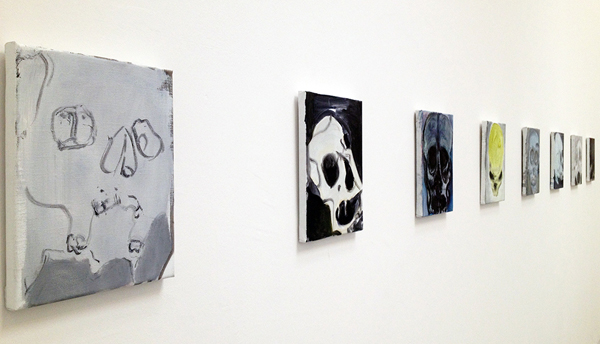
Marlene Dumas. Skulls, 2013-15; installation view, 56th International Art Exhibition, Venice. Courtesy of the Artist and la Biennale di Venezia. Photo taken by the author.
After the Romanian rub, I came to see everything else at the Biennale conventionally classified as a painting in the same light. Chris Ofili was an obvious choice for this curatorial effort, and under different circumstances his work would have been electrifying. But separate the historical context of the artist from the work, and it becomes harder to decipher the content from the decorative. To say that it took almost a full second to dismiss Georg Baselitz’s paintings would be generous; and Marlene Dumas’ brilliantly fun skull paintings could have single-handedly reversed the plight of painting for the entire exhibition, but by that point, it was too late. It read more of an epitaph for the medium of painting itself than a plausible warning on global excess. It’s demanding enough to take time to consider a work of art; placing a painting into a situation where it’s forced to supersede its primary function would appear to be asking too much.
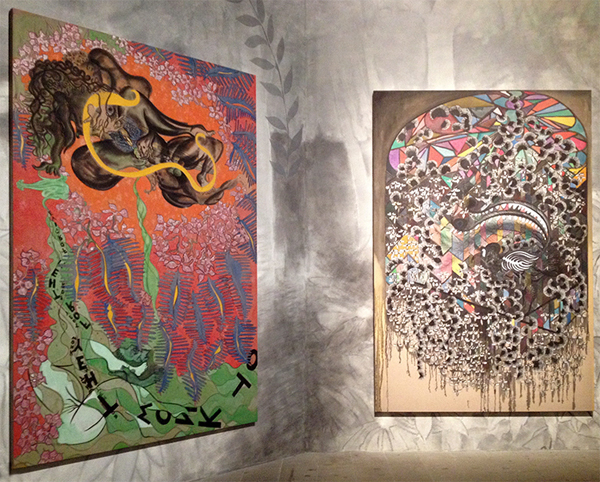
Chris Ofili. Installation view, the Corderie building, 56th International Art Exhibition, Venice. Courtesy of the Artist and la Biennale di Venezia. Photo taken by the author.
For the most part, this Biennale has been overwhelmingly well received. Nevertheless, there are some that find the critiquing filters too rich for their tastes. Evidently, the show is too Marxist–which is to say that any possibility of a Marxist critique is too Marxist. So it isn’t surprising that these guardians of capitalism have found refuge in the very thing that is at odds with the exhibition. As if it wasn’t tough enough for painting, it also has to deal with an enabler reinforcing its quandary.
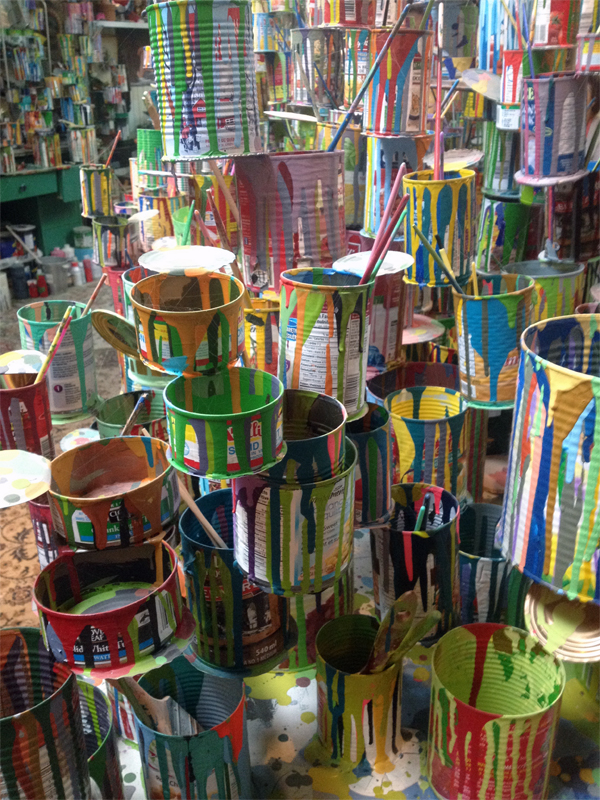
BGL. Canadassimo, 2015 (detail); mixed media; dimensions variable. Courtesy of the Artists, The National Gallery of Canada, and la Biennale di Venezia. Photo taken by the author.
To be clear, there were also plenty of non-painting works that lacked the ability to rise to the occasion, but when they failed, they did so independent of their respective medium. In the context of this exhibition, painting’s failure is a double jeopardy; its content offers a critique while simultaneously being a manifestation of the subject of that same critique. Either the content of a piece is undermined, or else the viewer is left with a lot of painterly naval gazing. (The Canadian Pavilion offered the only feasibly resolution of this point with BGL’s Canadassimo, 2015, but then it left painting deconstructed as sculptural remnants manifested from an accumulation of every Pollockian gesture ever made). Hence, viewers of this Biennale will have to decide if they can get past the paradox of critical painting’s self-defeating precondition or write it off as collateral damage of the greater critique.
All the World’s Futures is on view at the 56th International Art Exhibition – la Biennale di Venezia through November 22, 2015.
This article is made possible by our Writers Fund, thanks to readers like you. Help us keep it going!





