







Summer Reading
Summer Reading – (Un)doing (Un)compensation
In selecting the articles for our Summer Reading series—ones that we think exemplify current issues in the field of contemporary art—we would be remiss if we did not include Caroline Woolard’s consideration of “[the] seven ways in which I attempt to navigate inequity within institutions and collective projects.” This article was originally published in Art Practical’s special issue “Valuing Labor in the Arts” on April 3, 2014.
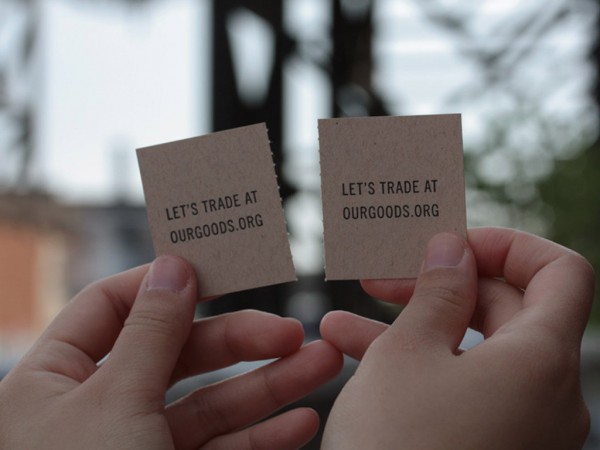
Caroline Woolard. ourgoods.org cards, 2010. Courtesy of the Artist.
Within a neoliberal economy that supports the debt-backed-professionalization of artists and activists, I question the relationship between overproduction and underpayment. What are the conditions that make overproduction desirable? When did monetary payment for art and activism become necessary? While artists and activists demand payment for work, we must also articulate our relationship to payment systems: market sales, state-support, philanthropy, and solidarity economies that center on livelihood. Acknowledging the diverse economies that I circulate in, I hope this writing points towards the internal contradictions that make professionalized, debtor artists and activists in the United States (including me) hustle for cash while engaging in projects on scales that cannot possibly compensate all participants equitably.
As most people reading this already know, the labor behind many works of art is veiled by a myth of individual genius. Although contemporary artworks that circulate in museums, galleries, and biennials are mostly produced by unpaid interns, underpaid artists’ assistants, seasonally-employed shop technicians, and far-flung contractors hired by artists’ project managers, narratives that celebrate individual charisma and “the artist’s touch” continue to permeate wall labels and art discourse alike.
Many artist-collectives, by sharing labor and decision making power, counteract the alienation that often occurs with an hourly wage and a drive towards efficiency in rapid production. To make labor visible, for Artists Experiment at MoMA in 2013, I proposed an ongoing event where artists, interns, assistants, and craftspeople would stand beside the works of art that they labored on, telling visitors about the process of producing each work, as well as the forms of compensation received by each person. This proposal, submitted as one of six options for Artists Experiment project at MoMA, was not chosen.





