







Interviews
Street Fighting Man
Today from our friends at REORIENT, we bring you an excerpt from Joobin Bekhrad‘s interview with artist and curator Ali Ettehad, who says, “I strongly believe that at a time—especially in the Middle East—when art is, for the most part, commercially-driven, performance art is powerful in its ability to help artists retain their independence and integrity.” This article was originally published on June 2, 2015.
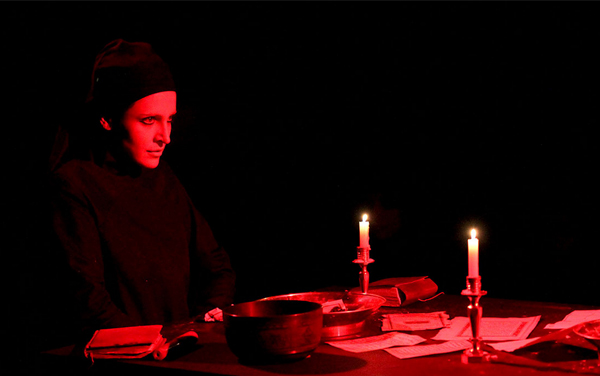
Ali Ettehad. A Requiem for Libricide, n.d.
Joobin Bekhrad: Unlike other forms of art in Iran—e.g. visual art, cinema, music, etc.—performance art has a relatively shorter history. What were the origins of performance art in Iran, and why do you think it has received little attention in comparison to other art forms?
Ali Ettehad: You of course have to remember that performance art, vis-à-vis other artistic mediums, is new all around the world in general; that’s why it’s taken much longer for it to be recognised in Iran, and for Iranian performance art to receive outside attention. The short history and newness of performance art aside, however, I do agree with you. As a medium, it has often been neglected, and has not received due attention. Performance art was seen for the first time in Iran in the 70s, and took shape on the fringes of the Shiraz-Persepolis Festival of Arts (earlier performances may have existed, but there are no known historical records of them), although following the Revolution in 1979, it became largely forgotten. Activity picked up again after 2000, however, and in the early years of the 21st century, much interest was shown in contemporary artistic mediums. Beginning in 2005, there was a surge of investment in the domestic art market (particularly from abroad), and Iranian art began to perform particularly well in Middle Eastern art auctions.
It was because of developments like these that non-commercial and non-sellable mediums such as performance art were once again pushed to the fringe. Taking into consideration the fact that the local art scene is dominated by private galleries (as opposed to state-run institutions or galleries receiving support from local municipalities) that are commercially-oriented, mediums such as performance art have never had the chance to be the centre of attention; and, even if performances are structured so that artists do not incur any costs (which is rarely the case), they still have to undergo a tortuous process in order to find suitable venues, especially in a country like Iran where it is forbidden to perform in most public spaces.





