







Venice
#Hashtags: Liveness
#participation #politics #capital #religion #access #inclusion
At the center of All the World’s Futures—The 56th Venice Biennale is the ARENA. Designed by architect David Adjaye, it is meant to serve as a platform for “live art” throughout the exhibition’s run. The space is defined by a large, low platform, flanked by risers and backed with a projection screen. Above the stage, a mezzanine provides another vantage point. The whole space is bright red, with carpeting and colorful pillows in the seating areas. According to Okwui Enwezor, “Over the course of All the World’s Futures, artists, musicians, composers, actors, intellectuals, students, and members of the public have been invited to contribute to the program of readings and performances that will flood and suffuse surrounding galleries with voices in an epic display of orality.” He intends for the activities in the ARENA to spill over into the adjacent spaces of display. Enwezor suggests that “liveness and epic duration” expand the “spatial and temporal” boundaries of the exhibition beyond that which the exhibition can fully contain or describe, and that the ARENA serves as “a dramatization of the space of the exhibition as a continuous, unfolding, and unceasing live event.”[1] Such language casts contemporary art viewing as a marathon endurance challenge rather than the experience of leisure or aesthetics that many visitors to the Biennale may be expecting.
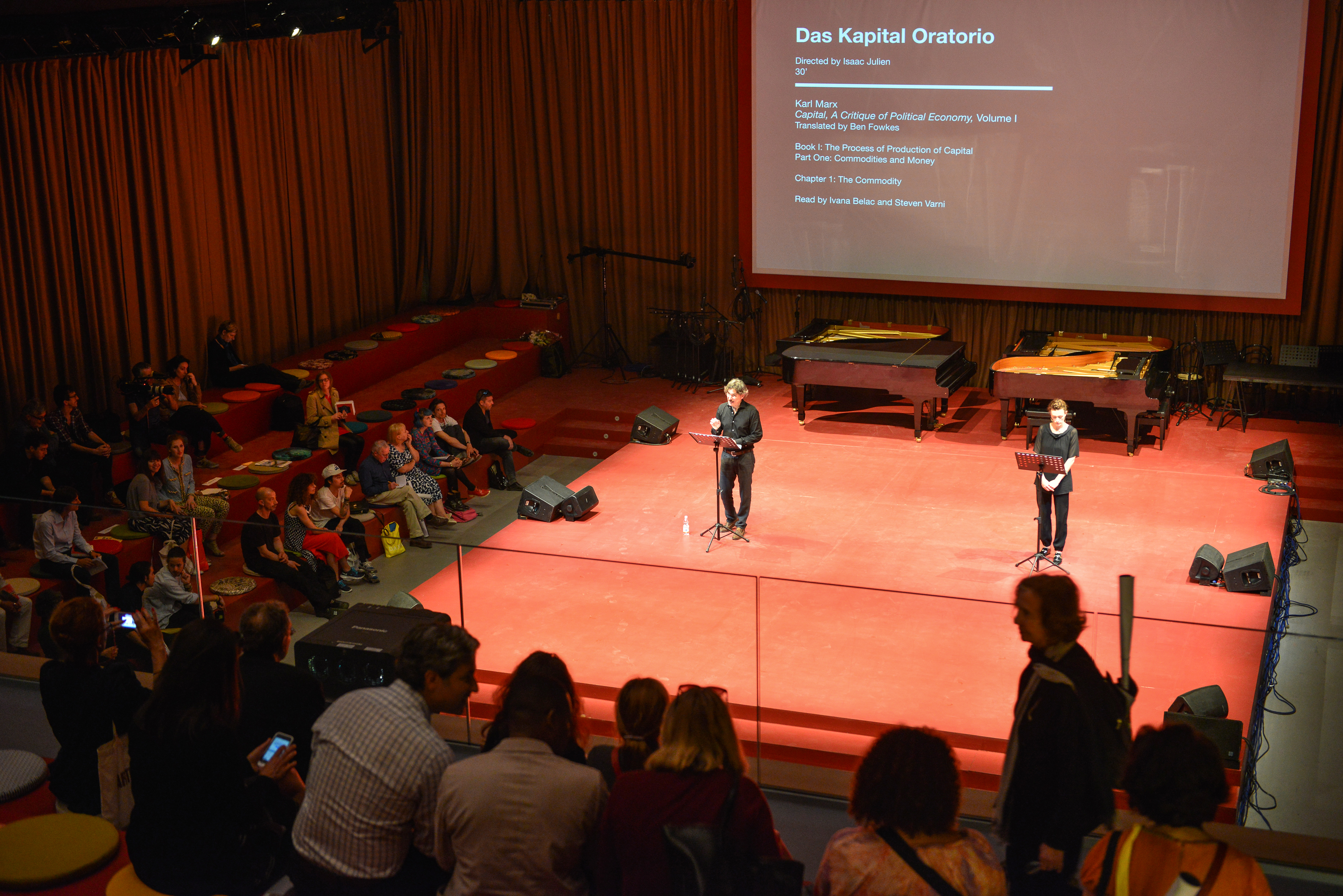
Isaac Julien. Das Kapital Oratorio, ARENA, Padiglione Centrale, Giardini. 56th International Art Exhibition – la Biennale di Venezia, All the World’s Futures. Courtesy of la Biennale di Venezia. Photo: Andrea Avezzù.
Manifestations of “epic duration” include Isaac Julien’s ongoing Das Kapital Oratorio, a series of staged readings of Marx’s foundational text read for thirty minutes each, at intervals, over the course of the exhibition’s seven-month run. This work has already generated widespread indignation from critics, many of whom misrepresent the reading as happening continuously, and some of whom fault Julien for taking up Marxist questions while simultaneously collaborating with Rolls-Royce on another project appearing elsewhere at the Biennale.[2] Others lament the concept as simply boring. After all, everyone or no one has read Das Kapital (depending on who you ask), and anyway, isn’t a contemporary text like Thomas Piketty’s Capital in the 21st Century more relevant? Julien cites the Sikh practice of the Akhand Path, a ritual reading of a holy text, as precedent. Is Das Kapital the holy text of contemporary art? Its recurring influence in art criticism and production would support this interpretation. As for being boring, the work invokes another spiritual element borrowed from South Asia, the drone, which stands in for the sound of the mechanism of the universe, and lulls us into a subconscious state.
Das Kapital Oratorio is interspersed with readings, presentations, and musical performances contributed by artists and collectives including Charles Gaines, Jason Moran and Alicia Hall Moran, Jeremy Deller, and Mathieu Kleyebe Abonnenc. These performances mine historical source material centering on labor, political representation, and race, sometimes to transcendent effect. Gaines sets pivotal civil-rights speeches to music, while the Morans present work songs written by laborers, and Deller unearths archival songs from 19th-century workers’ movements. Abbonenc resurrects the oeuvre of Julius Eastman, a midcentury avant-garde composer of African American origin. As promised, the program is impossible for any visitor to experience in its totality. How these performances affect the experience of viewing art objects in the adjacent galleries is difficult to determine. During my visit, I could not hear the sounds of the ARENA program filtering through the galleries—to my relief, as sound spill tends to raise my curatorial hackles; it strikes me as unfair to allow one artist’s work to interfere with the experience of another. Other features include e-flux’s lecture series SUPERCOMMUNITY, and a series of film screenings.
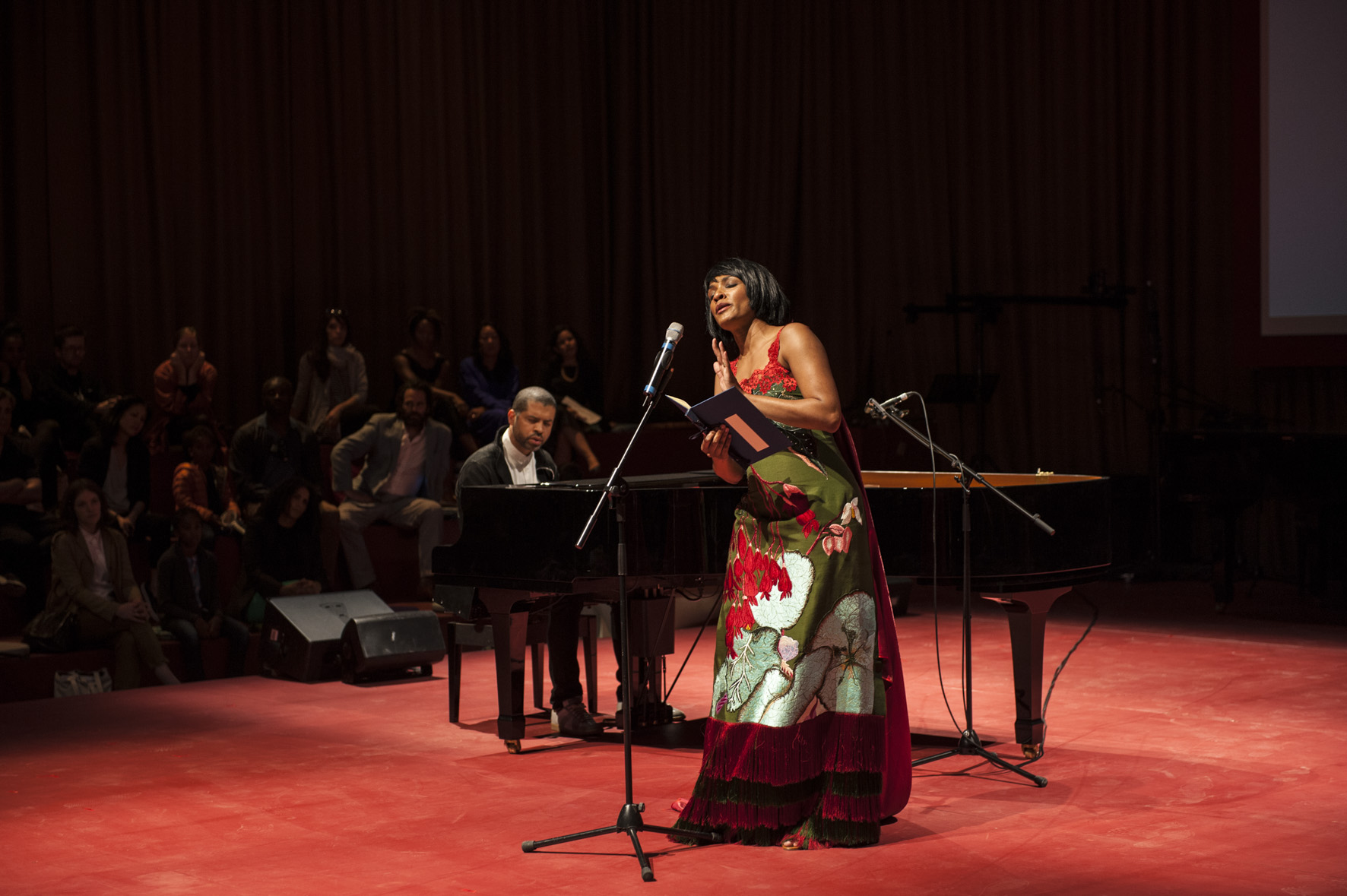
Jason Moran and Alicia Hall Moran. Work Songs, ARENA, Padiglione Centrale, Giardini. 56th International Art Exhibition – la Biennale di Venezia, All the World’s Futures. Courtesy of la Biennale di Venezia. Photo: Isabella Balena.
The chief limitation of Enwezor’s vision of “liveness” is that it adheres closely to traditional theater and lecture formats. Performers and speakers are onstage, and audiences are seated. Viewpoints are from the sides, diminishing eye contact between presenters and observers, or from above, creating distance. Decades of theater in-the-round, Happenings, public art, and social and relational practices seem to have escaped Enwezor’s attention. In this respect, even the nearly comatose performances staged by Tino Seghal at the 2013 Biennale did more to activate the exhibition than the ARENA does. A more contemporary approach would have situated performances throughout the gallery, or throughout the Giardini, and allowed for audience interaction either publicly or virtually. Inexplicably, Enwezor did not engage artists in his own exhibition known for compelling, participatory live performances, such as Theaster Gates, in the ARENA program. The works maintain hierarchical relationships between artists and audience, reflecting a recent trend among bigger contemporary art institutions to embrace theatrical performance presentations while moving more experimental forms into education departments, or simply setting them aside.
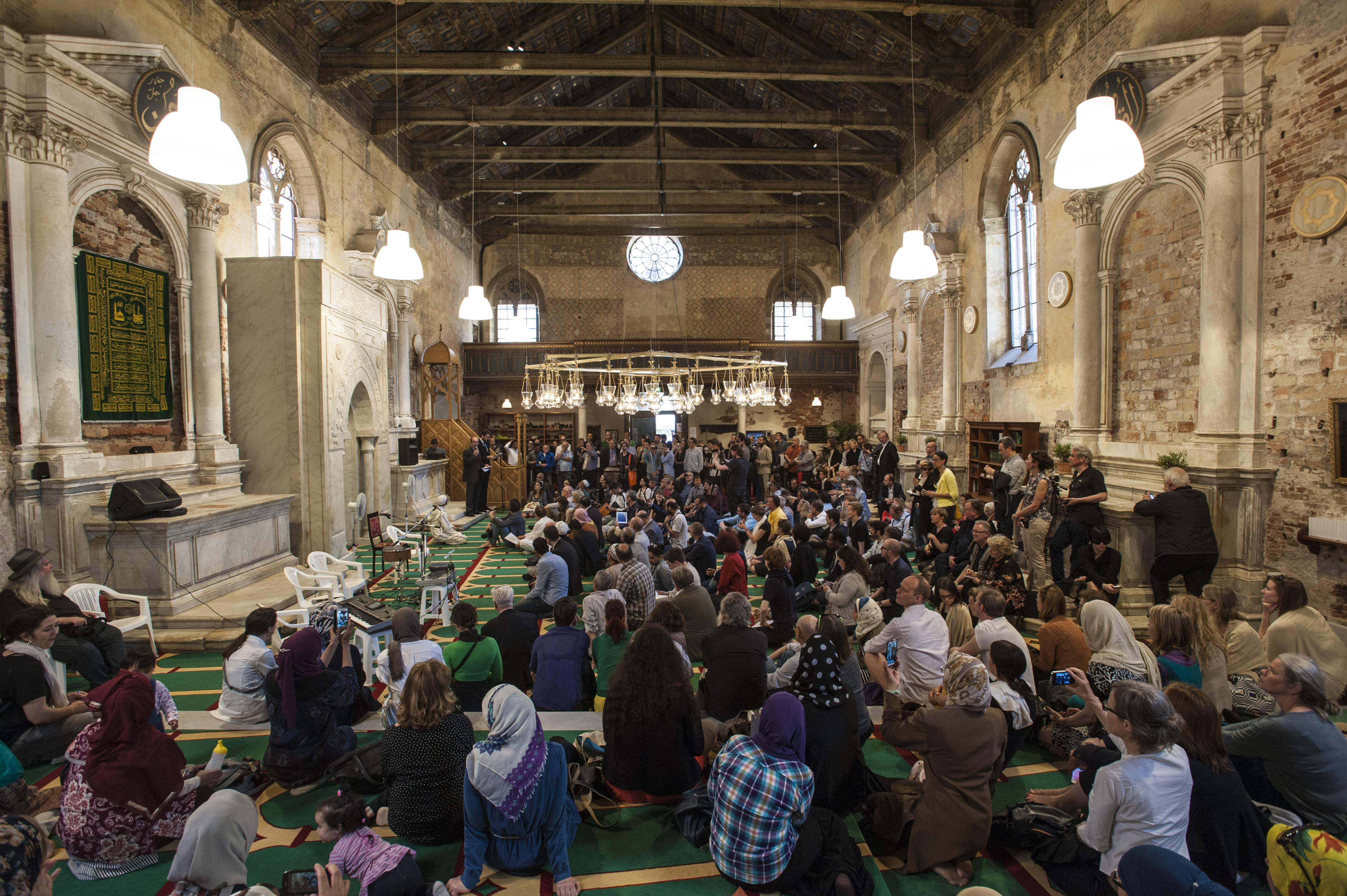
Christoph Büchel. The Mosque, Icelandic Pavilion. 56th International Art Exhibition – la Biennale di Venezia, All the World’s Futures. Courtesy of la Biennale di Venezia. Photo: Isabella Balena.
This conservative approach represents a missed opportunity for Enwezor’s “liveness” to do more than lecture at audiences, however poetically. It contrasts with more experimental approaches such as that taken by the Belgian Pavilion, a meditation on Belgium’s colonial history in the Congo organized by Vincent Meessen. The pavilion features an installation by Elisabetta Benassi, activated by a live reading of Mark Twain’s King Leopold’s Soliloquy. Integrating “orality” into the exhibition space, Benassi’s work accomplishes what Enwezor’s ARENA does not, infiltrating the whole space of the pavilion with a human voice that thematically augments and complements the works on view. Christoph Büchel’s Icelandic Pavilion, The Mosque, takes the concept of “liveness” further by repurposing the pavilion as a gathering place for a marginalized community with historical ties to Venice dating back hundreds of years.[3] Rather than embrace Büchel’s expansion of the exhibition space into a “continuous, unfolding, and unceasing live event,” Biennale officials have been circumspect in their support of the project amid controversy stoked by the Catholic Church and local police. Projects like these disrupt the controlled site of the exhibition, opening art up for discussion and challenge. They are more closely aligned with the future of art and institutions than Enwezor’s overly cautious live program would allow.
All the World’s Futures—The 56th Venice Biennale is on view through November 22, 2015.
#Hashtags is a series exploring the intersection of art, social issues, and global politics.
[1] Okwui Enwezor, “All the World’s Futures” curatorial statement, http://www.labiennale.org/en/art/exhibition/enwezor/
[2] Julien’s collaboration is underwritten by Rolls-Royce and slated for donation to Chelsea and Westminster Hospital, London, after the exhibition. Production of the work involved sending a crew of nearly 50 people to remote Icelandic glacial caves to shoot, a feat that could likely not have been financed by any non-corporate entity, and which may well serve a greenwashing purpose for the car manufacturer. As to the question of whether accepting Rolls-Royce money while considering Marx makes Julien a hypocrite, it seems akin to the conservative claim that activists with iPhones are not true revolutionaries. An artist limited by the structures of the system in which he operates is still entitled to critique the system while participating in it.
[3] Büchel’s pavilion was closed by Venetian authorities on May 22, 2015, on the basis of the city’s claim that the pavilion constituted an illegal house of worship. Pavilion organizers are contesting the decision.





