







Los Angeles
The Unmooring of Jibade-Khalil Huffman
Today from our partners at Art Practical, we bring you Anna Martine Whitehead’s consideration of the work of artist Jibade-Khalil Huffman. The author notes, “For Huffman, poetry is a means to shape-shift and mistranslate, reforming meaning by first dissolving it.” This article was originally published on April 16, 2015.
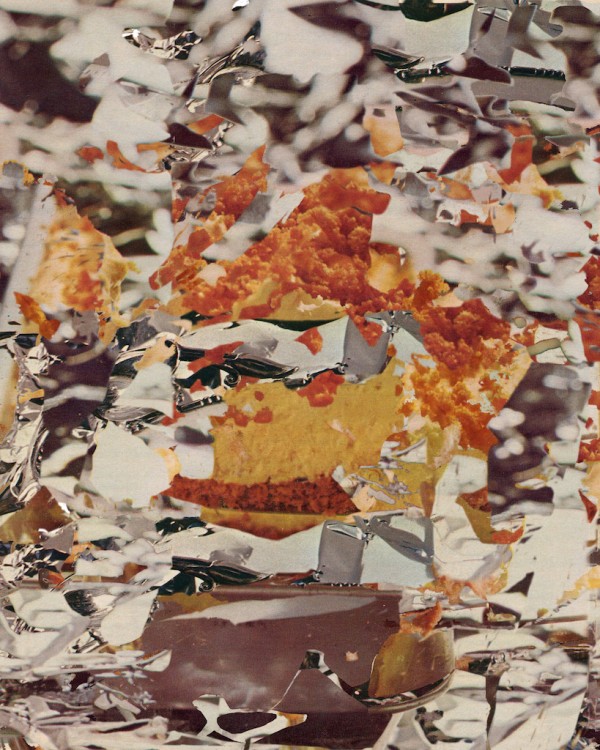
Jibade-Khalil Huffman. Untitled (Cake), 2015; archival inkjet print, 8 x 10 in. Courtesy of the Artist.
In her pivotal essay “Poetry Is Not a Luxury,” Audre Lorde writes of the “places of possibility within ourselves [which] are dark because they are ancient and hidden.” She demands we consider the radical and formative potential of “poetry as illumination.” For artist Jibade-Khalil Huffman, too, poetry is no luxury; it is a means to disentangle language from ontology, assembling new compositions suggestive of other ways of being. In Huffman’s video and slideshow-based installations, everything is subject to deconstruction—from subtitles to karaoke to slide presentations—making the viewer aware of their agency in forming meaning out of words, light, and composition.
Huffman’s interest in the expansiveness of language extends across mediums and genres, its trajectory following those traced by poets such as Lorde and Claudia Rankine. In fact, Huffman has been collaborating with the latter poet for an upcoming show at Mars Gallery. In Huffman’s poetry, words are collaged into combinations of sentences and delivered to the reader as fragments. In James Brown Is Dead and Other Poems, for example, the passage, “an awkward/silence by/DW Griffith,” is followed by a series of blank pages, an image of the Warner Bros. Pictures logo, and more blank pages. This collage of linguistic snippets and yawning gaps of silence creates a feeling of being perpetually unmoored. The uncertainty opened up by Huffman’s poetry also generates a space for him to address the cognitive dissonances that come with being an artist of color in a predominantly white art world. “In some ways I don’t deal in big subjects… I’m thinking of Race with a capital ‘R’—certainly that stuff slips in. But it’s embedded in a life. And that’s what I’m interested in,” he says. “The main thing is thinking through modes of text that already exist and employing poetry to deal with absurdity. Instead of writing an essay about misreading and how, for example, whenever I see an ‘applause’ sign I always see ‘applesauce’—there’s no word for this misreading. I just wanted to make a piece that shows this.”





