







Melbourne
Nature/Revelation at the Ian Potter Museum
Entering Nature/Revelation, in the rather hushed surrounds of Melbourne University’s Ian Potter Museum, the first thing visitors encounter is an enormous sperm whale. Looming in the darkened space, it has a startling presence and gravitas, even more so when you realize it’s a graphite drawing. Its skin is pitted, marked and scarred by travels through a world still mysterious to us, and its tiny eye regards us mournfully. Reflected onto the shiny floor of the gallery space, this being—massive, yet floating on its canvas surface—immediately calls into question the relationship between humans and the natural world. It’s a little like encountering Damien Hirst’s notorious shark, The Impossibility of Death in the Mind of Someone Living, but less trite. This work, Sperm Whale (Physeter Macrocephalus) (2013), by Jonathan Delafield Cook, is the key to Nature/Revelation. Curator Joanne Bosse has selected a curious mix of works by Australian and international artists in order to explore the capacity of art to provoke us; to make us think about the important questions of our age.
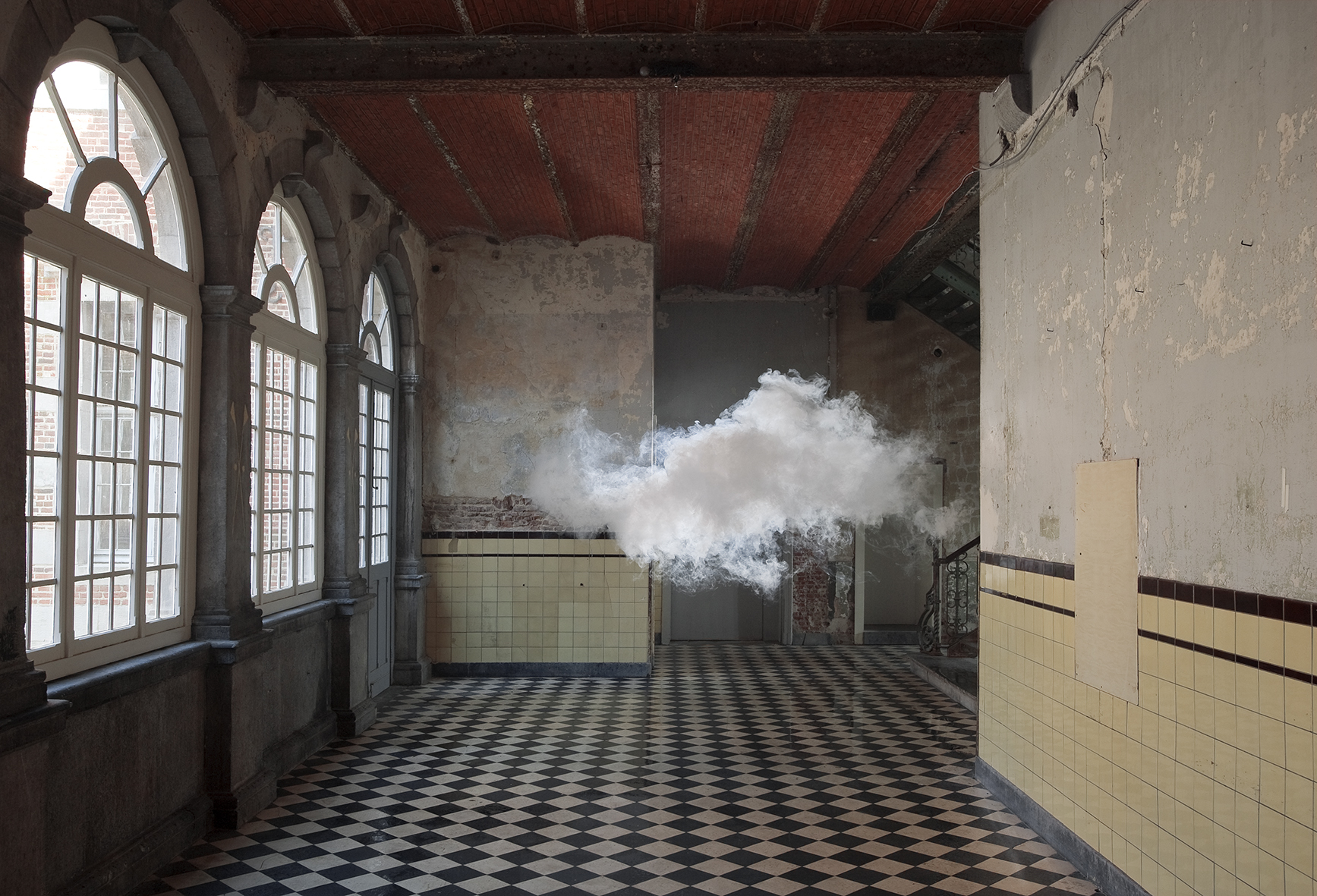
Berndnaut Smilde. Nimbus D’Aspremont, 2012; digital C-type print mounted on diabond; 75 x 110 cm.
Courtesy the Artist and Ronchini Gallery, London.
Part of the Art+Climate=Change festival, the exhibition is intended to stimulate discussion about global warming and its devastating impact. Truthfully, I expected it to be worthy and sincere but deadly boring. Instead, I was moved and, in front of some works, enchanted. Bosse proposes a reinvestigation of the sublime—but not in its Romantic, 19th-century guise, which placed humankind at the thrilling center of things. Here, humans are rather on the periphery, facing the unintended consequences of what we have wrought, filled with regret. Delafield Cook’s Sperm Whale is cleverly juxtaposed with photographs of the American wilderness by Ansel Adams—a passionate environmentalist when it was distinctly unfashionable to be one. This is art for the Anthropocene, the epoch in which we confront humankind’s impact on the planet: mass extinctions, the pollution of the oceans, and the alteration of the atmosphere.
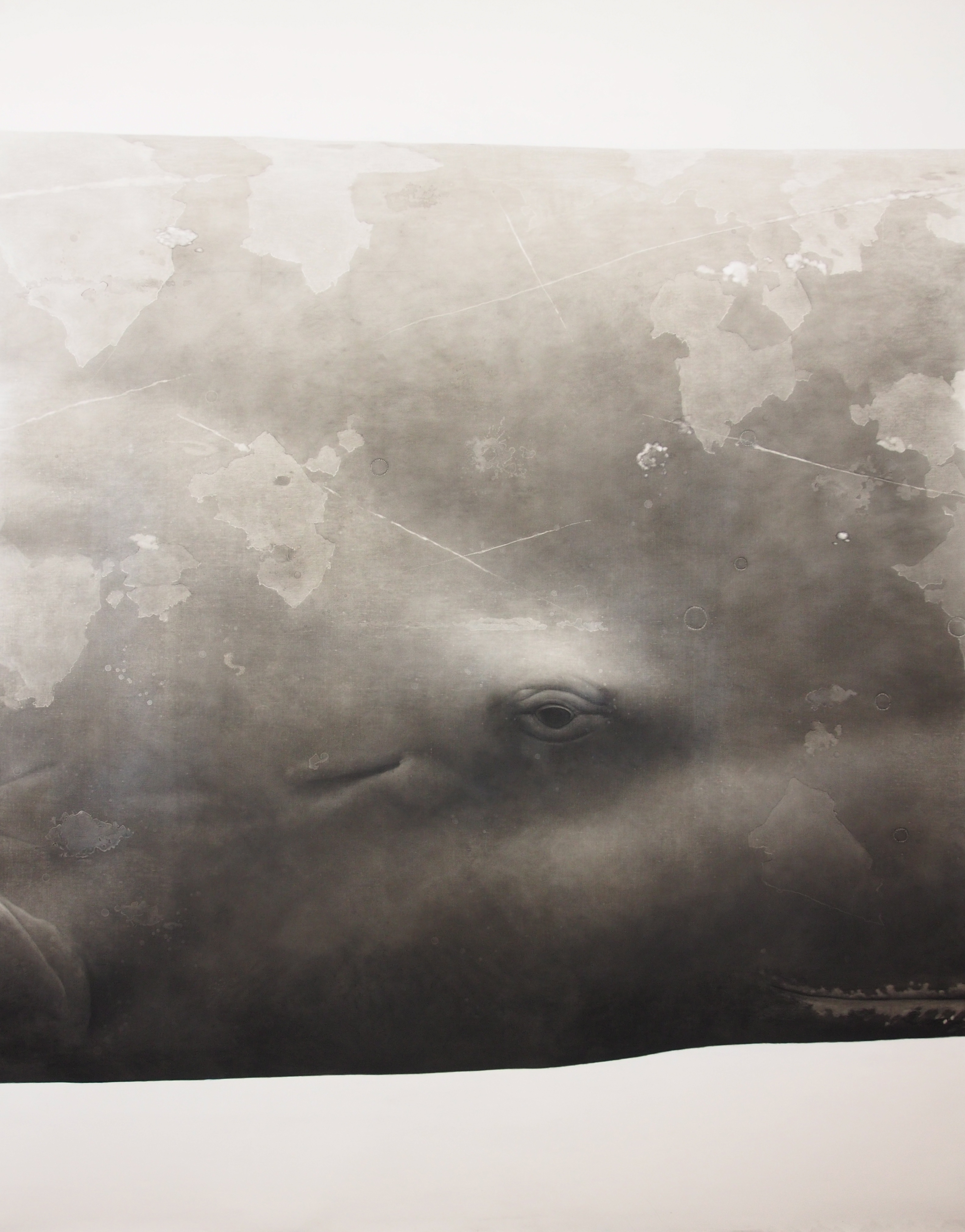
Jonathan Delafield Cook. Sperm Whale (Physeter Macrocephalus) (detail), 2013; graphite on canvas,
six panels; 245 x 1200 cm. overall. Courtesy of the Artist and Olsen/Irwin Gallery, Sydney.
Other works in the exhibition are equally compelling. Jamie North’s Slag Bowls are formed from concrete and steel slag, inhabited by moss collected from post-industrial sites. In 2014, North traveled to Pittsburgh to undertake a residency exploring new materials and technologies. Working with the Calgon Carbon Company and Pittsburgh Botanic Gardens, he wanted to investigate American “human-impacted landscapes” through sculpture and photography. Other works by the Australian artist stand like prehistoric stones in the darkened space of the gallery; fissured, weathered concrete columns appear to have formed naturally. Growing within their pitted gashes and broken surfaces are tiny ecosystems.
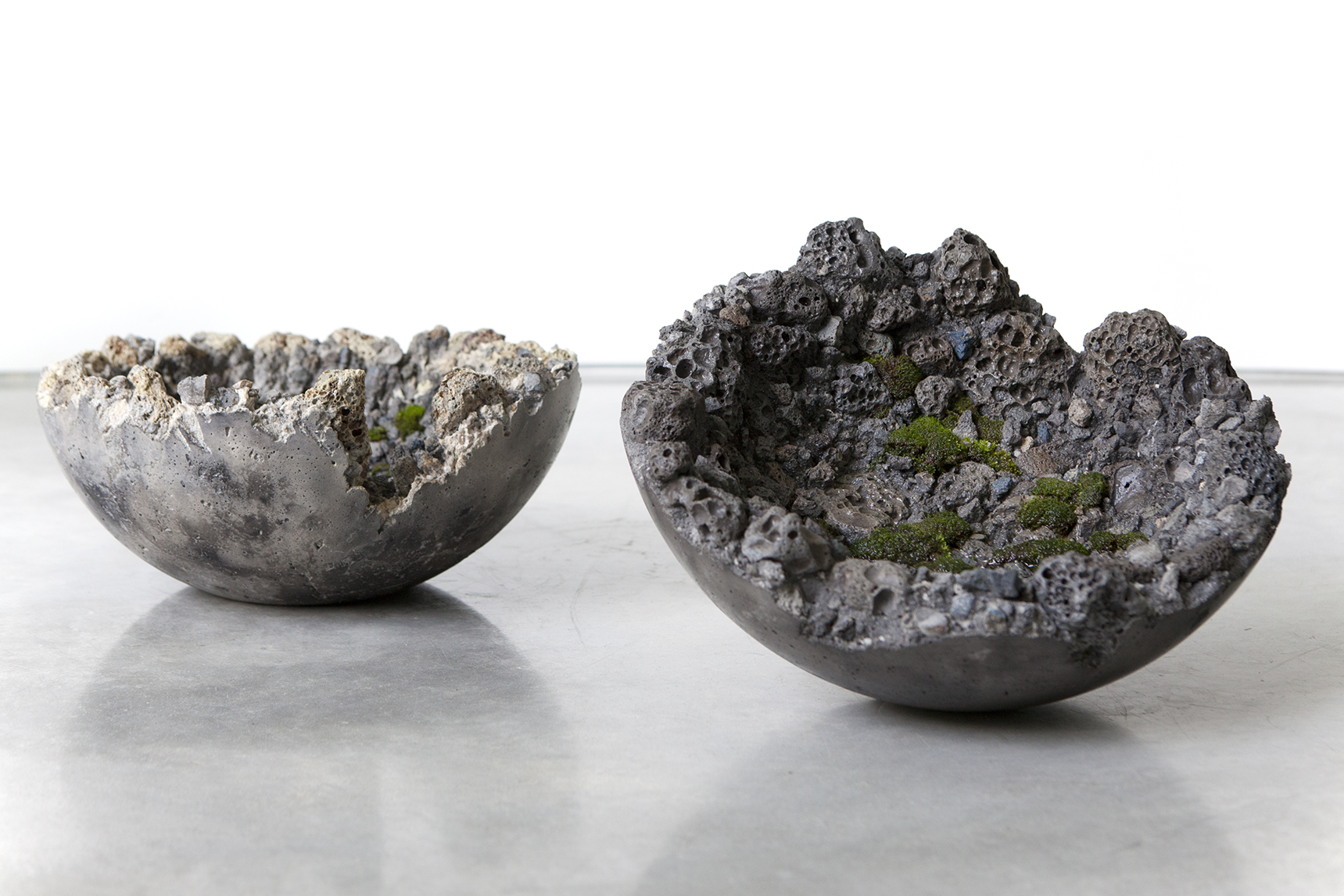
Jamie North. Slag Bowl I & II, 2013; concrete, coal ash, steel slag, Australian native plants and moss;
15 x 37 x 37 cm. each. Courtesy of the Artist and Sarah Cottier Gallery, Sydney.
Gabriel Orozco’s video of hands relentlessly turning a smooth river stone in a compulsive fashion suggests the relentless weathering actions of wind and water. David Haines’s mesmerizing two-screen video projection, Day and Night (2005), juxtaposes a rocky cliff and waves dashing against rocks. Slowly you realize there is a tiny, formally suited figure, almost invisible against the enormity of the landscape, clinging to the cliff face and shifting from foot to foot. Like Magritte’s Castle of the Pyrenees, it is an image of the impossible, and in its enormity it echoes Delafield Cook’s leviathan in the next room. The wall text suggests it is about climate change—something of a forced “fit” that left me a little skeptical. It seemed a larger metaphor for our puny ambitions and relentless ego in the face of forces beyond our control.
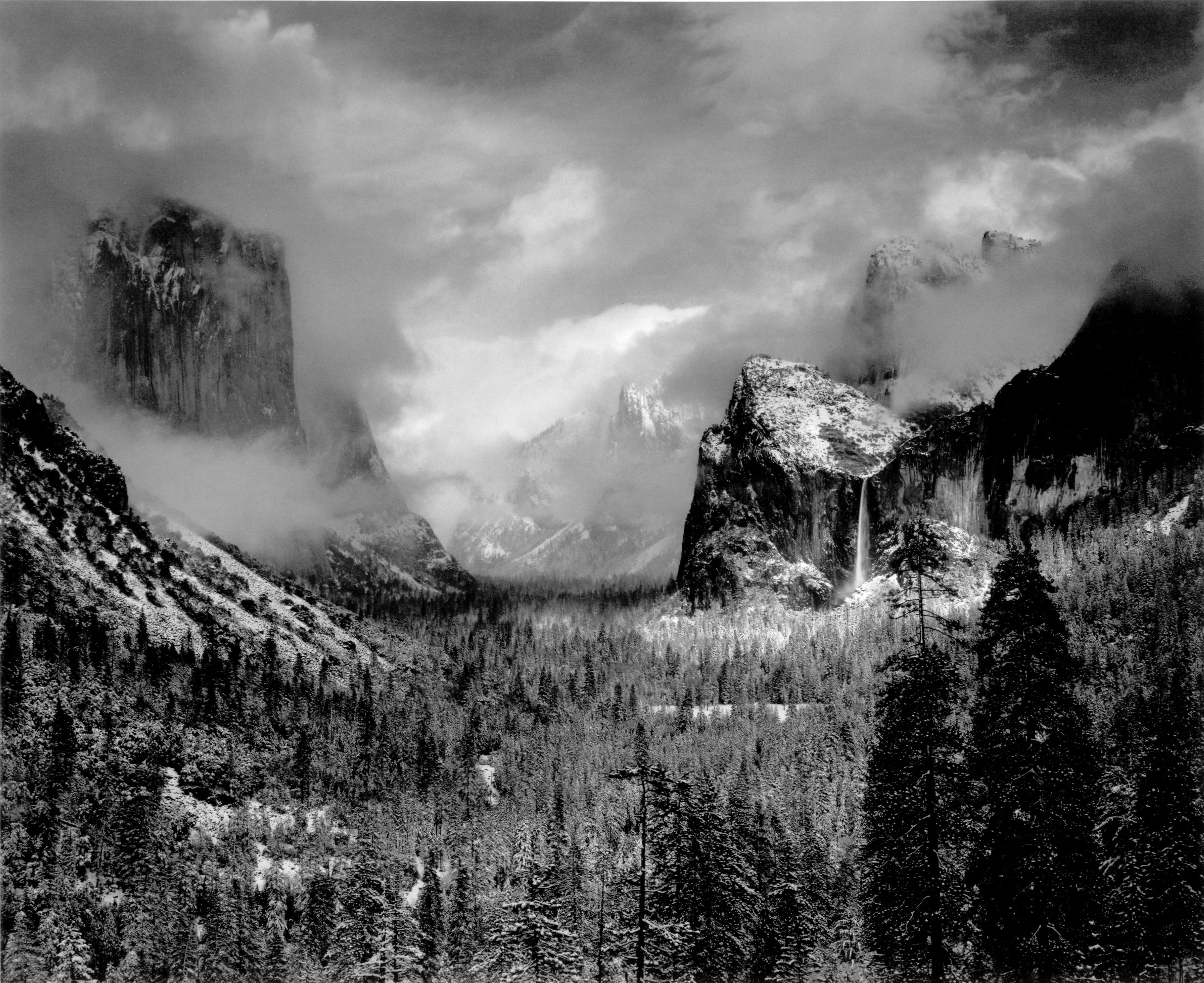
Ansel Adams. Clearing Winter Storm, Yosemite National Park, 1935; gelatin silver photograph; 56 x 71 cm. framed.
Issues of control—and lack of control—are paramount. Nature is the protagonist here, but the notable absence in these works is the controlling hand of humanity. Berndnaut Smilde creates clouds in his Nimbus series, like a magician conjuring up elemental forces. They are beautiful, mysterious images, but they cannot compete with Ansel Adams’ photographs of cloudy skies over Yosemite. The exhibition compels us to face the tragic consequences of the way we have interpreted Genesis 1:26: “And God said, Let us make man in our image, after our likeness: and let them have dominion over the fish of the sea, and over the fowl of the air, and over the cattle, and over all the earth, and over every creeping thing that creepeth upon the earth.”
Nature/Revelation is on view at the Ian Potter Museum in Melbourne through July 5, 2015.





