







San Francisco
Miriam Böhm: At On at Ratio 3
From our partners at Art Practical, today we bring you a review of Miriam Böhm’s current solo show at Ratio 3 in San Francisco. Author Danica Willard Sachs notes that the work has “a surreal dimensionality, with lines and planes that intersect in unusual ways, suggesting a simultaneous depth and flatness that refuses to resolve neatly into one or the other.” This article was originally published on April 14, 2015.
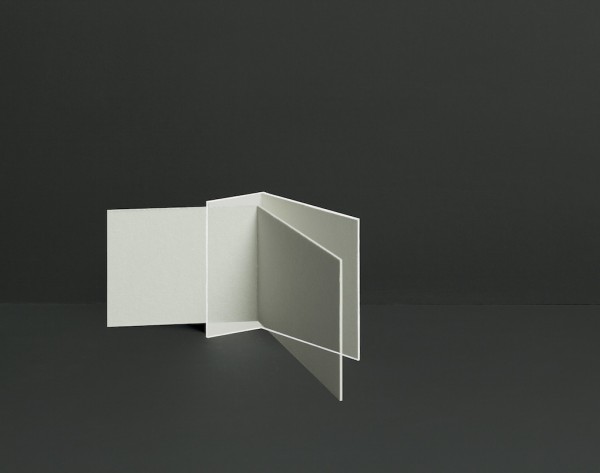
Miriam Böhm. Equally III, 2015; chromogenic print; 23 x 29 in. Courtesy of the Artist and Ratio 3, San Francisco.
The conceptual artist Jan Dibbets made his first Perspective Corrections in 1967, around the same time that he was experimenting with optical illusions in sculpture and painting. When photographing some of his artworks, the artist realized that the viewpoint of the camera could transform the shape of the object, removing the simultaneity of perspectives inherent in viewing a sculpture and fixing it in time and space.1 Dibbets came to make this metamorphosis a focal point of his practice, producing images such as Perspective Correction, My Studio I, 2: Square with 2 Diagonals on Wall (1969) that underscore the ambiguity of depth in the flat plane of the photograph. For At On, her third show at Ratio 3, Miriam Böhm has pushed the limits of her studio-based photography practice in the vein of Dibbets, creating confounding, abstract, minimalist images of intersecting geometric forms and planes. She has also translated her photographs into her first sculptural works, which likewise perplex.
The artist’s first foray into sculpture—the series Mutual (2015)—occupies the rear portion of the main gallery. With pedestals painted white to match the gallery walls, the sculptures appear to hover in midair when viewed from the entrance in the slanting afternoon light. Atop each pedestal perches an object composed of intersecting glass planes framed in dark walnut; photographs of wood grain printed on vinyl are adhered to the surface of the glass. Unlike Dibbets, who looked to photography as a means to eschew the multiple viewing angles demanded by sculpture, Böhm embraces the changing perspectival experience created when one moves around her objects. In Mutual I (2015), the printed vinyl strips form a pair of rhombuses positioned at perpendicular angles across the glass panels. Because the glass panes are clear and we can see through one form to the other—and also because the walnut frame holding the panels matches that of the printed vinyl—the result is a layering of lines that, when viewed head-on, appears flat and two-dimensional, like a drawing. As one moves around the work, however, the rhombuses shape-shift as the angles of intersection change.





