







Detroit
Ragnar Kjartansson: The End at the Museum of Contemporary Art Detroit
The Museum of Contemporary Art Detroit (MOCAD) presents Ragnar Kjartansson’s gorgeous and shrewd video installation The End (2009). On five rear projection screens, Kjartansson and his collaborator, Icelandic musician Davíð Þór Jónsson, play all of the parts of an unidentified country-music song on piano, banjo, drums, and acoustic and electric guitars. Shot in the Rocky Mountains in Canada, both men are bearded and dressed in raccoon-fur hats, shearling coats, and jeans. Kjartansson’s smartly staged romantic concert of two musicians tests the limits of “naturalness” while also invoking the awe of a pristine and secluded landscape.

Ragnar Kjartansson. The End, 2009; video. Courtesy of MOCAD, the Artist, Luhring Augustine, New York, and i8 Gallery, Reykjavik.
Like Edmund Burke’s sublime landscape,[1] which informed 18th- and 19th-century romantic landscape painting and writing,[2] Kjartansson positions human beings as solitary and commanding against the vast and sometimes chaotic natural world. Devoid of the architectural markings of human development, Kjartansson’s landscape is a field of white snow, mountains, and pine trees. Each of the five videos in the installation begins with shots of a landscape that includes the musicians’ equipment and instruments. Kjartansson and Þór Jónsson walk into the frame to play their song for thirty minutes and then walk off camera and into the landscape. This suggests that the landscape is the stable entity, with the duo intervening only for a brief time. Without a visible audience, the duo plays for themselves and the camera. However, at one moment, Kjartansson turns and plays toward the canyon below, pauses, and then listens as the music echoes off the ravine and disappears. While sited in the mountains, the musicians also play to it, suggesting landscape as a dynamic thing in itself.
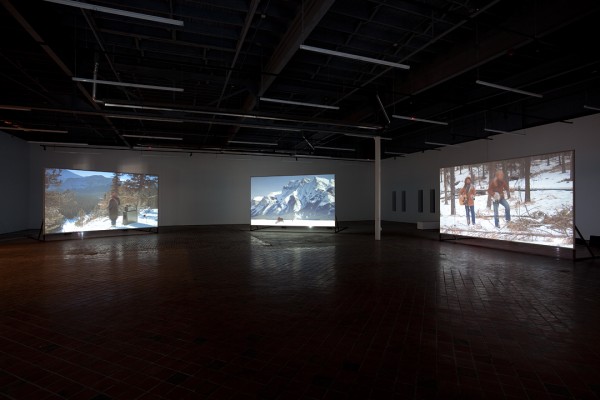
Ragnar Kjartansson. The End, 2015; exhibition installation view. Courtesy of MOCAD, the Artist, Luhring Augustine, New York, and i8 Gallery, Reykjavik.
Just as the landscape surrounds Kjartansson and Þór Jónsson, the five screens of the installation surround the exhibition’s viewers. Without any obvious edits or special effects, the videos take on a documentary quality and the camera angles create an almost 360-degree panoramic view, suggestive of an omnipresent eye that sees everything simultaneously. However, each video is shot at a different location, with Kjartansson and Þór Jónsson appearing simultaneously on the five screens. Standing in the middle of the installation, viewers are immersed in the landscape, but in a mediated form.
While Kjartansson’s work speaks to a “naturalness” of landscape, he suggests but never reveals the monumental feat of creating the video. We never see Kjartansson hauling a grand piano out into the mountains, but its presence in the wilderness suggests the romantic grandeur of his project. Moreover, we know that the microphones and amplifiers require electricity, presumably provided by an off-camera generator, as no other electrical sources exist in the Canadian Rockies. While Kjartansson does not reveal the tremendous effort of this production, these unnatural elements contrast with the untainted landscape. Adding to the heroism of the production, the artist and musician endured -4 degree Fahrenheit weather and play their instruments stoically, only occasionally rubbing their hands to warm them.
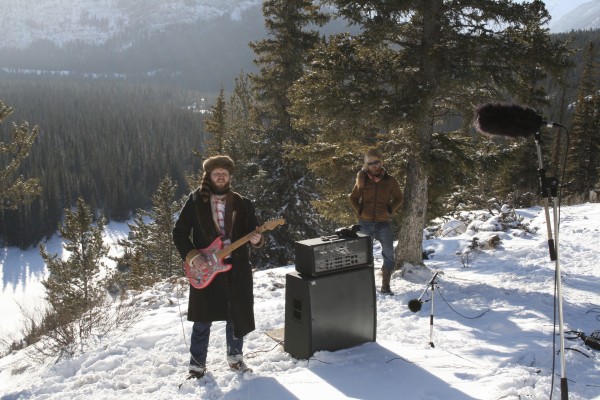
Ragnar Kjartansson. The End, 2009; video. Courtesy of MOCAD, the Artist, Luhring Augustine, New York, and i8 Gallery, Reykjavik.
Kjartansson and Jónsson reference a Davey Crockett-like outdoor woodsiness and traditional North American roots music, which as Icelanders they only have a secondhand or media-based relationship with. In raccoon-fur hats and beards, Kjartansson and Þór Jónsson sip whiskey and smoke cigarettes. While playing, the duo occasionally fall to their knees while playing guitar or stand up while emotively playing piano. Despite these theatrics, Kjartansson and Þór Jónsson refrain from hamming it up further with camera effects, close-ups of their grimacing and intent faces, or tempo breaks that would highlight these gestures. In addition to the more traditional instruments (a banjo, acoustic guitar, and piano), Kjartansson includes a small glittery pink electric guitar, which complicates his portrayal of country music.
As a former pop-music star with the Icelandic bands Kanada and Trabant, Kjartansson’s hybrid practice probes the relationship between performance and music through duration. Originally created for the 2009 Venice Biennale, The End dialogues with its companion piece The End – Venezia (2009). For The End – Venezia, Kjartansson transformed Iceland’s pavilion into an artist’s painting studio and had fellow Icelandic performance artist Páll Haukur Björnsson act as his life model for the entire six months of the exhibition. The artist is scheduled to produce a new piece for MOCAD in February of 2016, and if he continues on this trajectory, one might expect an endurance piece that breaks down the conventions and myths of the artist and musician in gorgeous and wry ways.
[1] Philosophical Inquiry into the Origin of Our Ideas of the Sublime and the Beautiful (1757).
[2] http://www.tate.org.uk/learn/online-resources/glossary/s/sublime





