







New York
Anicka Yi: You Can Call Me F at The Kitchen
At the entrance to the black box of the Kitchen’s upstairs gallery, a long vitrine houses an illuminated culture of bacteria on agar jelly. The cracked slab teems with biological entities colored like bruises on sallow skin. Imprinted with capital letters, it reads: YOU CAN CALL ME F. Anicka Yi’s current solo show stages part breeding ground, part containment camp for “F”—the feminine, the woman as concept. A series of thick plastic tents are illuminated from within by work lights and white neon. They house sculptural environments clandestinely alive with the biological samples of a hundred women, hand-collected by the artist.

Anicka Yi. Grabbing At Newer Vegetables, 2015; Plexiglas, agar, female bacteria, fungus; 84.5 x 24.5 in.
Courtesy of the Artist and 47 Canal. Photo: Jason Mandella
In Yi’s dark alternative laboratory, colorful symbols on the quarantined hubs suggest futuristic biohazard indicators. Viewers peek into the tents through slits in the soiled flaps; the dense, clear sheets are covered in grimy fingerprints and other smeared markers of human presence. The methodology of the lab is such that the boundary between Yi’s samples and those who care for them is nonexistent, both subjects’ traces unhygienically everywhere.
Yi’s sculptures are often fields designed to trigger emotional response. The artist has produced a series of elegant meditations on such fundamental affective conditions as death and divorce, deftly aestheticizing fraught feelings through the conflation of signifiers. Yi’s poetic sense of allusion carries through in You Can Call Me F, but it is messier here, more sprawling, as elusive as the concept of female itself.

Anicka Yi. You Can Call Me F, 2015; installation view, The Kitchen, New York City. Photo: Jason Mandella
The fragile biological ecosystems inside the tents are a fusion of organic and inorganic materials. A spaghetti of fabric and plastic jewels spills out of a stainless-steel cauldron, a crude circle of tar lines the floor, inscrutable motorcycle helmets slowly pivot atop poles. In one tent, a series of hides are hung out as if to dry; in another, an orb covered in what might be skin shavings or garlic cloves teeters precariously on a table’s edge. The viewer is awarded glimpses of these strange arrangements, but the implied limit of the tent’s quarantine precludes a full comprehension. Visitors are reminded of the dangerous, slippery category of female. Yi’s installation cultivates such anxieties surrounding the classification of the term and the linguistic terrorism that exists between gender, sex, and subjectivity.
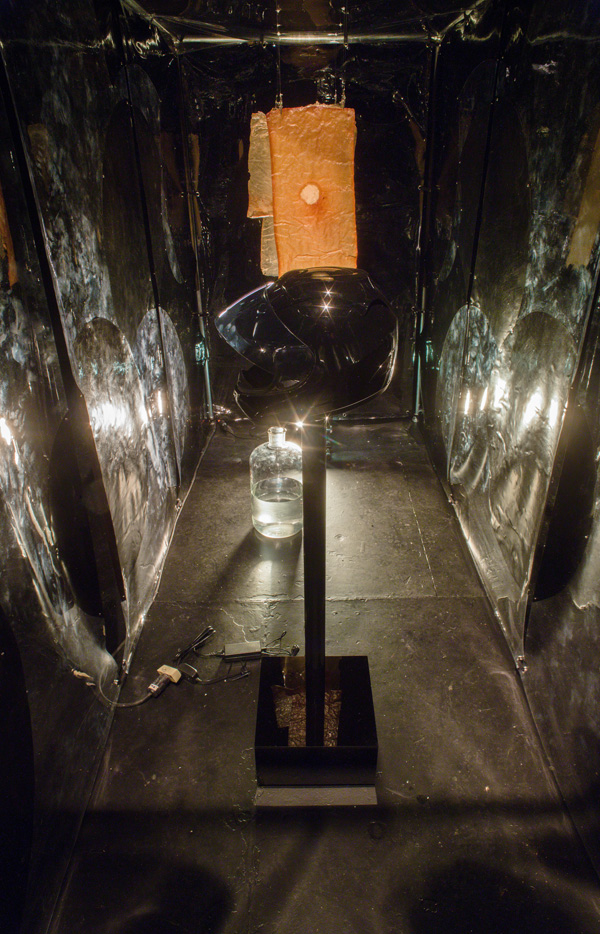
Anicka Yi. Fontenelle, 2015 (detail); vinyl, steel pipes, motorcycle helmet, scent diffuser, glass container, water, kombucha scoby leather, nylon string, worklight; 122 x 78 x 50 in. Courtesy of the Artist and 47 Canal. Photo: Jason Mandella
Yi’s published list of her one hundred subjects reads like a survey of dynamic women in the art world: Rachel Uffner, Bridget Donahue, Stefania Bortolami, Xavier Cha, Juliana Huxtable, and the artist’s dealer Margaret Lee, to omit many. In this way, her sample set is charged both by its powerful essence and by the historical marginalization of women in art. Yi’s frankensteined cultures acknowledge the legacy of the containment of the feminine even as the artist seeks to cultivate it as a crop. Science is turned upon itself, the technology responsible for the destructive categorization of women now reimagined in the service of new classifications—ones that amplify the chaotic hybrid power of the subject. Yi’s tents are beacons of a fantasy eco-terrorism, predictions of a revolution fueled by the fortified biology of the female subject.
Anicka Yi: You Can Call Me F is on view at the Kitchen in New York City through April 11, 2015.





