







Los Angeles
William Binnie: Flame as Flag at Paul Loya Gallery
William Binnie’s exhibition at Paul Loya Gallery in Culver City emerged from a residency granted to the Dallas-based artist by the Rauschenberg Foundation in Captiva, Florida, this past summer. While there, the artist made a series of paintings in bleach on denim drawn from photographs of fires set by political radicals. Binnie’s paintings merge Rauschenberg’s photo-transfer aesthetic with Andy Warhol’s fascination with media spectacle—the grimmer, the better. Like Warhol did with his car crashes, Binnie represents destruction and death from an arm’s-length perspective. The intense fires that consume cars and buildings in his works take on a cool, ghostly affect.
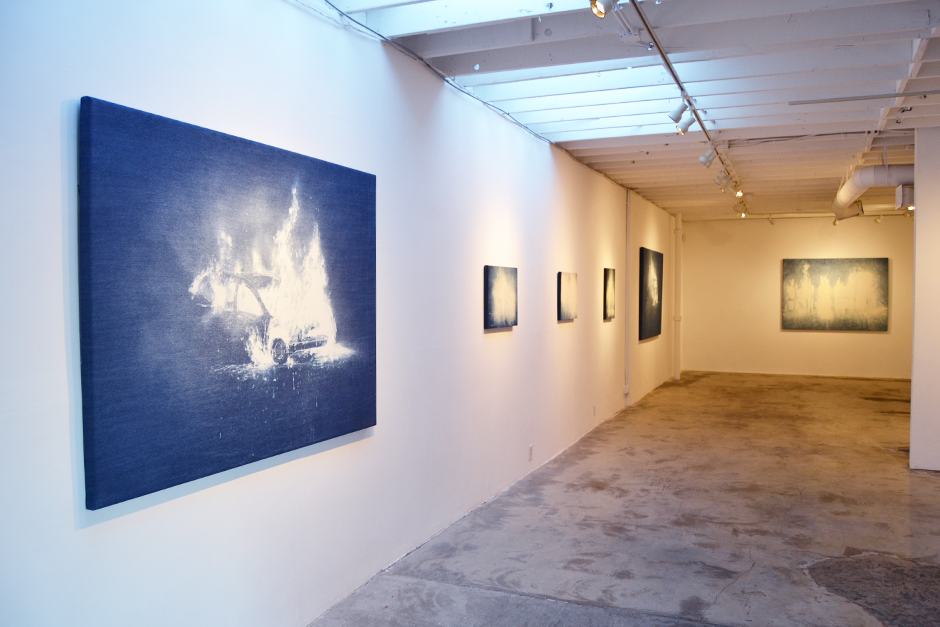
William Binnie. Flame as Flag. installation view, Paul Loya Gallery.
Binnie draws his subject matter from documentary images of riots from around the world. His selections suggest equivalences between a car set alight by Islamists in Pakistan and a church burned by black metal enthusiasts from Sweden. If his interest is in “locating the social embedded in his chosen materials,” he seems to be identifying a global trend of disaffected subjects of all political stripes finding solidarity in acts of property destruction, rejecting both a culture of accumulation and the rule of law. The bleached cotton ranges from cool to warm tones, producing a surprisingly effective representation of the flames’ intense warmth. The materialistic architectures of the city dissolve in the glow. The best works, such as Untitled (Church) (2014), allow these structures to all but disappear. The weakest, such as A Flag (The Flag) (2012), suggest a teenage rebel’s denim jacket, long outgrown.
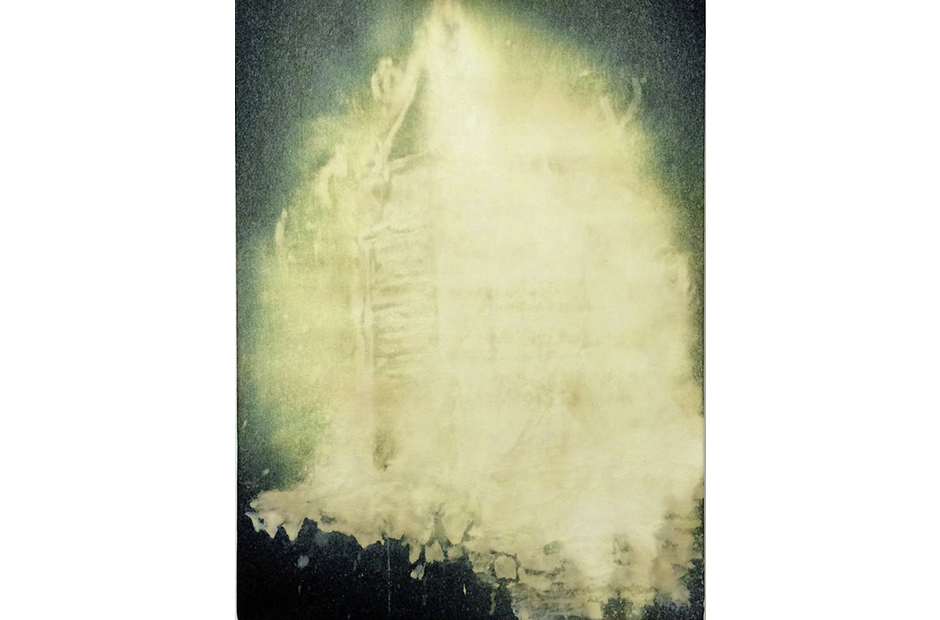
William Binnie. Untitled (Church), 2014. Bleach on denim. 24 x 18 in. Courtesy Paul Loya Gallery.
Binnie applies bleach directly to cotton denim in order to create these works, which retain the brushwork and object-hood of painting in a color palette reminiscent of early cyanotype photography. The conceit of painting in negative is clever, and the technique, which derives from DIY punk fashion, is used to elegant effect. Combined with the source material, the style transcends gimmick, though it is difficult to imagine it working as well with any other content represented. Even so, the work feels superficial, informed more by the rebellious (and misnamed) nihilism of Johnny Rotten than the socially conscious anarchism of Antonio Gramsci.
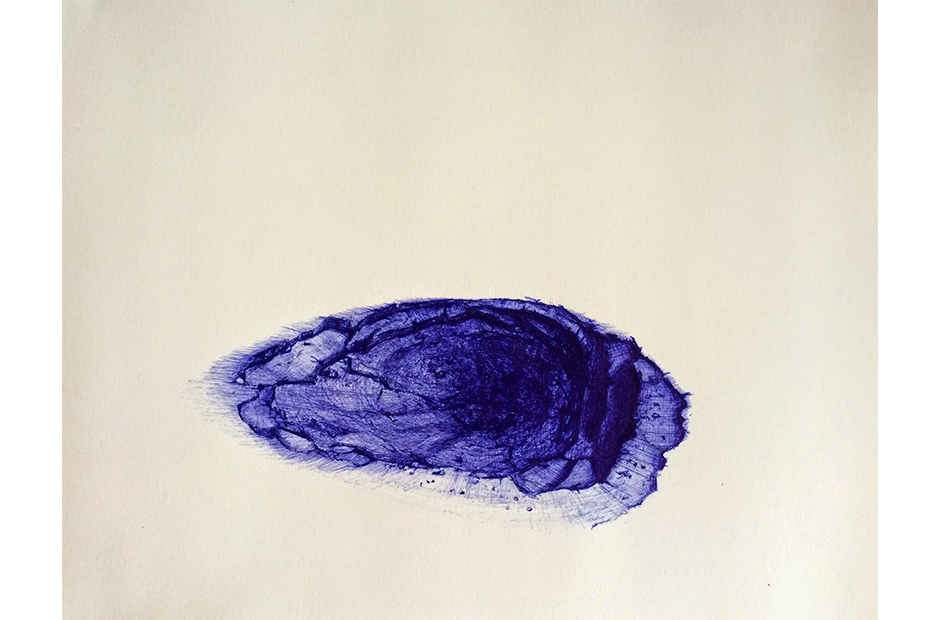
William Binnie. Car Bomb, 2014. Ballpoint pen on paper. 9 x 12 in. Courtesy Paul Loya Gallery.
A series of ballpoint pen drawings reverses the white-on-blue palette of the paintings. The works titled Car Bomb (2014) appear like flesh wounds or moon craters within the field of the page. More images of tattered flags again lack the subtlety of the other works. Flame as Flag is a compelling idea when applied to the notion of individuals rallying around acts of arson as a politically unifying tactic. That power dissipates when the flag becomes literal.
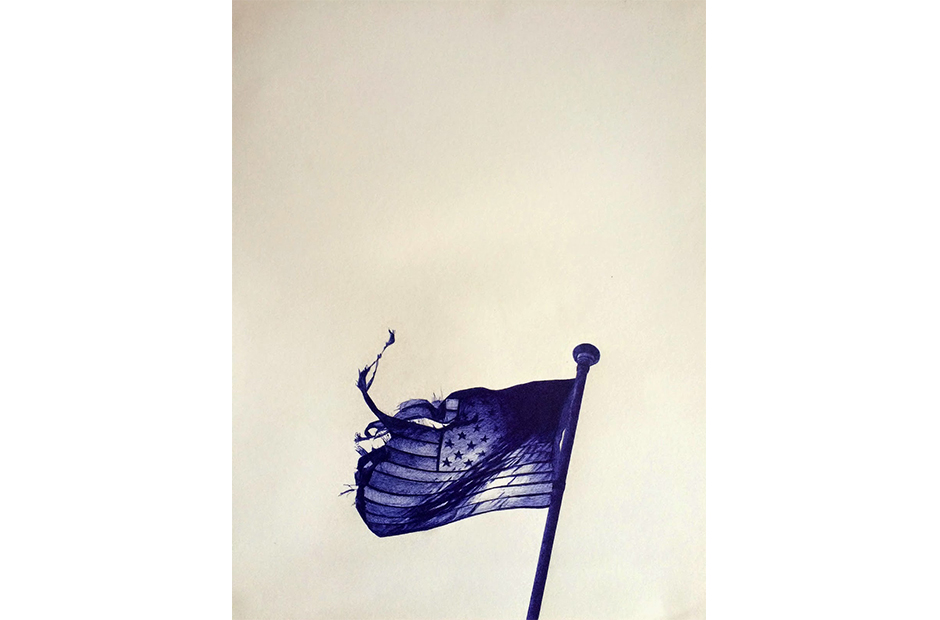
William Binnie. A Flag (The Flag), 2014. Ballpoint pen on paper. 12 x 9 inc. Courtesy Paul Loya Gallery.
Rauschenberg used lighter fluid as the medium to transfer photo emulsion onto the surfaces of his paintings, immolating images in potentia that were incendiary in their queer sensibility. Warhol showed us the violence of the state—race riots, the electric chair—as a national pastime, an electronic gallows in the town square. Both artists retained an edge in their works that Binnie is not able to achieve. Perhaps the contemporary moment is so media-saturated that such images no longer have an effect. Or perhaps the paintings’ bleach-and-denim materiality is too apparent to recede behind the subject matter. Maybe radical art needs the official context of the art museum to push against, and a commercial gallery simply feels too safe. The revolution, after all, will not be on consignment.
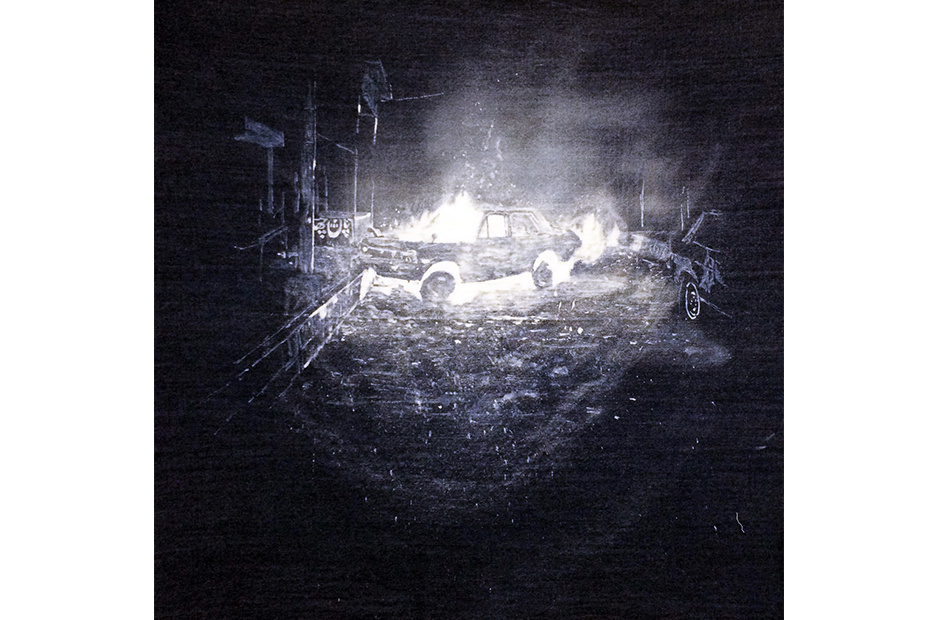
William Binnie. Untitled (Pakistan), 2014. Bleach on denim. 54 x 54 in. Courtesy Paul Loya Gallery.
William Binnie: Flame as Flag is on view at Paul Loya Gallery in Culver City through March 7, 2015.





