







Room Full of Mirrors: The Dazzling Life And Legacy Of Monir Shahroudy Farmanfarmaian
Today from our friends at REORIENT, we bring you an excerpt from Nicola Baird‘s feature on the life and work of artist Monir Shahroudy Farmanfarmaian. Baird explains, “Monir’s works present a world wherein everything is moving to transformative effect.” This article was originally published on January 5, 2015; an exhibition of Monir’s works will open in New York at the Guggenheim on March 13, 2015.
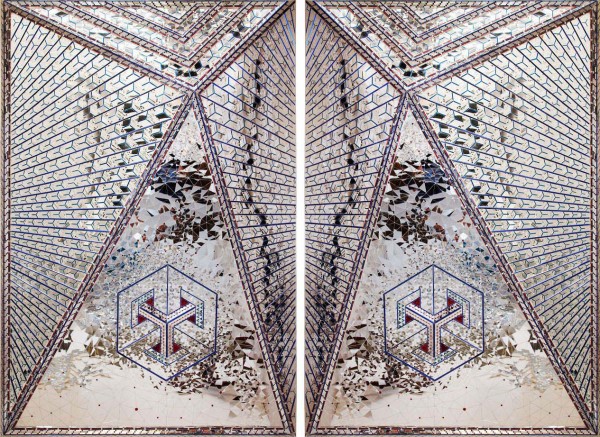
Monir. Lightning for Neda, 2009; Courtesy the Artist and The Third Line
The artist who signs her work simply as “Monir” is a prolific and interdisciplinary figure whose 70-year-plus career is currently being celebrated in a retrospective exhibition curated by Suzanne Cotter at the Serralves Museum of Contemporary Art in Porto, Portugal. Infinite Possibility–Mirror Works and Drawings is the first museum survey of work produced by the nonagenarian between 1974 and 2014, which will also travel to other venues across the world, beginning with the Guggenheim in New York. Undoubtedly a pioneer, Monir is not only the most renowned, but perhaps also the only practitioner working today in the sphere of mirror mosaics.
Monir melds in her hypnotic hybrid creations the legacy of traditional Iranian architectural adornment with an awareness of the aesthetics of abstraction and minimalism made popular by her friends and contemporaries in New York in the 60s, such as Frank Stella and Robert Morris. The majority of the works selected have been drawn from the artist’s own collection, and have not been exhibited in public since the 70s. Included are early mirror reliefs on plaster and wood – spontaneous, energetic compositions accented with glimpses of nightingales nestling amid florid bouquets of flowers and fragments of broken Qajar paintings behind glass—and a series of large-scale geometric mirror works that formed part of a solo show organised by Denise René at her gallery in Paris in 1977. The exhibition also features previously unseen abstract arrangements on paper—many of which were made in exile in New York in the absence of a proper studio in the years following the 79 Iranian Revolution—a series of heptagonal works, four mirror balls (one of which famously lay atop Andy Warhol’s desk until his death in 1987), and a graduated ziggurat-shaped sculpture of particular architectural beauty.





