







New York
Charles Atlas: The Waning of Justice at Luhring Augustine
“Glitter/Utopia,” “Boring/Because,” “Decade/Asshat,” “Wartime/Paisley”: These are a few of the word combinations that appear in Charles Atlas’ two-channel video projection, Ethel’s Fortune or The Waning of Justice (2015), currently filling two expansive, adjacent walls at Luhring Augustine’s Chelsea location. Each term in the dyad phases into position in front of footage of a maritime sunset while the letters themselves open up similar vistas contained within their block forms. Alone, this composition does not amount to much: an exquisite corpse and a field of solar kitsch, folded into one another with the aid of pedestrian video-effects software.

Charles Atlas. The Waning of Justice, 2015; installation view, Luhring Augustine, New York. Photo: Farzad Owrang.
But it is not alone. Ethel’s Fortune has three companion pieces, Terri’s Option (2015), Chai (2015), and Kiss the Day Goodbye (2015). Although described by the gallery as autonomous works, the four are linked by shared medium, duration, subject matter (most involve sunset footage that Atlas captured while at the Rauschenberg Residency in Florida), and an audio track composed by the London-based electronic artist Helm. Their combined presence creates what the gallery aptly characterizes as “one dynamic visual experience” (effectively having it both ways): an immersive, Rothko-esque bath of fiery ochres, salving lavenders, and darkling blues, in places interpolated by digital enumeration, notably countdowns. The latter element, paired with Helm’s soundtrack of gloomy, anxious electronica followed by a funerary bagpipe, serves to evoke the more brooding connotations of sunset. Behind the brilliance, we perceive a harbinger of inevitable darkness.
Charles Atlas. The Waning of Justice, 2015; installation view, Luhring Augustine, New York. Photo: Farzad Owrang.
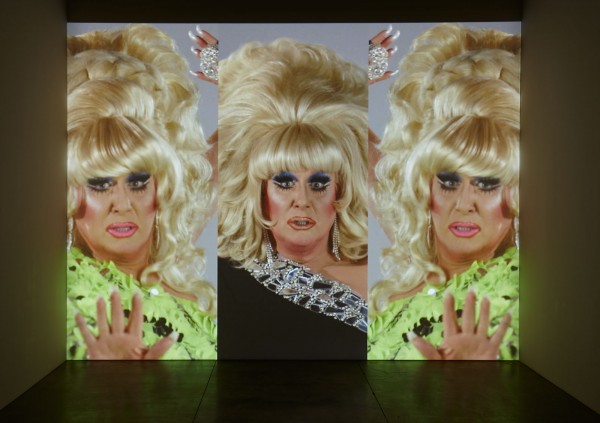
There is a fourth companion piece, less immediate but nevertheless inextricable from the sensational meld that characterizes the exhibition. Titled Here She Is…v1, this video gives a soapbox to an exuberant and monumentally wigged drag queen, who with Southern charm rambles breezily but articulately through front-page topics ranging from trade agreements, to energy summits, to war profiteering. Though installed in its own room, this projection is clearly visible and audible from the anterior gallery, and its duration (just under twenty minutes) aligns exactly with that of the other pieces. With the dazzlingly cataclysmic sunsets and portentous musical soundtrack nearby bleeding into her performance, this improbable political commentator takes on a phantasmagoric presence: a talking head belonging to a world on a knife edge between utopia and dystopia. An absurd resolution comes by way of a lip-synced musical number, pumped loudly through all the galleries.
By now, such tendencies toward immersion and interdisciplinarity (borrowing from the worlds of music or performance) are hallmarks of contemporary art. (The exhibition I most recently reviewed for this publication, Pierre Huyghe at the Los Angeles County Museum of Art, is a shining example.) While signaling a liberation from modernist doctrines of autonomy and specificity that held firm almost until the end of the past century, exhibitions like The Waning of Justice also make clear the ambivalences and pitfalls within this turn—here most clearly evident in the gallery’s untenable claim that the five individual works remain autonomous despite their syncing, shared components, and unified installation. Indeed, it is clear that in order to work its magic, Atlas’ recent art requires a highly specific, technologically outfitted exhibition environment. It is impossible not to see this as a move toward confinement as much as toward liberation.
The Waning of Justice is on view at Luhring Augustine through March 14, 2015.





