







Interviews
The New Endurance of Linda Mary Montano, Part 1
Today, from our partner site Art Practical, we bring you an excerpt of Patricia Maloney‘s conversation with artist Linda Montano, who says, “I am most authentic when I am performing. I am really 100 percent there. I can’t say that about any other aspect of my life.” This interview was originally published on January 19, 2015.
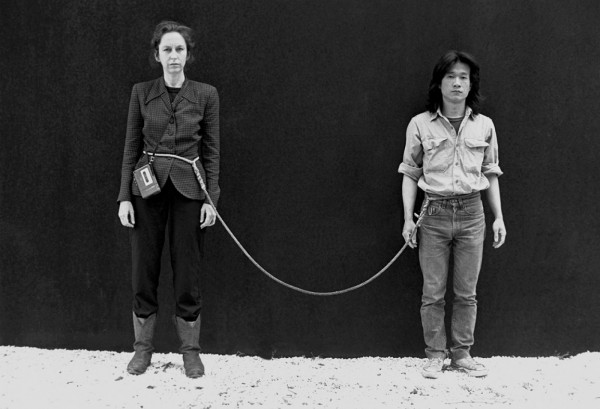
Linda Mary Montano with Tehching Hsieh. Art/Life: One Year Performance 1983–1984 (Rope Piece), 1983–84 (still); performance documentation. Courtesy the Artist.
Linda Mary Montano, born in 1942, is a seminal figure in the field of feminist performance art. She came to prominence in the 1960s and is best known for performances of long duration that require tremendous endurance on the part of the artist. Some performances have lasted as long as fourteen years; others have required her to be bound and blindfolded and to undergo hours of physical exertion. Her most significant contribution to the field of performance art, however, is the incredible empathy she conveys to her audience. Hers is a practice of affirmation, meditation, and empowerment.
Patricia Maloney: How would you define the correspondence between performance as a spiritual practice and as a feminist practice?
Linda Montano: It took a lot of therapy and a lot of prayer and a lot of spiritual counseling to understand that question. It’s really asking the inner child to heal and to have permission to dialogue with both brains. As a performance artist, I get to play in the right brain without critique. But as the feminist woman–priest Catholic performance artist, there is incredible suffering to pull that inner child out of her position and out of that jail of the past into the dignity of both brains.
PM: Do you think that is why you created some of these early performances, like Handcuff (1973), or Art/Life: One Year Performance 1983–1984 (Rope Piece), in which you are tethered to other individuals? They were, in a sense, keeping you in that jail, was it not?
LM: Well, in both cases, it was with men. It’s almost like seducing the teacher, you know? I’m sharing the power with the patriarchy in both those pieces. Tom [Marioni] was the king of the conceptual art scene here in San Francisco, and Tehching Hsieh was the reigning guru of endurance. They’re about sharing the power but also could be seen as rubbing up against the power. I now see them as both. But it takes a great deal of healing in order to see it as both and not just the slave of the patriarchy, or as the object or accouterment of the male.





