







San Francisco
Robert Frank in America at Cantor Arts Center
From our partners at Art Practical, today we bring you a review of a new exhibition of Robert Frank’s photographs at the Cantor Arts Center at Stanford University. Though these photographs are now sixty years old, they are still surprisingly relevant; author Danica Willard Sachs remarks, “Through revealing details, Frank charts the uneasy political geography of a vast country on the verge of change.” This article was originally published on December 18, 2014.
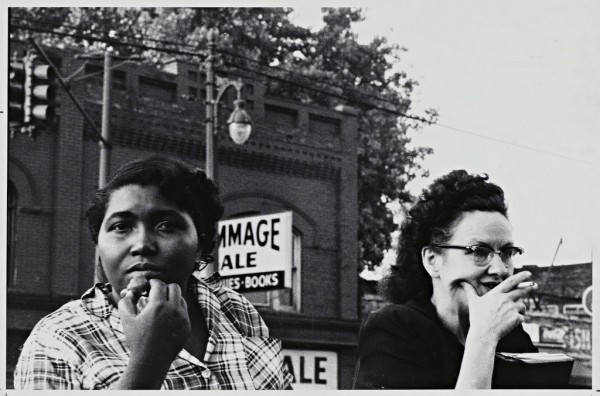
Robert Frank. Detroit, 1955; gelatin silver print, 8 ½ x 13 in. Courtesy of Cantor Arts Center at Stanford University. © Robert Frank.
Few landmarks in photographic history loom as large as Robert Frank’s The Americans. This seminal book has been so widely exhibited, riffed on, and dissected, it would be easy to assume that the Cantor Arts Center’s current exhibition, Robert Frank in America, does little to expand on the narrative surrounding this body of work. Instead, the exhibition, curated by Peter Galassi, surprises with a host of unfamiliar photographs drawn from the Cantor’s collection paired with some favorites from the original series. The result is a survey that reveals how The Americans was distilled from hundreds of equally captivating photographs to a neat eighty-three.
Swiss photographer Frank was most productive between 1955 and 1956, when a Guggenheim Fellowship allowed him to travel across the country. Aside from the photographs that eventually became part of The Americans, the bulk of Frank’s work from this time has been largely unseen. The Cantor’s exhibition flushes out this period. As Galassi writes in the accompanying catalog, “In all of Frank’s American work there are no natural wonders, no amber waves of grain, no mighty ports, no grand public monuments, no cozy towns or bright lights of Broadway.” Instead, Frank focused on politics, race, religion, Hollywood, and cars—themes that organize the Cantor’s exhibition—creating compositions that highlight the quirks and eccentricities of American culture.





