







Fan Mail
Fan Mail: Ben Bigelow
Two sets of blinds layered over each other—one horizontal, one vertical, both a brilliant clean white—open and close slowly with nearly imperceptible movement. Like a dancer spinning in an endlessly repeating circle with no clear beginning or end, they move without purpose. When fully open, they form a matrix-like grid of perfect, uniform squares with an infinite series of colors glowing beneath, shifting, chemical, and delicate. All of this takes place on a flat-panel monitor flipped on edge—a rectangle taller than it is wide, framed with white wood to hide the cold boundaries of the screen.
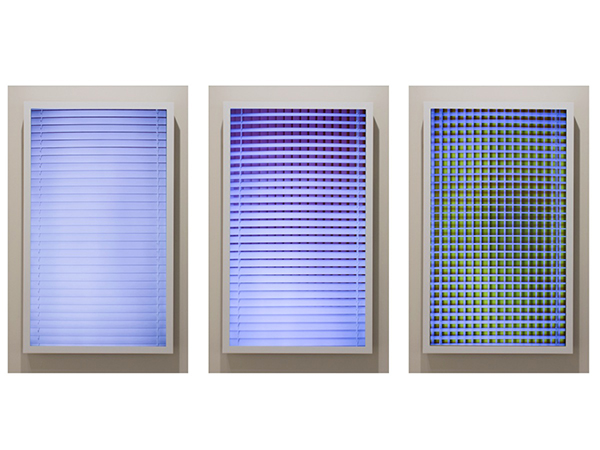
Ben Bigelow. Shift, 2014; generative video software, framed flat-screen monitor, computer (three still images); 43 x 26 x 2.5 in. Courtesy of the Artist.
In Shift (2014), a palpable tension exists among the pulsing matrix of endless colors, the shifting vertical and horizontal lines, and the flat yet sculptural qualities of the monitor. Throughout his work across media—including video, installation, sculpture, photography, and performance—artist Ben Bigelow often employs a measured tension that juxtaposes politics, humor, history, and an investigation of digital versus analog technologies.
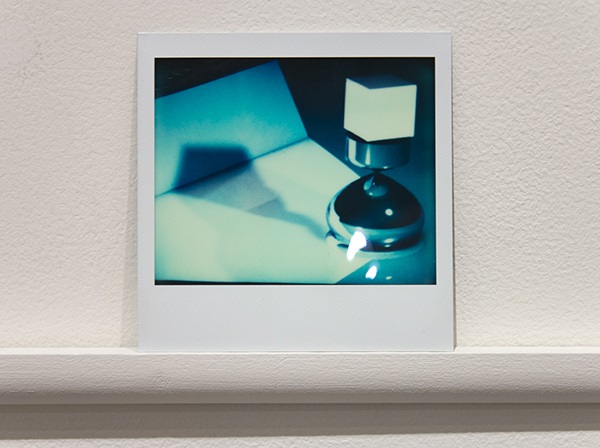
Ben Bigelow. Screen Shot 2014-03-06 at 3.18, 2014; Polaroid instant film; 4 x 4 in. Courtesy of the Artist.
In the Screen Shot series (2014), Bigelow continues his investigation of the tensions between digital and analog technologies. This set of fifteen Polaroid photographs of computer-generated setups also explores and expands the commonly made distinctions between photography, animation, and painting. Screen Shot 2014-02-23 at 3.18 (2014), like other works in the series, could be a still life of real, physical objects, created in three-dimensional space—at least at first glance.
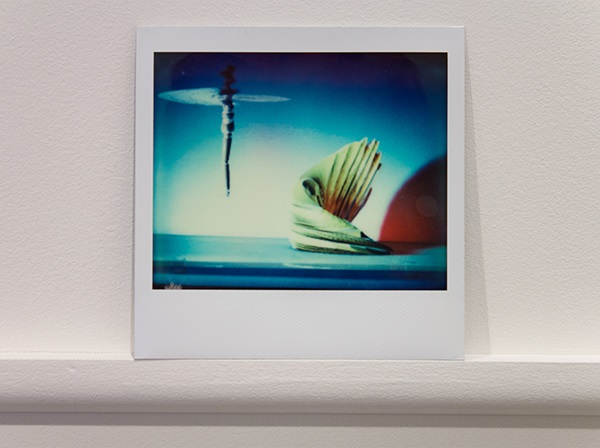
Ben Bigelow. Screen Shot 2014-02-23 at 5.12, 2014; Polaroid instant film; 4 x 4 in. Courtesy of the Artist.
In the image, a white cube sits atop what appears to be a glass or plastic stand, casting a long shadow—that looks very much like the top of a lamp post—onto a folded sheet of paper. However, upon closer review, the surfaces and the shapes aren’t quite plausible; they are too soft, glossy, and amorphous.
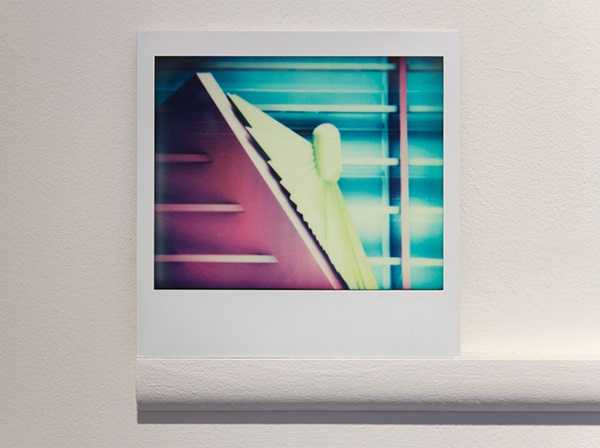
Ben Bigelow. Screen Shot 2014-02-17 at 2.51, 2014; Polaroid instant film; 4 x 4 in. Courtesy of the Artist.
Bigelow creates each three-dimensionally rendered still life on a computer and then photographs the screen with a Polaroid camera to create these perplexing works. Some compositions, like Screen Shot 2014-02-23 at 5.12 (2014), look and feel real but are nearly indefinable; each of the elements exist less as recognizable objects and more like abstract motifs from a painting or sculpture. Like puzzles flipped on their heads, the Screen Shot works vacillate between being recognizable and opaque, somewhere between real and hyper-real.
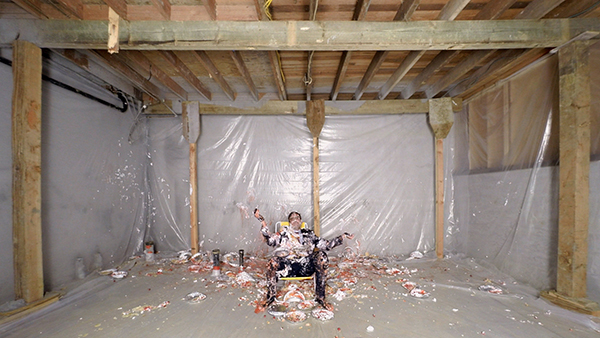
Ben Bigelow. With Sounding Brass and a Tinkling Cymbal, 2014; video installation (still); 11:42. Courtesy of the Artist.
In another body of work titled With Sounding Brass (2014)—which includes a video installation, a photograph, and a sculpture—Bigelow approaches the current climate of political gridlock and stagnation that exists within American government. The life-size video installation depicts Bigelow, dressed in a blue suit and red tie, repeating a twelve-minute apology for an unknown yet easily imagined act of malfeasance.
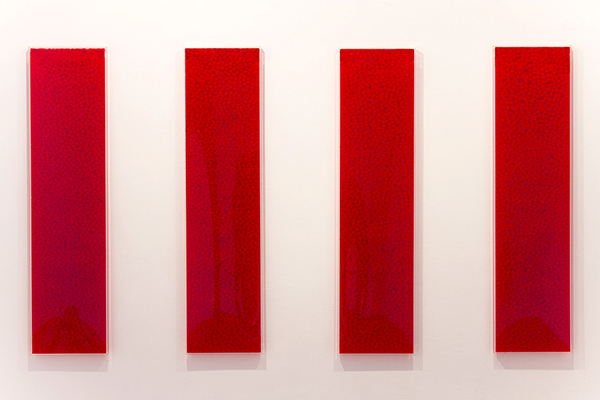
Ben Bigelow. The Four Freedoms, 2014; maraschino cherries and juices encased in Plexiglas; 48 x 12 x 1 in. (each). Courtesy of the Artist.
With each utterance of the words “I’m Sorry,” a cherry pie is thrown at Bigelow from somewhere offscreen until he is nearly unrecognizable from the character at the beginning of the video. Pie throwing has been associated with both comedy and tragedy, and in this case becomes a metaphor for the absurdity of the current political challenges facing the two dominant and often obstructionist political parties that govern the nation from Washington, D.C. In The Four Freedoms (2014), Bigelow replicates the flag that was created after a famous 1941 speech by President Franklin Delano Roosevelt, in which Roosevelt outlined the four liberties—freedom of speech, of worship, from want, and from fear—as the central tenets of democracy. In this flag, four red bars are meant to evoke the four freedoms, each with its own vertical pillar of democracy.
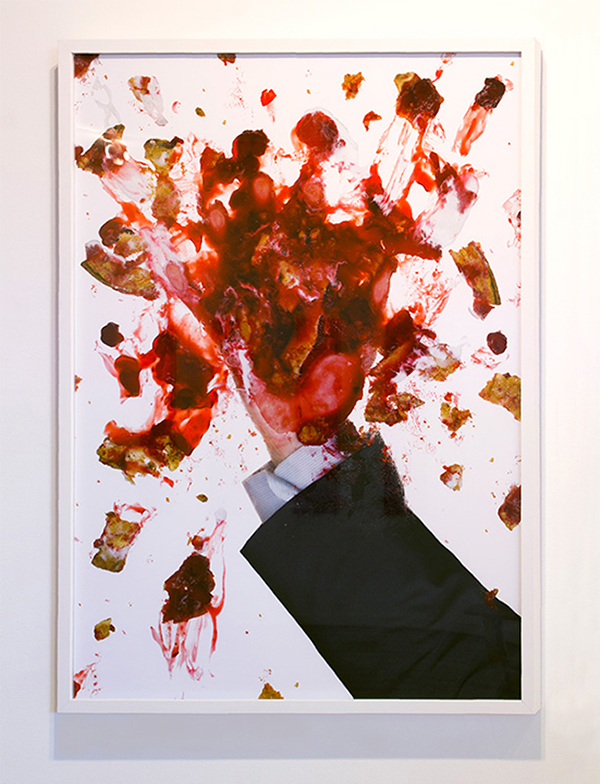
Ben Bigelow. Zeal!, 2014; pigment print; 34 x 47 in. Courtesy of the Artist.
The Four Freedoms is a large-scale installation in which Bigelow filled four wall-mounted vitrines with maraschino cherries and their red syrup. From a distance, the four cases appear as solid sculptures painted a vibrant red; the use of cherries, however, lends a comical and critical edge to these works—as though to state that simply outlining four freedoms as the basis for an incredibly complex and seemingly failing political system is at best naïve and at worst quite possibly dangerous.
Each body of work Bigelow creates is distinct from the next. The varied forms and subjects he tackles create a resounding tension between seemingly simple ideas and subjects. Furthermore, all of his works convey more than what is initially visible. They require long—yet rewarding—looking, as each holds a strong blend of political critique and perceptual experimentation, both overt and subtle.
Ben Bigelow has an MFA from Stanford University, a BFA from Carnegie Mellon University, and has studied at the Lexia International in Berlin, Germany. His work has been exhibited in solo and group presentations across the United States including the Pittsburgh Filmmakers Gallery, Pittsburgh, PA; 533 Gallery, Los Angeles, CA; ACRE Projects, Chicago, IL; Institute of Contemporary Art, Philadelphia, PA; Kala Gallery, Berkeley, CA; City Limits Gallery, Oakland, CA; and Kathleen Cullen Fine Arts, Brooklyn, NY.





