







Best of 2014 – Ann Hamilton: The Common S E N S E at Henry Art Gallery
For our Best of 2014 series, Fan Mail columnist A. Will Brown selected Sarah Margolis-Pineo’s review of Ann Hamilton’s recent solo show in Seattle. Says Brown, “Sarah‘s review of The Common S E N S E at the Henry Art Gallery provides key insights into Hamilton’s ability to engage an audience across senses—touching, seeing and hearing—through multifaceted artwork that is grounded in a sense of urgency. The exhibition also brings to light the importance of collecting objects and experiences through conscious participatory and shared methods.” This review was originally published on December 5, 2014.

Ann Hamilton. The Common S E N S E, 2014. Courtesy of Henry Art Gallery, Seattle. Photo: Jonathan Vanderweit.
I was instantly drawn to the Siberian Rubythroat. It must have been the vibrant red flash of exposed underbelly that first caught my eye, but it was the bird’s placement that focused my attention, a diminutive creature adrift in a mauve fog. The Rubythroat is just one of 200 animal specimens that have been scanned, printed in multiple, and hung in a mosaic of thick newsprint pads covering the Henry Art Gallery’s walls. Amid the mashed fur pelts and abstracted hoofs, claws, and beaks of the unruly ecosystem on view, something about the Rubythroat’s smallness—a ghostly thing to be cradled in hand—compelled me to reach up, take tentative hold, and slowly tear the bird’s portrait down from the wall.
This exhibition by Ann Hamilton, The Common S E N S E, is a constellation of objects, images, textures, and sounds—a multisensory splendor that invites visitors to look, touch, and listen as they wind circuitously through the museum’s galleries and halls. The menagerie is just a single component to Hamilton’s multifaceted production. The exhibition weaves text and textile, fur and fashion, in a way that facilitates new encounters with common things. The installation plays with the conventions of museum display, going beyond simply upending expected narratives to address the audience and promote tactile participation as a generative aspect of the work. Hamilton explores the intimacy achieved through collectivity, provoking viewers to reexamine the familiar and question how it feels—how we feel—to exist in the world.
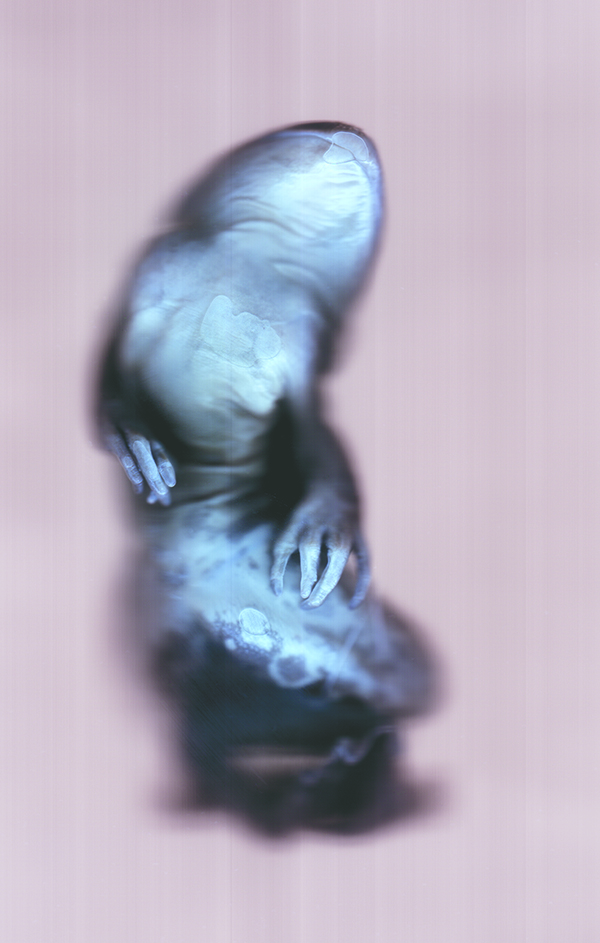
Ann Hamilton. Digital scan of specimens from University of Washington’s Burke Museum of Natural History and Culture Herpetology Collection, 2014. Courtesy of the Artist
Resonant with Hamilton’s previous work, The Common S E N S E relies on processes of accretion and subtraction for the project to expand and evolve. Stacks of literary excerpts replicated on letter-size sheets grow and contract daily as visitors cycle through the space. Pablo Neruda, Margaret Atwood, and Maurice Merleau-Ponty are among the writers, researchers, and theorists represented in Hamilton’s bookish buffet. Visitors are encouraged to take at will, mindful that it is they who are responsible for replenishing the dwindling supply by submitting new fragments to the exhibition’s Tumblr site.[1] “Your presence leaves a trace. The exhibition is changed by your being here,” explains Hamilton in an exhibition text.
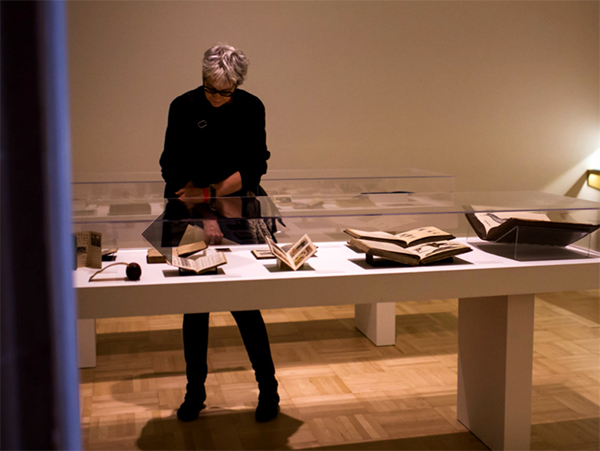
Ann Hamilton. The Common S E N S E, 2014. Courtesy of Henry Art Gallery, Seattle. Photo: Jonathan Vanderweit.
All entries to this Tumblr are expected to reflect in some way on the concept of touch. Hamilton, citing Aristotle, claims that touch is common to all animal species. It is a sense fundamental to our understanding of the world and ourselves in it. The solidity of earth, the chill of outside air, and the warmth of clothing are reminders of the continuous tactile exchanges that are an inherent part of living. “When we touch we go from being observers to being included; things seen become things felt,” writes Hamilton. “To touch is always to be touched in return.”
To touch is to exist with each other, to be alone together. As I toured the exhibition, I wondered who submitted the fragment on taxidermy and the portrait of a Siberian explorer that I took away. How many other visitors were drawn to the same text, squirreling it away into their collections?
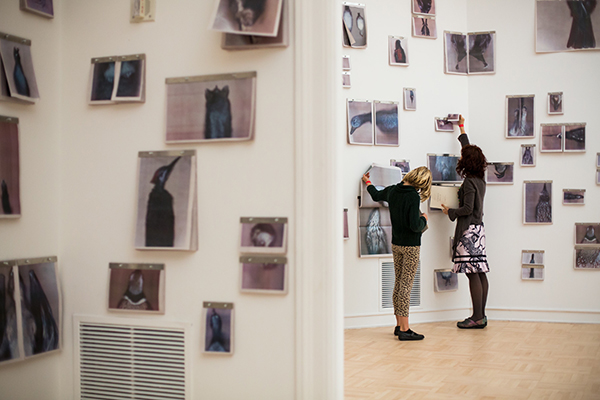
Ann Hamilton. The Common S E N S E, 2014. Courtesy of Henry Art Gallery, Seattle. Photo: Jonathan Vanderweit.
Hamilton’s exhibition articulates the ways in which texts form tangential threads between myriad readers. Sharing a text means moving beyond divisive boundaries to create a shared context—a momentary touch—through the affective power of writing. According to the poet Susan Stewart (a favorite of Hamilton), “The locus of action is not in the text but in the transformation of the reader.”[2] The Common S E N S E points visitors toward the transformative power of touch, through shared texts and takeaway images, as well as through tactile objects and sound.
Objects punctuate the exhibition. Beyond displaying historic manuscripts and specimens in glass cases, Hamilton provides hooks that allow visitors to feel physically and psychologically engaged with the work on view. Throughout her libraries, she provides specially designed wool blankets for readers to take comfort in as they peruse. In a lower-level installation, Hamilton has displayed historic fur and animal-skin garments on gurney-like plinths that require parting a set of curtains in order to take a look.
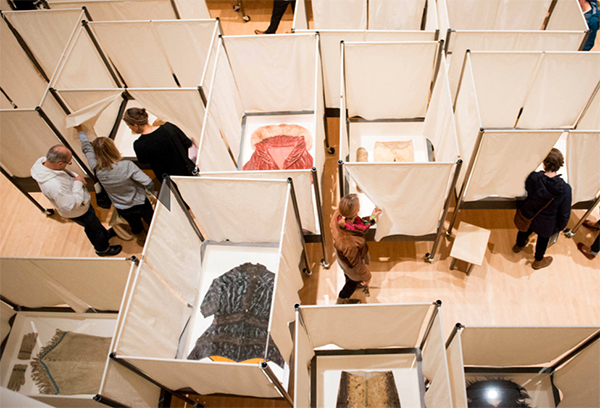
Ann Hamilton. The Common S E N S E, 2014. Courtesy of Henry Art Gallery, Seattle. Photo: Chona Kasinger.
Hamilton punctuates The Common S E N S E with a soundscape generated by bull-roarers, an ancient device used to call across great distances. These machines employ wooden propellers to emit a sonic rupture that is part siren and part heartbeat, one that seems to emerge from a place beyond the natural disasters of our present time. Some part of me expected to see flashing emergency beacons materialize on cue, and it wasn’t until I considered the merging of a cry for help with a call for touch that the entire experience of Hamilton’s exhibition was made clear.
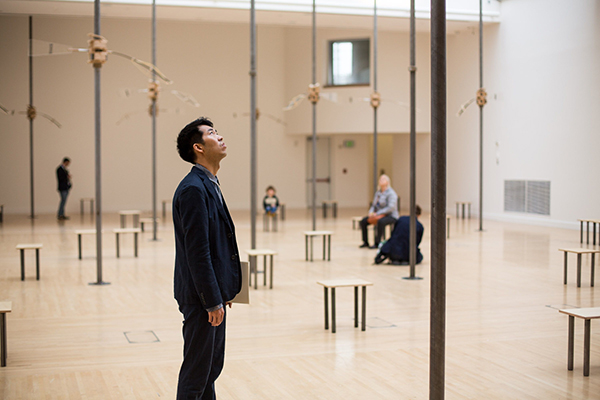
Ann Hamilton. The Common S E N S E, 2014. Courtesy of Henry Art Gallery, Seattle. Photo: Jonathan Vanderweit.
It all comes back to animals: the furry and feathered masses that share our planet, with whom we are wholly connected. In this context, witnessing printed text and images torn, taken, and dwindling to nothing becomes strikingly ominous. That said, the exhibition struck me as a celebration of the covenant between human and animal more than an omen of its demise. The connection between living beings is tangible, like a wool blanket against skin, yet somehow it remains inscrutable and beyond linguistic comprehension. In this way Hamilton cues the bull-roarers that call out to us—coming to speech—from a space beyond language, to express the potential for transformation within touch.
Ann Hamilton: The Common S E N S E is on view at Henry Art Gallery in Seattle through April 26, 2015.
[1] readers-reading-readers.tumblr.com
[2] Susan Stewart, On Longing: Narratives of the Miniature, the Gigantic, the Souvenir, the Collection (North Carolina: Duke University Press, 1984), p. 3





