







New York
The Heart Is Not a Metaphor: Robert Gober at MoMA
The Heart Is Not a Metaphor, the first large-scale survey of Robert Gober’s career to take place in the United States, is a testament to the breadth of the artist’s provocative articulation of those moments of cultural past that linger in the corners of peripheral vision—a lingering that keeps one unsettled. Queered, uncanny objects of the everyday radiate the trauma of the half-remembered event. In Gober’s untitled piece from 1997, an open leather suitcase on the floor reveals a storm grate in its base that looks down into an underground chamber: a riverbed of flowing water. Kelp and stones brush against a man’s feet, submerged; a child’s legs dangle in front of the adult body. At every angle at which one peers down past the grate, a full image is precluded; any meaning is merely triggered by the mystery of the unseen.
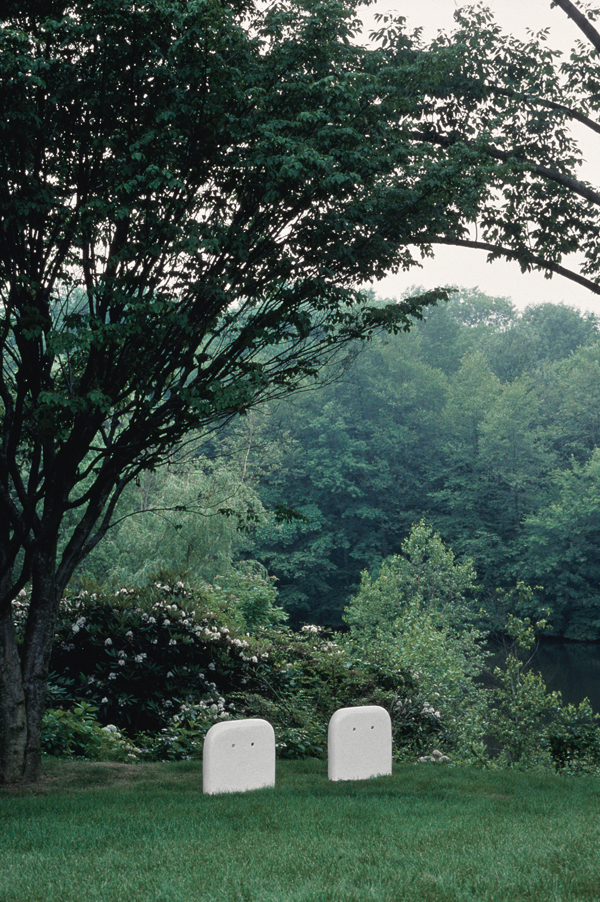
Robert Gober. Two Partially Buried Sinks, 1986-87; cast iron and enamel paint; right: 39 x 25 ½ x 2 ½ in. (99.1 x 64.8 x 6.4 cm.); left: 39 x 24 ½ x 2 3/4 in. (99.1 x 62.2 x 7 cm). Courtesy of the Artist. Photo: Andrew Moore.
In Gober’s insistence on painstakingly replicating by hand quotidian manufactured objects, he literally reproduces talismans of trauma. A meticulous, empty Seagrams bottle (untitled, 2000–01) sits upright on the floor by the wall, sinisterly close to a fireplace in which beeswax children’s legs in Mary Jane shoes burn like logs (also untitled, 1994–95). Another untitled work, from 1986, is a sparse, simple, wood-framed bed with white sheets and a blue woolen blanket. Gober is a rarity in that he presents a poeticism on white male subjectivity that does not glorify it; his objects instead graze against the fear and dark sadness associated with the father, the grandfather. One of Gober’s wallpapered rooms features the repeated illustration of a black figure hanging by a noose from a tree. Gober’s is the sad and sick history of a particular working-class masculinity and a trauma that taints everything it touches. Sculptures like the neatly made bed neither vilify nor glorify, instead tucked into the confused tenderness of a mahogany-tinged, 1950s masculine Catholic ethos.
Gober’s chapel in honor of September 11, 2001, originally shown at Matthew Marks in 2005, is one of the culminating rooms in the exhibition. Rows of concrete pews bearing offerings of cat litter and fruit bowls attend a large stone crucifix. Water pours from Christ’s hollow nipples into a rift in the gallery floor. At the front of the chapel are two doors through which one can barely make out a naked pair of legs submerged in a running bathtub. The child peeks through the cracked door and sees something it cannot understand—something it is, perhaps, not supposed to see.

Robert Gober. The Heart Is Not a Metaphor; installation view. The Museum of Modern Art, New York. Courtesy of the Artist and The Museum of Modern Art. Photo: Jonathan Muzikar.
The walls of the chapel are lined with framed drawings done on newspaper clippings from the days surrounding the September 11 attacks. Naked couples embrace on top of the newsprint. The most basic impulse in the face of horror is to hold a loved one close. Adjacent to the chapel room is an untitled work from 2011—a framed, fabricated copy of Rogers and Hammerstein’s sheet music for “Climb Ev’ry Mountain.” The sheet instructs that the piece should be sung “with great feeling, like a prayer.” As with the casual Seagrams bottle by the fire, moments of curatorial genius show themselves through the deft organization of Gober’s objects. This placement becomes crucial in Gober’s theater of psychological associations. Positioned so close to the raw emotion of the chapel, “Climb Ev’ry Mountain” reads like an American national anthem.
Half Stone House (1979–80) is a dollhouse fashioned after a suburban home and painted a predictable shade of dark green, its screened-in windows vacant and haunting. The house is so American as to incite shivers of involuntary recognition in anyone who grew up in the innocuous, lonely vacuum of the cul-de-sac. This is Gober’s market cornered: the troubled and sad and deeply sweet texture of America, its complicated subjectivity obsessed with a dangerous father, wounded, bigoted, working its hands masochistically toward a fantasy too bright.
Robert Gober: The Heart is Not A Metaphor is on view at MoMA in New York City through January 18, 2015.





