







San Francisco
Reading Basquiat: Exploring Ambivalence in American Art
Today from our partners at Art Practical, we bring you an assessment of Jordana Moore Saggese’s new monograph, Reading Basquiat: Exploring Ambivalence in American Art. Of Basquiat’s work, reviewer Anton Stuebner notes: “[the] canvases require viewers to […] recognize that the boundaries of pictorial representation, like language, can be redefined and reformed.” This article was originally published on October 7, 2014.
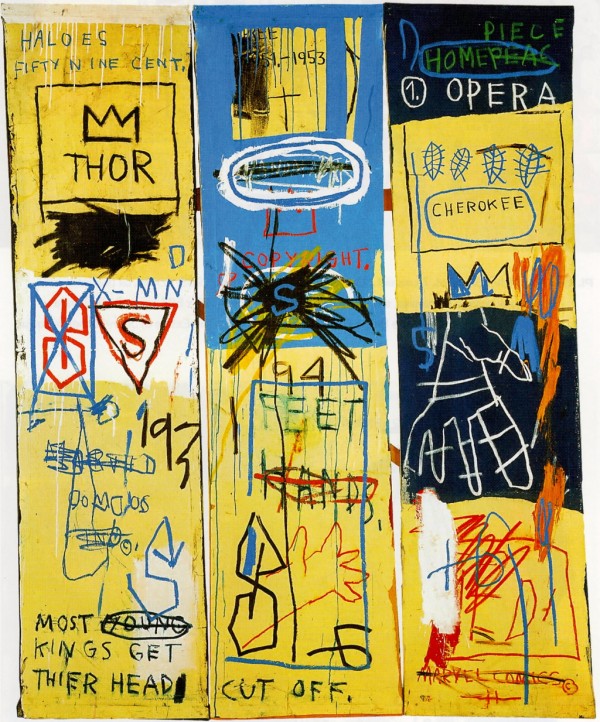
Jean-Michel Basquiat. Charles the First, 1982; acrylic and oil paintstick on canvas; three panels, 78 x 65 in. Courtesy of the Estate of Jean-Michel Basquiat, New York © The Estate of Jean-Michel Basquiat.
The mythology around Jean-Michel Basquiat continues to proliferate in the twenty-six years since his death. The standard-issue biography of his life reads like a cautionary tale on the perils of success: the early years in the graffiti movement; the street art produced with classmate Al Diaz under the tag SAMO; the sudden media attention on the East Village art scene; the transition into formal painting and the overnight success of shows with Annina Nosei and Mary Boone; the highly publicized friendship with Andy Warhol; the meteoric rise of auction and gallery sales; the heroin addiction; the self-destruction at a preternaturally young age. It’s a story that owes much to clichés of the artist as tragic hero, reduced in equal parts through simplification and fabrication. It is also a story that sells art, and at record prices.
Basquiat’s work is invariably tied to the market booms of the 1980s, and like his contemporaries Keith Haring and Julian Schnabel, he redefined the perception of the artist as celebrity, making frequent appearances in print periodicals like The New York Times Magazine and Vanity Fair. This celebrity status is still growing. His art appears on high-fashion street wear and luxury knits. Documentary and narrative films have been made about his life. And market prices for his paintings continue to soar. His canvasDustheads (1982) sold for $48.8 million during Christie’s record-breaking contemporary art auction in 2013. In January 2014, former Interview magazine editor Paige Powell organized a show at Suzanne Geiss Company that featured black-and-white nude photographs of Basquiat, snapshots taken while Powell was dating the artist. Shortly thereafter, a second sale at Christie’s was postponed after an injunction from Basquiat’s family over the authenticity of the pieces at auction.





