







Interviews
Laida Lertxundi
Today from our friends at BOMB Magazine, we bring you an excerpt from Katie Bradshaw‘s interview with filmmaker Laida Lertxundi. The artist describes her process: “I rearrange and take apart these formal conventions and then you have to enter a new space, and maybe there’s something freeing in that. […] I think it’s productive, when there’s something happening in the form that’s uncomfortable.” This interview was originally published on October 20, 2014.
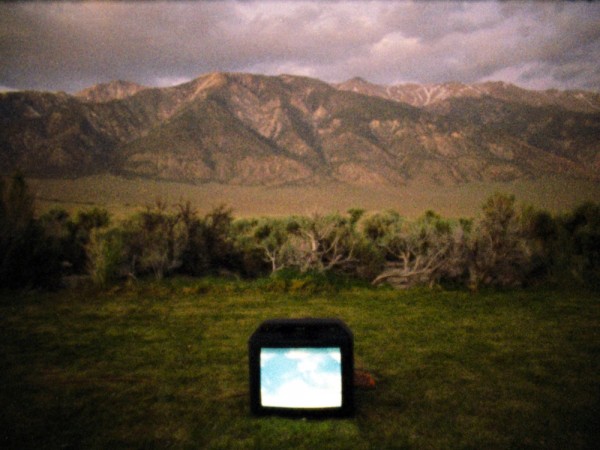
Laida Lertxundi. Still from Cry When it Happens/Llora Cuando Te Pase, 2010; 16mm film, color, sound; 14:00.
Laida Lertxundi makes films using landscape and sounds. The first of Laida’s films I saw was Footnotes to a House of Love (2007), a thirteen-minute 16mm film in which a few people spend time in and around a dilapidated house in a southern California desert listening to Shangri-Las cassettes along with other, less immediately recognizable sounds. Footnotes struck me visually and sonically, though at the time I don’t think I was able to fully grasp the complexity in method or the way in which she, as Genevieve Yue has phrased it, “treats feeling as material.” As I moved through her filmography, Laida’s films felt threaded together. They could locate minutes that I felt I had already seen, previously collected but unnoticed until now, almost memories in progress—the sun at a particular time of day, the quiet feeling of being at home with another person, simply co-existing.
I am interested in her choice of careful frames, her relation to the body and its representation, and how uniquely and interestingly she succeeds in emphasizing the aural environment so that it directly influences and cannot be pulled apart from the image. There is a mysterious quality to her films that is both natural and unpretentious. I watch her films over and over again, the same way I’ve rewound a mixtape over and over again to a specific track that pulls me out of myself.
Katie Bradshaw: You’ve talked about bringing your soundtracks to the foreground. I think the sounds in your films take precedence over the images. It’s as though they move the image and carry the film.
Laida Lertxundi: Yes, sound is not an accompaniment. I never disassociate the process of editing sound from that of images. There is this Michel Chion phrase I love about the predominance of sound: “a ‘heard space’ in which the ‘seen’ bathes.”
KB: Do you ever start making a film with a song in mind? Or do the songs usually come after?
LL: The song becomes this piece that responds in rhythm, emotion, or content to the environment it’s in, to the landscapes, people, props, and rooms but also to its location in the film. I try out different versions first.
KB: And how do you “cast” your films? Did you know you wanted Josette Chiang to be the woman on the bed in A Lax Riddle Unit?
LL: I’m interested in the comfort and intimacy you can feel with someone, while so much of them is unknown to you. I asked Josette if she’d be around to help with the Lax shoot and if she’d be in the movie, and she said, “Be in the movie? No way!” That’s the common denominator, if someone doesn’t want to be in the film or has resistance. If they don’t want to be on camera and if we can make it work, it’s like working through something and it’s an interesting challenge. If they’re going to act, you can see it in their face, and that’s going to ruin everything.
This interview, Laida Lertxundi by Katie Bradshaw, was commissioned by and first published by BOMB Magazine, October 20, 2014. © Bomb Magazine, New Art Publications, and its Contributors. All rights reserved. The BOMB Digital Archive can be viewed at www.bombmagazine.org.





