







Fan Mail
Fan Mail: Dene Leigh
Dene Leigh paints, constructs, combines, and assembles his work using traditional and old-master techniques to confront the neurological conditions of human memory. With a mixture of found and trompe l’oeil representations of objects, Leigh creates works that push the boundaries of collage, painting, assemblage, and installation.
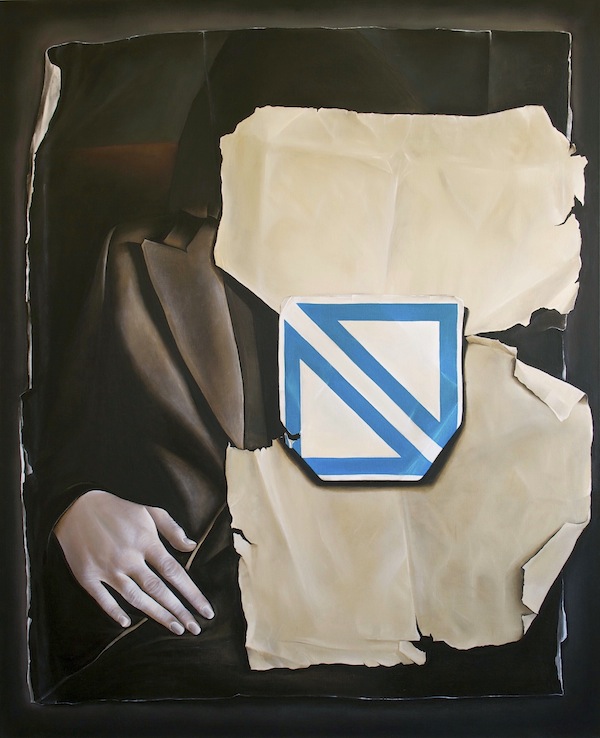
Dene Leigh. Identify (Someone or Something) From Having Encountered Before, 2014; oil on linen; 51 x 62 inches. Courtesy of the artist.
Many of Leigh’s works deal specifically with the neuropsychological disorder called agnosia, which struck Leigh’s grandfather late in life after a stroke. Under the conditions of agnosia, the afflicted subject can see and hear normally but has difficulty identifying formerly familiar objects, people, sounds, and places—or is entirely unable to do so. It is common for someone with agnosia to not recognize the faces of people they know.
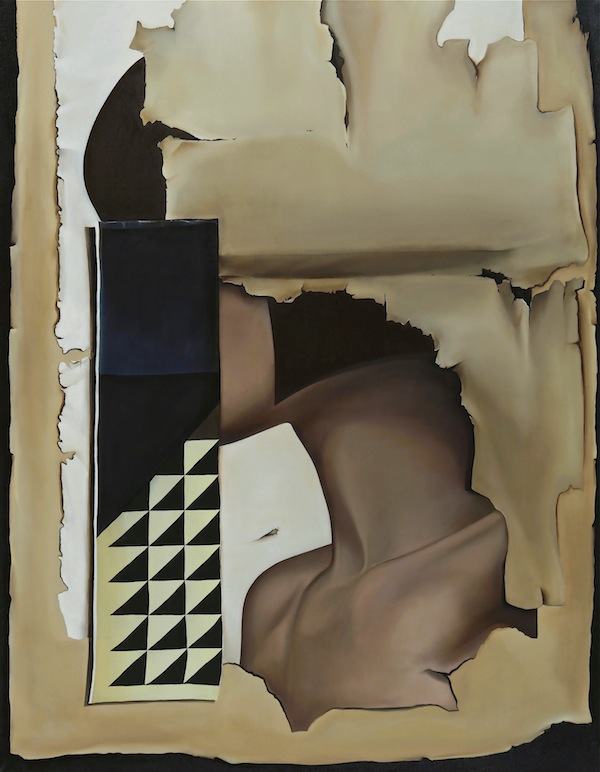
Dene Leigh. Agnosia, 2012; oil on linen; 47 x 61 in. Courtesy of the Artist.
Leigh constructs a representation of sensory disorder as an empathic mechanism to connect, understand, and explain the difficulties—emotional, psychological, and physical—that his grandfather and family members faced after the stroke-induced agnosia. In paintings like Identify (Someone or Something) From Having Encountered Before (2014) and Agnosia (2012), Leigh constructs a relatively literal yet engaging depiction of the altered state of his grandfather’s memory as it relates to facial recognition, and plays with ideas of documentation and portraiture that are historically and contemporaneously specific to photographs and paintings.
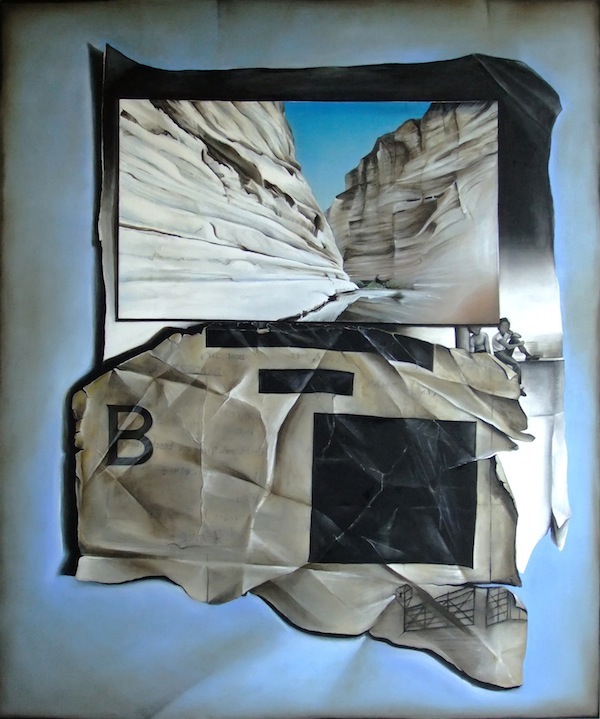
Dene Leigh. Paradise, 2014; oil on linen; 57 x 68 in. Courtesy of the Artist.
In both works he uses representational techniques such as trompe l’oeil to reveal and conceal. The identifying features (facial and otherwise) of these two figures are occluded, forcing the viewer into a visual state not dissimilar to that of Leigh’s grandfather. These figures could be the most recognizable people—his son or daughter, for example—but it is impossible to know. The details in the paintings, and the frayed edges portrayed in Agnosia in particular, allude to the fraying and damaged neural pathways in the brain of an agnosia sufferer. Perhaps whatever physical changes happen to the brain’s structure echo the wear and tear on antique or old objects, photographs, and paintings that occur due to neglect and the passing of time. Whether or not agnosia harms the brain in ways relatable to the damages that objects accrue over time is unclear, but there is an interesting potential relationship between the falsely aged materials painted into Leigh’s works and the condition of his grandfather’s brain.
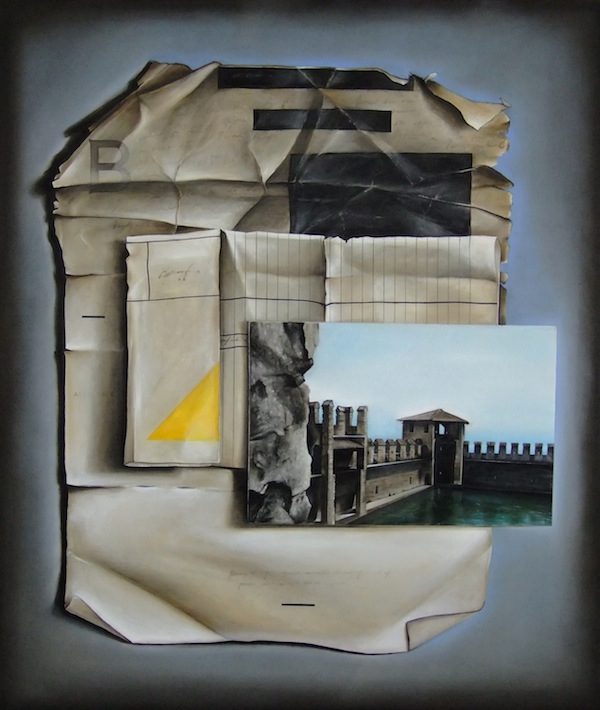
Dene Leigh. A Picture and a Thousand Words, 2014; oil on linen; 57 x 68 in. Courtesy of the Artist.
In A Picture and a Thousand Words(2014), Leigh once again constructs hyper-real false images—a page from a notebook, a photograph, and an official document—to confront the effects agnosia has on memories of specific places. The items could have been taken from a diary entry, or a family record of a trip to the battlement or castle depicted in the photograph. By making the visual information identifiable, but the textual and more granular documentation unavailable, Leigh offers a more challenging depiction of memory loss: the ability to see, fully, but to not know; the experience of having an image but no words to describe it.
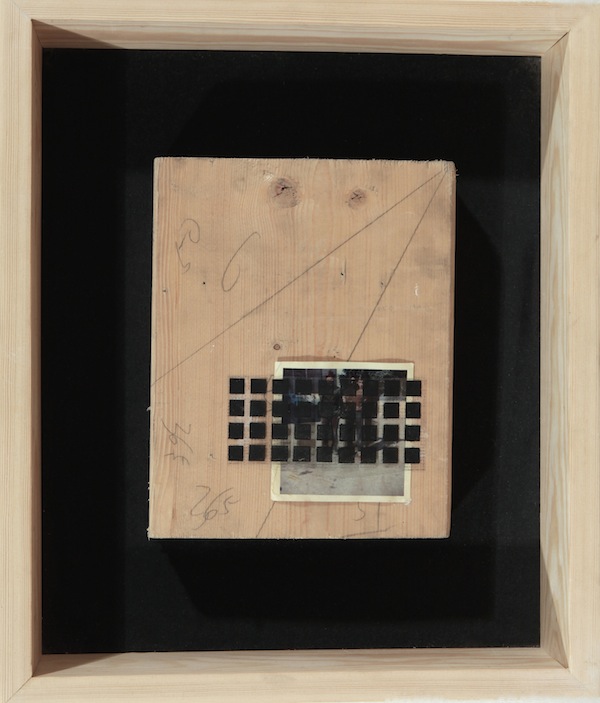
Dene Leigh. (French) Rico in the Middle, 2012; print, velvet, wood, pencil, acetate; 14 x 17 x 4 in. Courtesy of the Artist.
Although painting represents the bulk of Leigh’s work, he does create assemblage and sculptural works. One such work, (French) Rico in the Middle (2012), presents a sparse, reduced depiction of the processes of human memory and recognition. (French) Rico in the Middle introduces a more formal, cold, and mathematical language of memory that is inscribed in numbers and linear connections with a much-reduced color palette. The grid of small black cubes that cover the photographic print—four high by nine long—obscure what is beneath them, but in their stark blackness they open up holes in the image itself that burrow into the very fabric of memory itself, tearing loose the components of the image. It is a stark yet poignant reminder of how dependent we all are on such an imperfect, provocatively mutable and easily lost capacity—to remember.
Dene Leigh’s work forces the viewer to reevaluate—through confrontation with a highly personal history and lived experience—how one receives, retains, and recalls information by offering a series of unique reorganizations, occlusions, and juxtapositions of visual information most often coded and referred to as memory.
Dene Leigh is a London-based artist with a BFA in painting from Wimbledon College of Art, London, UK. His work has been shown in group exhibitions at: Sphinx Fine Art, London; Nunnery Gallery, London; and Dye House, London. Leigh was recently shortlisted for the Young Masters Art Prize. His work is in private collections throughout the UK and in Canada.





