







Fan Mail
Fan Mail: Carlo Speranza
A kayak that goes only in circles, a disappearing art gallery, a film that begins and ends at the credit sequence, and a set of pure gold nails driven into a gallery wall are just some of Northern Italy-based artist Carlo Speranza’s deceptively clever projects. Speranza, as the previous list implies, works across an exceptionally broad range of mediums; his work is made using wood, concrete, gold, neon, prints, photographs, cardboard, film, video, and a host of site-specific materials.
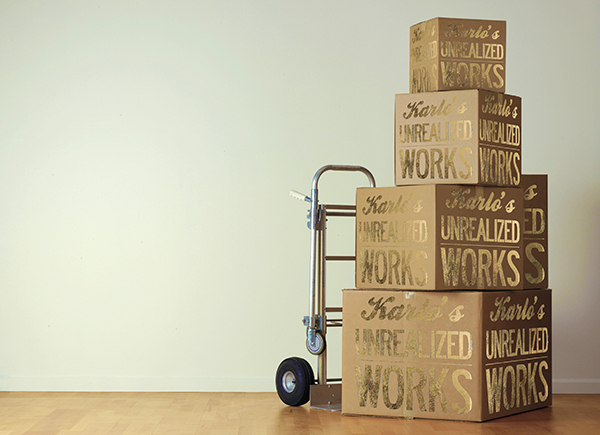
Carlo Speranza. Karlo’s Unrealized Works, 2014; 24k gold leaf on cardboard boxes; dimensions variable. Courtesy of the Artist.
One ongoing unlimited series, Karlo’s Unrealized Works (2014), is a set of cardboard boxes of varying sizes that have the words “Karlo’s Unrealized Works” applied to all six surfaces in pure 24-karat gold leaf. The boxes—which pay homage, visually and conceptually, to Andy Warhol’s Kellogg’s Corn Flake Boxes (1971)—all contain nothing except the promise of an unrealized future artwork that Speranza vows to make one day. The boxes are aesthetically restrained yet still seductive. By making containers for pure concept (and preconceived concept at that), Speranza offers his viewer a striking, art-historically resonant narrative that reads as a slight-of-hand gesture that is not gimmicky, but goading.
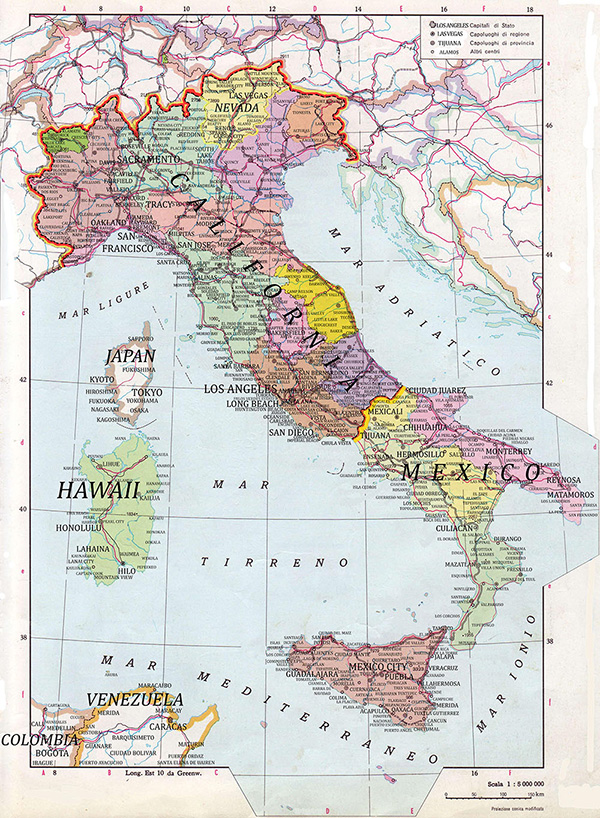
Carlo Speranza. A New Level of Easy, 2013; digital prints on PVC and inkjet on photographic paper; dimensions variable. Courtesy of the Artist.
As Chet Baker’s melancholy composition “The Wind” plays against a backdrop of rose-tinged clouds hanging in a fading evening sky, the ending credit sequence begins to roll in Carlo Speranza’s video Superstition (2011–14). In a gesture that is frustrating and poetic, Superstition consists solely of a four-minute credit sequence in which the artist’s name appears in a number of places—director, lead actor, screenwriter, etc. Superstition is black humor, ostensibly the credit sequence to the end of the artist’s life. While the credits roll, numerous friends, family members, acquaintances and collaborators are listed in particular roles—sound technician, executive producers, and so on—that coincide with Hollywood production credits. Most emblematic of what unifies Speranza’s work, though, is that he credits “Fate” for casting his life.
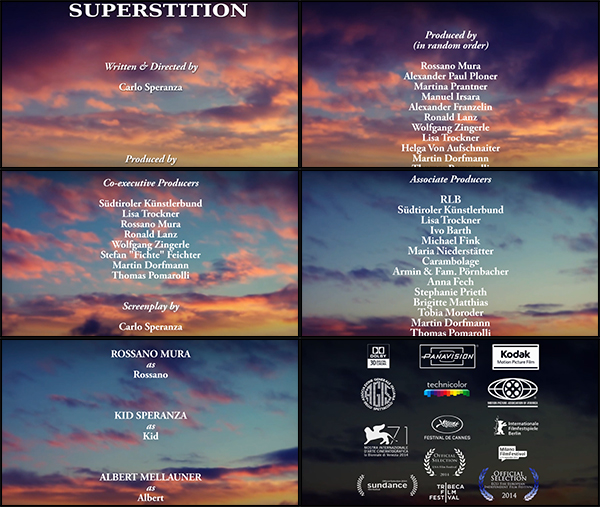
Carlo Speranza. Superstition, 2011-2014; digital video, color, sound; 4:06. Courtesy of the Artist.
Holzpijama (Wooden Pajama) (2011) is a samurai-esque wooden suit of armor that riffs off of the words for “coffin” in two dialects, one Italian and the other Austrian/German. In both dialects a coffin is referred to as a wooden pajama, evoking a new layer of nurturing protection for the place where one finds final sleep. Speranza’s Holzpijama is made of thousands of tiny pieces of thin wood that have been sewn and nailed together. The work is complete with interior leather joints that make it functional as a wearable, if morbid, suit—even appropriate for sleeping.
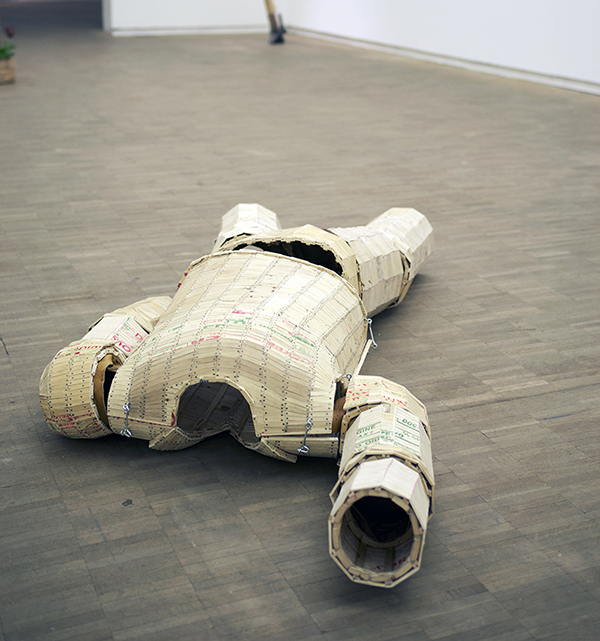
Carlo Speranza. Holzpijama (Wooden Pajama), 2011; wood, leather, nails, glue; 175 x 85 x 41 cm. Courtesy of Südtiroler Künstlerbund and Sissa Micheli.
In an effort to address the problematic economic and infrastructural disparity that plays out between Italian artists and arts institutions, Speranza made a site-specific work at the Stadtmuseum Bruneck in Bolzano, Italy. Speranza noticed that the museum had tremendous resources for producing expensive exhibitions, yet chose almost pathologically to mount exhibitions by younger artists that the museum did not offer to pay. The installation 2019 (Goldnails) (2012) was composed of three solid-gold nails forged from a melted-down gold necklace that the artist received as a child. After making the nails, Speranza drove them into the walls of the gallery at the proper height and spacing for artworks to hang from them. By suggesting the presence of typical artworks like paintings but not actually including any, Speranza offers a materially subtle and conceptually poignant critique of the ways in which Italian museums allocate their resources.
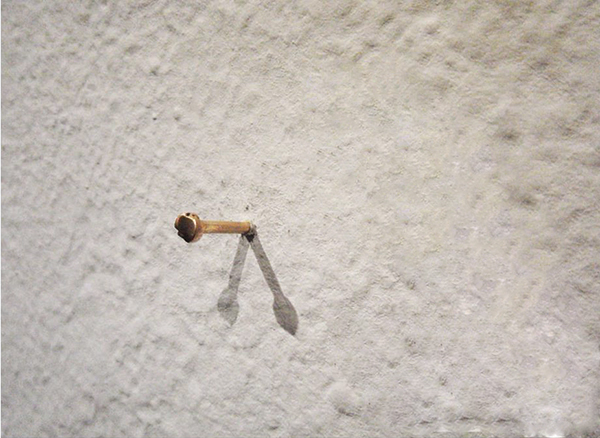
Carlo Speranza. 2019 (Goldnails), 2012; 24-karat gold; 2.5 x 0.3 x 0.2 cm. Courtesy of the Artist.
Speranza’s work ranges from serious to distinctly comical, and it derives from and advances a legacy of conceptual art that plays out in a host of materials that are often site- and project-specific. What is surprising and laudable in Speranza’s artwork is his nimble ability to combine slick and witty ideas—both heavy and light—with incredibly well executed and crafted artworks, whether wood carvings or cardboard boxes.
Carlos Speranza is an artist living and working in Bolzano, Italy. His work has been shown internationally in group and solo exhibitions including: Museum Bärengasse, Zürich, CH; Scope Art Fair, New York, NY & Miami, FL; Rathaus Galerie, Bressanone, IT; Stadtmuseum Bruneck, Bolzano, IT; Messner Mountain Museum RIPA, Brunico, IT; Künstlerhaus Vienna, AT; Museo Civico Brunico, Brunico, IT; and Künstlerhaus, Klagenfurt, AT.





