







Fan Mail
Fan Mail: Lisa Wicka
At the heart of Lisa Wicka’s artwork is a set of keenly nuanced spatial and visual adaptations. Her work transforms motifs, compositions, and ideas—human figures, abstract shapes, and reinterpretations of physical and perceived spaces—into unified bodies. Her small canvases, combine-like sculptures, and large-scale installations all mark their spaces of display with striking gravity.
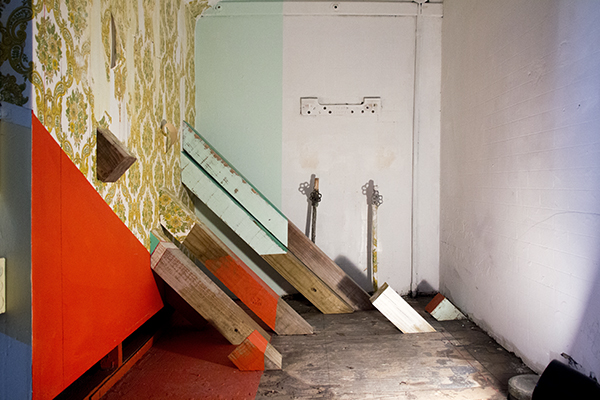
Lisa Wicka. Construction of Self (detail), 2013; house paint, vintage wallpaper, laminate flooring, wood, and chalk line; two interior spaces: 5 x 7 x 15 ft. and 4 x 5 x 6 ft. Courtesy of the Artist.
Most arresting is Wicka’s ability to create compositions that profoundly alter visual perception; she disrupts and disorients visual expectations while simultaneously building new patterns of seeing through careful layering and juxtaposition of physical material—wood, paper, canvas, windows—with geometric shapes, hard grid-like lines, and rich swatches of saturated color. In her installation Construction of Self (2013), Wicka transformed two vacant interior spaces into vibrant, immersive compositions that she describes as, “Remnants of vintage wallpaper, colors, and the architectural elements of this building (that) reminded me of my past spaces, in particular my childhood home.”
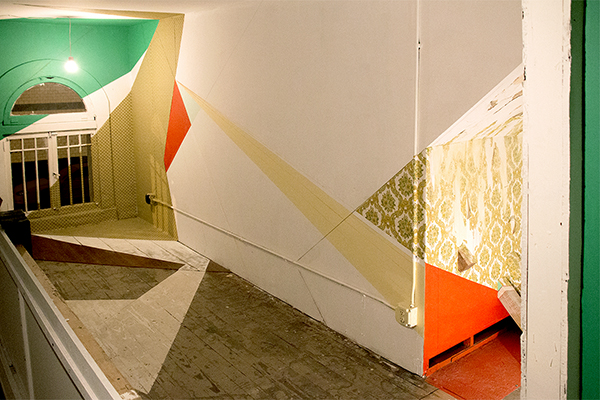
Lisa Wicka. Construction of Self (detail), 2013; house paint, vintage wallpaper, laminate flooring, wood, and chalk line; two interior spaces: 5 x 7 x 15 ft. and 4 x 5 x 6 ft. Courtesy of the Artist.
The artist continues: “Past architectural spaces are continually merging, shifting, and adjusting internally to coexist with new spaces. This piece explores ideas of past and current, internal and external, fragmentation and the ongoing construction of the self.” The interior spaces in Construction of Self feel simultaneously organic and mechanical, soft and forgiving, yet firm and clean—like hybrid forms composed of living, breathing elements and hard, unchanging structural components. The spaces also elicit a feeling of disorder, or a new order in which sight lines and spatial relationships are at jarringly steep angles.
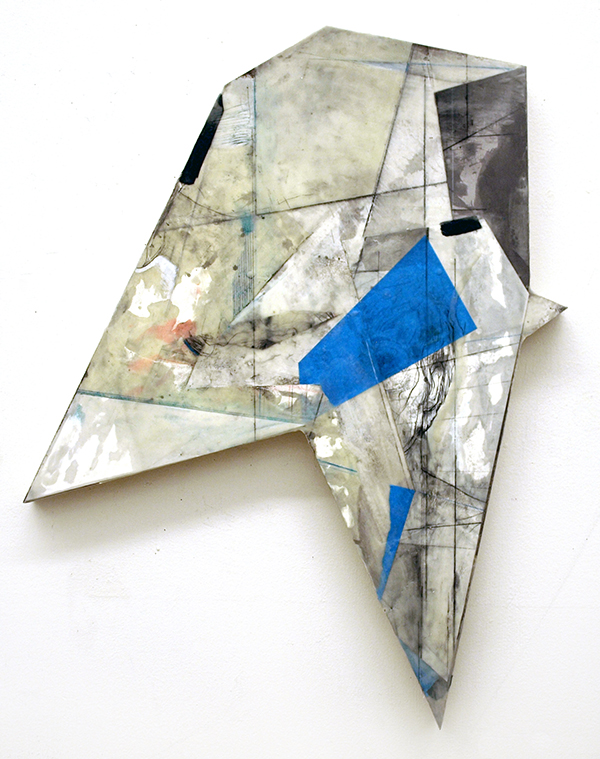
Lisa Wicka. Construct IX, 2013; charcoal, encaustic wax, Prismacolor, tape, acrylic, ink, and collaged paper on laser-cut panel; 20 x 28 in. Courtesy of the Artist.
In works like Construct IX (2013), Wicka combines elements from painting and drawing with a unique three-dimensional form. The results of this combination are small geometric wooden sculptures covered with fields of paint and marked by loose drawings of human features and abstract shapes that emerge, and sometimes nearly pop, from the gallery wall.
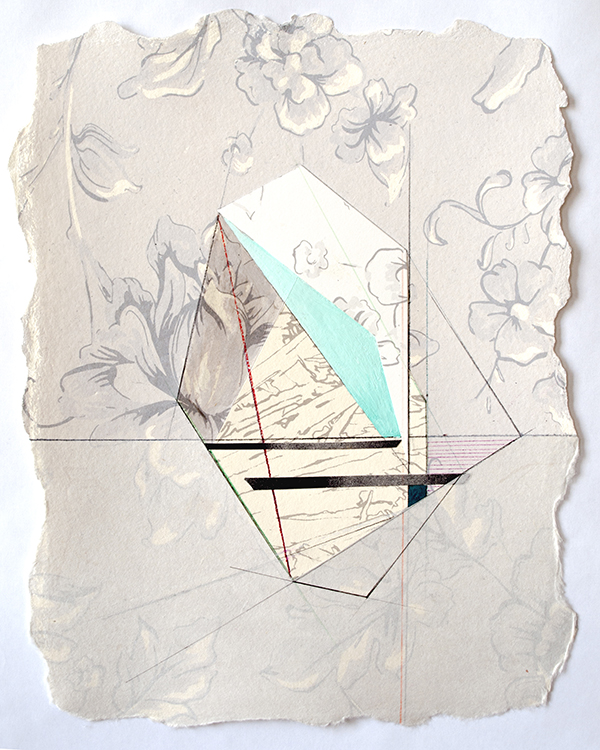
Lisa Wicka. Merge IV, 2014; silkscreen, relief, acrylic, gouache, Prismacolor, and collaged paper; 10 x 12 in. Courtesy of the Artist.
Another work, Merge IV (2014), juxtaposes the soft organic qualities of heavy paper—here, printed with a light floral pattern—with a geometric design composed of hard black, red, and green lines that appear almost stamped or carved into the paper. In Merge II (2014), the hard edges of the designs and the soft curvilinear markings begin to blend in a series of subtle shifts in color and tone—the artist places a pale gray block of color adjacent to a block filled with a flat red-grey, and the eye moves seamlessly though the composition. In turn, these understated shifts are punctuated by a smaller yet intense shock of fuchsia pink that brings the subtleties only closer together.
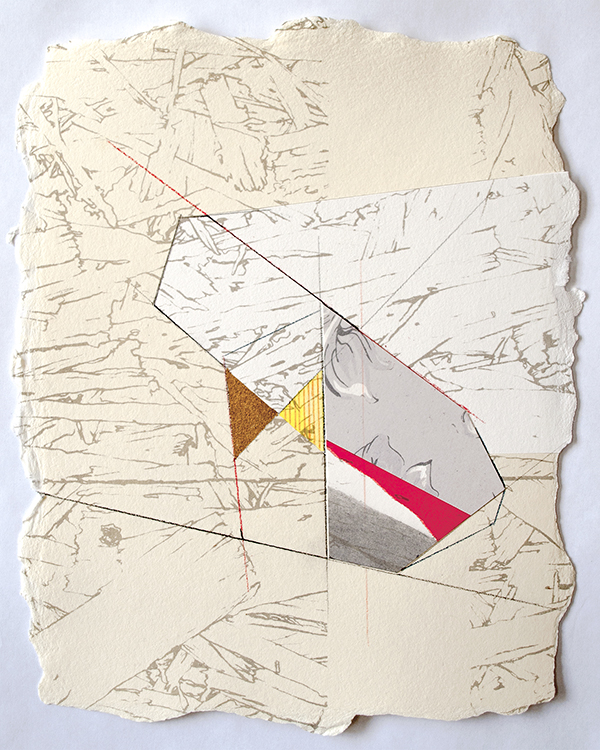
Lisa Wicka. Merge II, 2014; silkscreen, relief, acrylic, gouache, Prismacolor, copper leafing, and collaged paper; 10 x 12 in. Courtesy of the Artist.
In Merge IV and Merge II (and other works in the series), the artist strikes a remarkable balance between intense and restrained colors—a balance that pits abstraction against illustration, as if to ask and answer: Why are the domestic, the organic, and the illustrative so often considered contrary to the architectural and the mechanical?
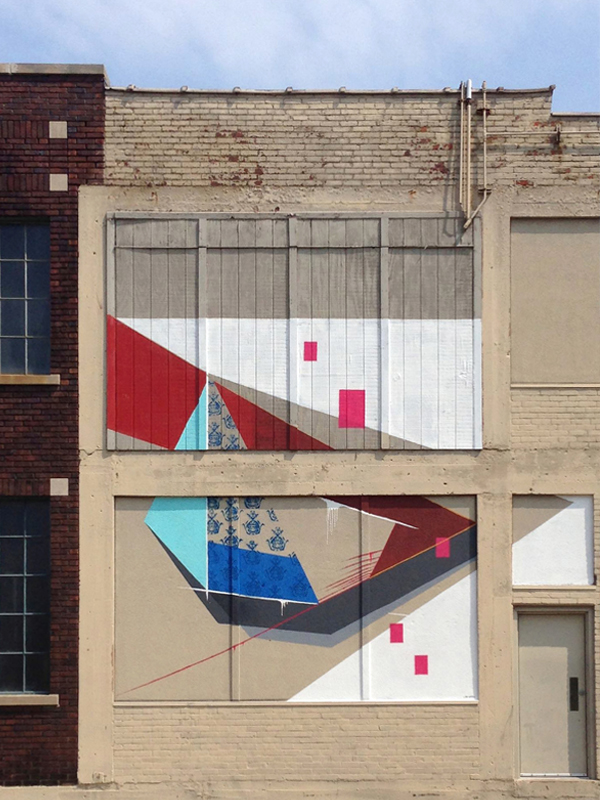
Lisa Wicka. Fifth and Ferry, 2014; house paint, one-shot enamel, and spray paint; 15 x 20 ft. Courtesy of the Artist.
Lisa Wicka’s work—prints, installations, drawings, sculptures, collages, and photographs—explores large physical spaces and small two-dimensional representations of space with the same level of a measured tenacity, one that at times renders the familiar as unknown, and at other times provides instances of shared ground for disconnected elements.
Lisa Wicka earned a BFA from the University of Central Florida and an MFA in Printmaking and Drawing from Purdue University. Her work has been shown in solo and group exhibitions both nationally and internationally, including cities: New York, NY; Chicago, IL; Ann Arbor, MI; Brooklyn, NY; Cincinnati, OH; Boras, Sweden; Jalisco, Mexico; and Vancouver, British Colombia. In 2013 she was awarded the Granville Memorial Award from the National Society of Arts and Letters for her mixed-media sculptural work, which was exhibited in the Andy Warhol Museum. Her work has been collected by a number of institutions, including: Oregon State University, Oregon; Purdue University, Indiana; Brooklyn Art Library, NY; and the Southern Graphics Council, Indiana.





